Herring Nicole R, Schaefer Tori L, Tang Peter H, Skelton Matthew R, Lucot James P, Gudelsky Gary A, Vorhees Charles V, Williams Michael T
Division of Neurology, Cincinnati Children's Research Foundation and University of Cincinnati College of Medicine, Cincinnati, Ohio, USA.
BMC Neurosci. 2008 May 30;9:49. doi: 10.1186/1471-2202-9-49.
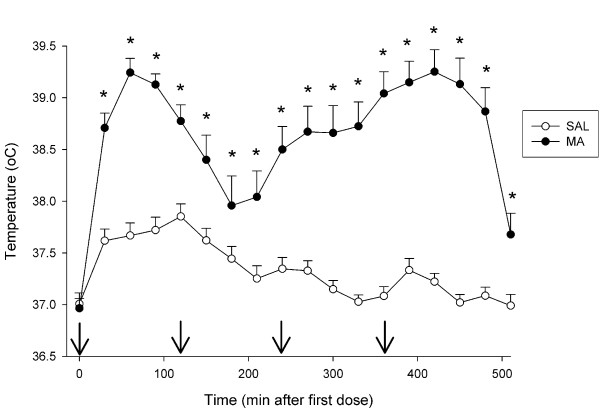
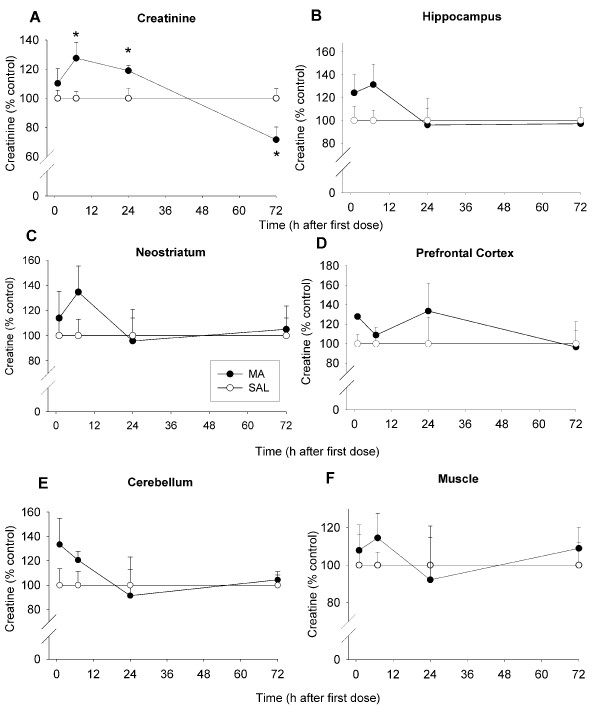
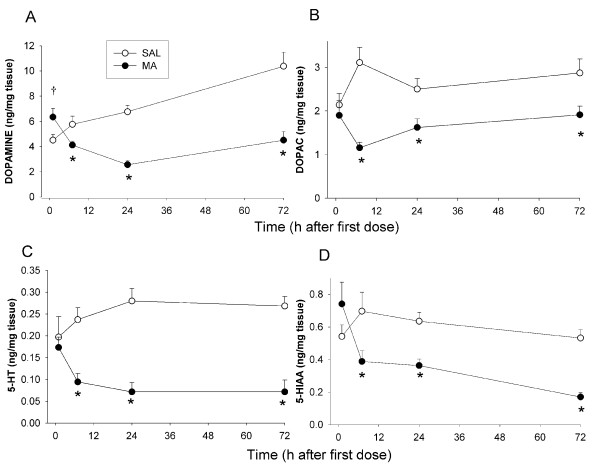
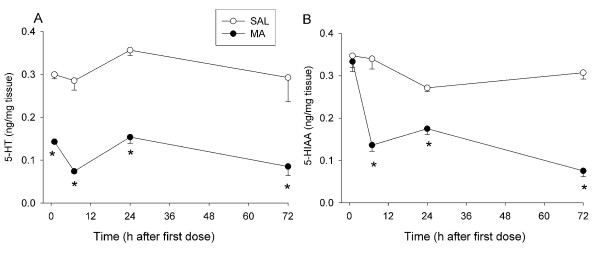
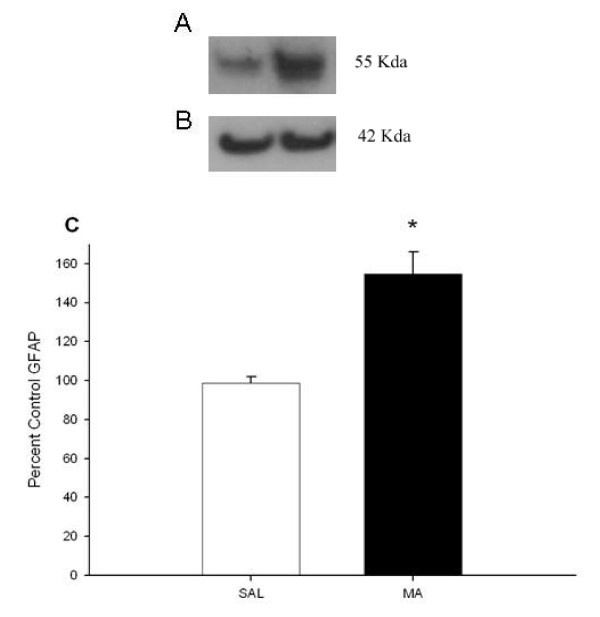
Methamphetamine (MA) use is a worldwide problem. Abusers can have cognitive deficits, monoamine reductions, and altered magnetic resonance spectroscopy findings. Animal models have been used to investigate some of these effects, however many of these experiments have not examined the impact of MA on the stress response. For example, numerous studies have demonstrated (+)-MA-induced neurotoxicity and monoamine reductions, however the effects of MA on other markers that may play a role in neurotoxicity or cell energetics such as glucose, corticosterone, and/or creatine have received less attention. In this experiment, the effects of a neurotoxic regimen of (+)-MA (4 doses at 2 h intervals) on brain monoamines, neostriatal GFAP, plasma corticosterone, creatinine, and glucose, and brain and muscle creatine were evaluated 1, 7, 24, and 72 h after the first dose. In order to compare MA's effects with stress, animals were subjected to a forced swim test in a temporal pattern similar to MA administration [i.e., (30 min/session) 4 times at 2 h intervals].
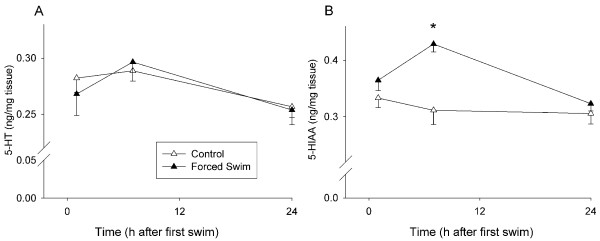
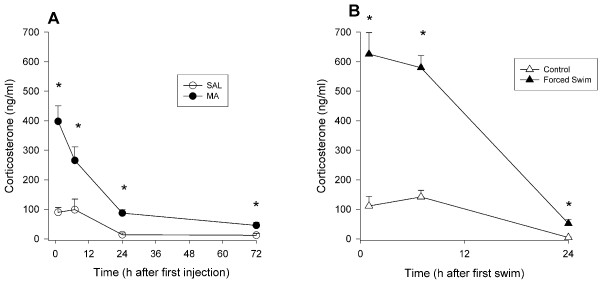
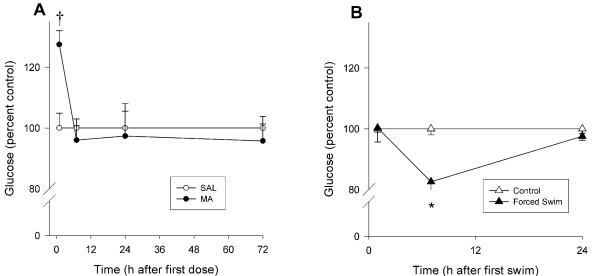
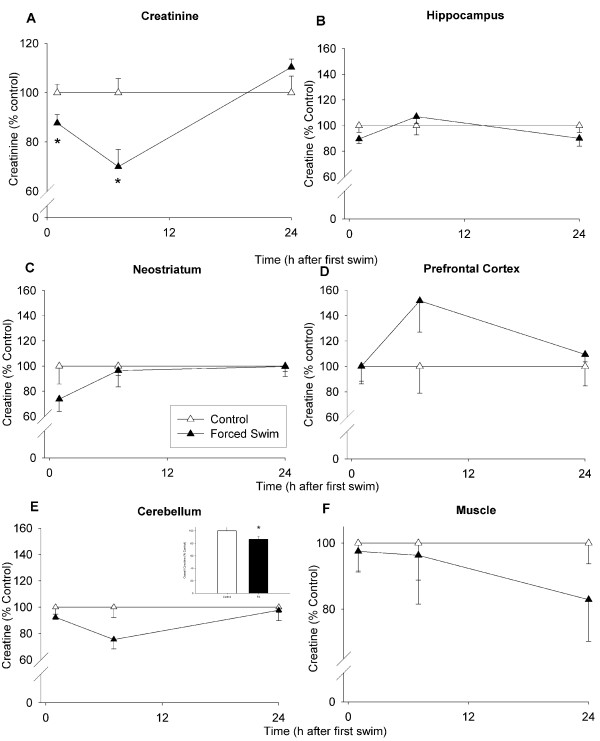
MA increased corticosterone from 1-72 h with a peak 1 h after the first treatment, whereas glucose was only increased 1 h post-treatment. Neostriatal and hippocampal monoamines were decreased at 7, 24, and 72 h, with a concurrent increase in GFAP at 72 h. There was no effect of MA on regional brain creatine, however plasma creatinine was increased during the first 24 h and decreased by 72 h. As with MA treatment, forced swim increased corticosterone more than MA initially. Unlike MA, forced swim reduced creatine in the cerebellum with no change in other brain regions while plasma creatinine was decreased at 1 and 7 h. Glucose in plasma was decreased at 7 h.
Both MA and forced swim increase demand on energy substrates but in different ways, and MA has persistent effects on corticosterone that are not attributable to stress alone.
甲基苯丙胺(MA)的使用是一个全球性问题。滥用者可能出现认知缺陷、单胺减少以及磁共振波谱结果改变。动物模型已被用于研究其中一些影响,然而许多此类实验并未考察MA对应激反应的影响。例如,大量研究已证明(+)-MA诱导的神经毒性和单胺减少,然而MA对其他可能在神经毒性或细胞能量代谢中起作用的标志物(如葡萄糖、皮质酮和/或肌酸)的影响受到的关注较少。在本实验中,在首次给药后1、7、24和72小时评估了神经毒性剂量的(+)-MA(每2小时给药4次)对脑单胺、新纹状体胶质纤维酸性蛋白(GFAP)、血浆皮质酮、肌酐和葡萄糖以及脑和肌肉肌酸的影响。为了将MA的影响与应激进行比较,动物按照与MA给药相似的时间模式(即每次30分钟,每2小时进行4次)接受强迫游泳试验。
MA在1至72小时内使皮质酮升高,首次治疗后1小时达到峰值,而葡萄糖仅在治疗后1小时升高。新纹状体和海马体中的单胺在7、24和72小时减少,同时在72小时GFAP增加。MA对脑局部肌酸没有影响,然而血浆肌酐在最初24小时内升高,到72小时降低。与MA治疗一样,强迫游泳最初使皮质酮升高的幅度超过MA。与MA不同,强迫游泳使小脑肌酸减少,其他脑区无变化,而血浆肌酐在1和7小时降低。血浆葡萄糖在7小时降低。
MA和强迫游泳均以不同方式增加了对能量底物的需求,且MA对皮质酮有持续影响,这并非仅由应激导致。