• 文献检索
  • 文档翻译
  • 深度研究
  • 学术资讯
  • Suppr Zotero 插件Zotero 插件
  • 邀请有礼
  • 套餐&价格
  • 历史记录
应用&插件
Suppr Zotero 插件Zotero 插件浏览器插件Mac 客户端Windows 客户端微信小程序
定价
高级版会员购买积分包购买API积分包
服务
文献检索文档翻译深度研究API 文档MCP 服务
关于我们
关于 Suppr公司介绍联系我们用户协议隐私条款
关注我们

Suppr 超能文献

核心技术专利:CN118964589B侵权必究
粤ICP备2023148730 号-1Suppr @ 2026

文献检索

告别复杂PubMed语法,用中文像聊天一样搜索,搜遍4000万医学文献。AI智能推荐,让科研检索更轻松。

立即免费搜索

文件翻译

保留排版,准确专业,支持PDF/Word/PPT等文件格式,支持 12+语言互译。

免费翻译文档

深度研究

AI帮你快速写综述,25分钟生成高质量综述,智能提取关键信息,辅助科研写作。

立即免费体验

香港某指定创伤中心收治患者群体的损伤严重程度评分(ISS)与国际疾病分类衍生的损伤严重程度评分(ICISS)对比

Injury Severity Score (ISS) vs. ICD-derived Injury Severity Score (ICISS) in a patient population treated in a designated Hong Kong trauma centre.

作者信息

Wong Sydney S N, Leung Gilberto K K

机构信息

Queen's University Kingston, Ontario, Canada.

出版信息

Mcgill J Med. 2008 Jan;11(1):9-13.

PMID:18523534
原文链接:https://pmc.ncbi.nlm.nih.gov/articles/PMC2322932/
Abstract

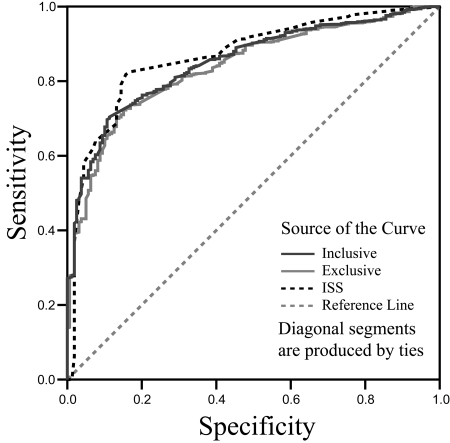
Trauma and Injury Severity Score (TRISS) has been the benchmark of mortality risk in trauma centers for over 30 years. TRISS utilizes the Injury Severity Score (ISS) as an index of anatomical injury. This study investigated the efficacy of a new type of index of anatomical injury called the ICD-derived Injury Severity Score (ICISS) compared to the ISS using a logistic regression analysis and a global chi-square test of the areas under the Receiver Operator Characteristic (ROC) curves. We found that the empirically derived ICISS performed as well as the consensus derived ISS with no statistical differences between their respective area under the ROC curves.

摘要

创伤与损伤严重程度评分(TRISS)在创伤中心一直是30多年来死亡率风险的基准。TRISS使用损伤严重程度评分(ISS)作为解剖学损伤的指标。本研究使用逻辑回归分析和受试者工作特征(ROC)曲线下面积的全局卡方检验,调查了一种新型解剖学损伤指标——国际疾病分类衍生损伤严重程度评分(ICISS)与ISS相比的有效性。我们发现,根据经验得出的ICISS与根据共识得出的ISS表现相当,其各自ROC曲线下面积之间无统计学差异。
https://cdn.ncbi.nlm.nih.gov/pmc/blobs/be13/2322932/3046d733dc85/mjm11_1p9f1.jpg

相似文献

1
Injury Severity Score (ISS) vs. ICD-derived Injury Severity Score (ICISS) in a patient population treated in a designated Hong Kong trauma centre.香港某指定创伤中心收治患者群体的损伤严重程度评分(ISS)与国际疾病分类衍生的损伤严重程度评分(ICISS)对比
Mcgill J Med. 2008 Jan;11(1):9-13.
2
ICISS: an international classification of disease-9 based injury severity score.ICISS:基于国际疾病分类第9版的损伤严重程度评分
J Trauma. 1996 Sep;41(3):380-6; discussion 386-8. doi: 10.1097/00005373-199609000-00002.
3
Predictors of mortality in pediatric trauma: experiences of a level 1 trauma center and an assessment of the International Classification Injury Severity Score (ICISS).小儿创伤死亡率的预测因素:一级创伤中心的经验及国际疾病分类损伤严重程度评分(ICISS)评估
Pediatr Surg Int. 2016 Jul;32(7):657-63. doi: 10.1007/s00383-016-3900-7. Epub 2016 Jun 2.
4
The end of the Injury Severity Score (ISS) and the Trauma and Injury Severity Score (TRISS): ICISS, an International Classification of Diseases, ninth revision-based prediction tool, outperforms both ISS and TRISS as predictors of trauma patient survival, hospital charges, and hospital length of stay.损伤严重度评分(ISS)与创伤和损伤严重度评分(TRISS)的终结:ICISS,一种基于国际疾病分类第九版的预测工具,在预测创伤患者的生存率、住院费用和住院时间方面优于ISS和TRISS。
J Trauma. 1998 Jan;44(1):41-9. doi: 10.1097/00005373-199801000-00003.
5
Validation of the International Classification of Diseases 10th Edition-based Injury Severity Score (ICISS).基于国际疾病分类第10版的损伤严重程度评分(ICISS)的验证。
J Trauma. 2000 Feb;48(2):280-5. doi: 10.1097/00005373-200002000-00014.
6
Harborview assessment for risk of mortality: an improved measure of injury severity on the basis of ICD-9-CM.海港景医院死亡率风险评估:基于国际疾病分类第九版临床修订本(ICD - 9 - CM)的一种改进的损伤严重程度测量方法。
J Trauma. 2000 Sep;49(3):530-40; discussion 540-1. doi: 10.1097/00005373-200009000-00022.
7
Predictors of mortality in adult trauma patients: the physiologic trauma score is equivalent to the Trauma and Injury Severity Score.成年创伤患者死亡率的预测因素:生理创伤评分等同于创伤和损伤严重程度评分。
J Am Coll Surg. 2002 Jun;194(6):695-704. doi: 10.1016/s1072-7515(02)01211-5.
8
Comparison of the Injury Severity Score and ICD-9 diagnosis codes as predictors of outcome in injury: analysis of 44,032 patients.损伤严重程度评分与ICD - 9诊断编码作为损伤预后预测指标的比较:对44,032例患者的分析
J Trauma. 1997 Mar;42(3):477-87; discussion 487-9. doi: 10.1097/00005373-199703000-00016.
9
Comparison of Injury Severity Score, New Injury Severity Score, Revised Trauma Score and Trauma and Injury Severity Score for Mortality Prediction in Elderly Trauma Patients.损伤严重度评分、新损伤严重度评分、修订创伤评分及创伤和损伤严重度评分在老年创伤患者死亡率预测中的比较
Indian J Crit Care Med. 2019 Feb;23(2):73-77. doi: 10.5005/jp-journals-10071-23120.
10
Impact of AIS 2015 versus 1998 on injury severity scoring and mortality prediction - single centre retrospective comparison study.2015 年与 1998 年版 AIS 对创伤严重程度评分和死亡率预测的影响-单中心回顾性比较研究。
Am J Emerg Med. 2022 Oct;60:73-77. doi: 10.1016/j.ajem.2022.07.050. Epub 2022 Jul 25.

引用本文的文献

1
Development of a severity score based on the International Classification of Disease-10 for general patients visiting emergency centers.基于国际疾病分类第10版为急诊中心普通患者制定严重程度评分。
BMC Emerg Med. 2025 Apr 5;25(1):53. doi: 10.1186/s12873-025-01214-y.
2
A Propensity Score-Matched Comparison of In-Hospital Mortality between Dedicated Regional Trauma Centers and Emergency Medical Centers in the Republic of Korea.韩国专用区域创伤中心与急诊医疗中心住院死亡率的倾向评分匹配比较
Emerg Med Int. 2022 Nov 16;2022:5749993. doi: 10.1155/2022/5749993. eCollection 2022.
3
Injury severity score as a predictor of mortality in adult trauma patients by injury mechanism types in the United States: A retrospective observational study.

本文引用的文献

1
Canadian benchmarks in trauma.加拿大创伤治疗基准。
J Trauma. 2007 Feb;62(2):491-7. doi: 10.1097/01.ta.0000202483.67135.f3.
2
The ICD-9-based illness severity score: a new model that outperforms both DRG and APR-DRG as predictors of survival and resource utilization.基于国际疾病分类第九版(ICD-9)的疾病严重程度评分:一种优于诊断相关分组(DRG)和全病种预付费制度(APR-DRG)的预测生存和资源利用的新模型。
J Trauma. 1998 Oct;45(4):791-9. doi: 10.1097/00005373-199810000-00032.
3
Predicting survival, length of stay, and cost in the surgical intensive care unit: APACHE II versus ICISS.
损伤严重度评分作为美国不同损伤机制成人创伤患者病死率的预测因子:一项回顾性观察研究。
Medicine (Baltimore). 2022 Jul 15;101(28):e29614. doi: 10.1097/MD.0000000000029614.
4
Model for predicting the injury severity score.预测损伤严重程度评分的模型。
Acute Med Surg. 2014 Nov 7;2(3):158-162. doi: 10.1002/ams2.89. eCollection 2015 Jul.
5
Traumatic injury in the United States: In-patient epidemiology 2000-2011.美国的创伤性损伤:2000 - 2011年住院患者流行病学
Injury. 2016 Jul;47(7):1393-403. doi: 10.1016/j.injury.2016.04.002. Epub 2016 Apr 22.
6
Early hospital mortality among adult trauma patients significantly declined between 1998-2011: three single-centre cohorts from Mumbai, India.1998年至2011年间,印度孟买三个单中心队列研究表明,成年创伤患者的早期医院死亡率显著下降。
PLoS One. 2014 Mar 3;9(3):e90064. doi: 10.1371/journal.pone.0090064. eCollection 2014.
7
Systematic review of predictive performance of injury severity scoring tools.系统评价损伤严重程度评分工具的预测性能。
Scand J Trauma Resusc Emerg Med. 2012 Sep 10;20:63. doi: 10.1186/1757-7241-20-63.
8
Possibilities and challenges in occupational injury surveillance of day laborers.临时工职业伤害监测的可能性和挑战。
Am J Ind Med. 2010 Feb;53(2):126-34. doi: 10.1002/ajim.20741.
9
A review of injury epidemiology in the UK and Europe: some methodological considerations in constructing rates.英国和欧洲伤害流行病学综述:构建发病率时的一些方法学考量
BMC Public Health. 2009 Jul 10;9:226. doi: 10.1186/1471-2458-9-226.
预测外科重症监护病房的生存率、住院时间和费用:急性生理与慢性健康状况评分系统II(APACHE II)与重症监护病房生存率预测模型(ICISS)的比较
J Trauma. 1998 Aug;45(2):234-7; discussion 237-8. doi: 10.1097/00005373-199808000-00006.
4
Illness severity adjustment for outcomes analysis: validation of the ICISS methodology in all 821,455 patients hospitalized in North Carolina in 1996.用于结果分析的疾病严重程度调整:1996年在北卡罗来纳州住院的821,455名患者中ICISS方法的验证
Surgery. 1998 Aug;124(2):187-94; discussion 194-6.
5
The end of the Injury Severity Score (ISS) and the Trauma and Injury Severity Score (TRISS): ICISS, an International Classification of Diseases, ninth revision-based prediction tool, outperforms both ISS and TRISS as predictors of trauma patient survival, hospital charges, and hospital length of stay.损伤严重度评分(ISS)与创伤和损伤严重度评分(TRISS)的终结:ICISS,一种基于国际疾病分类第九版的预测工具,在预测创伤患者的生存率、住院费用和住院时间方面优于ISS和TRISS。
J Trauma. 1998 Jan;44(1):41-9. doi: 10.1097/00005373-199801000-00003.
6
Comparison of the Injury Severity Score and ICD-9 diagnosis codes as predictors of outcome in injury: analysis of 44,032 patients.损伤严重程度评分与ICD - 9诊断编码作为损伤预后预测指标的比较:对44,032例患者的分析
J Trauma. 1997 Mar;42(3):477-87; discussion 487-9. doi: 10.1097/00005373-199703000-00016.
7
ICISS: an international classification of disease-9 based injury severity score.ICISS:基于国际疾病分类第9版的损伤严重程度评分
J Trauma. 1996 Sep;41(3):380-6; discussion 386-8. doi: 10.1097/00005373-199609000-00002.
8
Injury severity grading in trauma patients: a simplified technique based upon ICD-9 coding.创伤患者的损伤严重程度分级:一种基于国际疾病分类第九版(ICD-9)编码的简化技术。
J Trauma. 1993 Oct;35(4):497-506; discussion 506-7.
9
Injury severity and probability of survival assessment in trauma patients using a predictive hierarchical network model derived from ICD-9 codes.使用从ICD - 9编码派生的预测分层网络模型评估创伤患者的损伤严重程度和生存概率。
J Trauma. 1995 Apr;38(4):590-7; discussion 597-601. doi: 10.1097/00005373-199504000-00022.
10
An anatomic index of injury severity.一种损伤严重程度的解剖学指标。
J Trauma. 1980 Mar;20(3):197-202. doi: 10.1097/00005373-198003000-00001.