Massaro Melanie, Starling-Windhof Amanda, Briskie James V, Martin Thomas E
School of Biological Sciences, University of Canterbury, Christchurch, New Zealand.
PLoS One. 2008 Jun 4;3(6):e2331. doi: 10.1371/journal.pone.0002331.
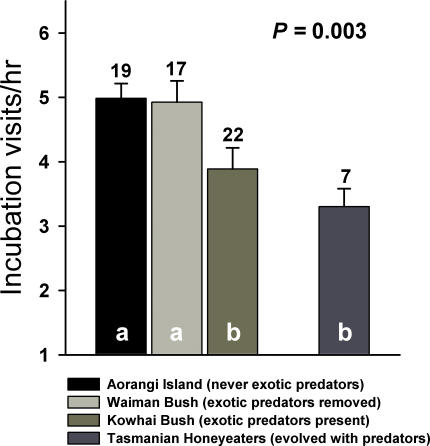
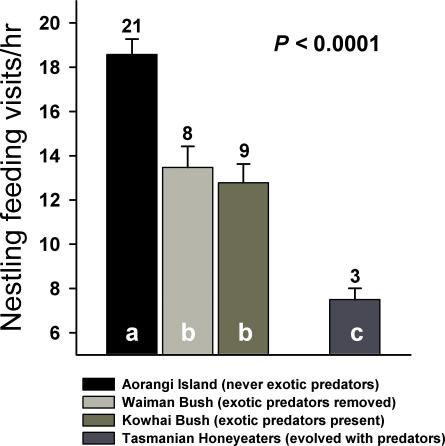
The introduction of predatory mammals to oceanic islands has led to the extinction of many endemic birds. Although introduced predators should favour changes that reduce predation risk in surviving bird species, the ability of island birds to respond to such novel changes remains unstudied. We tested whether novel predation risk imposed by introduced mammalian predators has altered the parental behaviour of the endemic New Zealand bellbird (Anthornis melanura). We examined parental behaviour of bellbirds at three woodland sites in New Zealand that differed in predation risk: 1) a mainland site with exotic predators present (high predation risk), 2) a mainland site with exotic predators experimentally removed (low risk recently) and, 3) an off-shore island where exotic predators were never introduced (low risk always). We also compared parental behaviour of bellbirds with two closely related Tasmanian honeyeaters (Phylidonyris spp.) that evolved with native nest predators (high risk always). Increased nest predation risk has been postulated to favour reduced parental activity, and we tested whether island bellbirds responded to variation in predation risk. We found that females spent more time on the nest per incubating bout with increased risk of predation, a strategy that minimised activity at the nest during incubation. Parental activity during the nestling period, measured as number of feeding visits/hr, also decreased with increasing nest predation risk across sites, and was lowest among the honeyeaters in Tasmania that evolved with native predators. These results demonstrate that some island birds are able to respond to increased risk of predation by novel predators in ways that appear adaptive. We suggest that conservation efforts may be more effective if they take advantage of the ability of island birds to respond to novel predators, especially when the elimination of exotic predators is not possible.
将食肉哺乳动物引入海洋岛屿导致了许多特有鸟类的灭绝。尽管引入的捕食者应该会促使生存下来的鸟类物种发生降低捕食风险的变化,但岛屿鸟类对这种新变化的应对能力仍未得到研究。我们测试了引入的哺乳动物捕食者带来的新捕食风险是否改变了新西兰特有铃鸟(Anthornis melanura)的亲代行为。我们在新西兰三个捕食风险不同的林地地点研究了铃鸟的亲代行为:1)一个有外来捕食者的大陆地点(高捕食风险),2)一个通过实验移除了外来捕食者的大陆地点(近期低风险),以及3)一个从未引入外来捕食者的近海岛屿(一直低风险)。我们还将铃鸟的亲代行为与两种与塔斯马尼亚食蜜鸟(Phylidonyris spp.)亲缘关系密切的鸟类进行了比较,后者与本土巢捕食者共同进化(一直高风险)。据推测,巢捕食风险增加有利于减少亲代活动,我们测试了岛屿铃鸟是否对捕食风险的变化做出反应。我们发现,随着捕食风险增加,雌性在每次孵化回合中在巢上花费的时间更多,这是一种在孵化期间将巢上活动降至最低的策略。雏鸟期的亲代活动,以每小时喂食次数衡量,也随着各地点巢捕食风险的增加而减少,并且在与本土捕食者共同进化的塔斯马尼亚食蜜鸟中最低。这些结果表明,一些岛屿鸟类能够以看似适应性的方式应对新捕食者带来的捕食风险增加。我们建议,如果保护措施能够利用岛屿鸟类应对新捕食者的能力,特别是在无法消除外来捕食者的情况下,可能会更有效。