Huizinga Mary Margaret, Beech Bettina M, Cavanaugh Kerri L, Elasy Tom A, Rothman Russell L
Diabetes Research and Training Center, Vanderbilt University Medical Center, Nashville, Tennessee, USA.
Obesity (Silver Spring). 2008 Aug;16(8):1966-8. doi: 10.1038/oby.2008.294. Epub 2008 Jun 5.
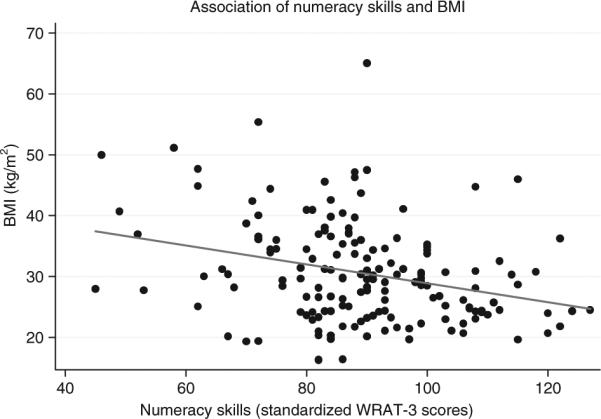
Low numeracy skills and obesity are both common. Numeracy skills are used in healthy weight management to monitor caloric intake. The relationship between obesity and numeracy skills in adult primary care patients is unknown. A cross-sectional study enrolled adult, English-speaking primary care patients. BMI was assessed by self-report; numeracy and literacy skills were measured with the Wide Range Achievement Test, 3rd Edition (WRAT-3) and the Rapid Estimate of Adult Literacy in Medicine (REALM), respectively. The relationship between numeracy and BMI was described with Spearman's rank correlation and linear regression analyses. In 160 patients, the mean (s.d.) age was 46 (16) years, 66% were white, 70% were female, and 91% completed high school. The mean BMI was 30.5 (8.3) kg/m(2). Less than 9th grade numeracy skills were found in 66% of the participants. Participants with numeracy skills <9th grade had a mean BMI of 31.8 (9.0) whereas those with numeracy skills > or =9th grade had a mean BMI of 27.9 (6.0), P = 0.008. Numeracy was negatively and significantly correlated with BMI (rho = -0.26, P = 0.001). This correlation persisted after adjusting for age, sex, race, income, years of education, and literacy (beta coefficient = -0.14; P = 0.010). Literacy skills were not associated with BMI. We found a significant association between low numeracy skills and higher BMI in adult primary care patients. A causal relationship cannot be determined. However, numeracy may have important clinical implications in the design and implementation of healthy weight management interventions and should be further evaluated to determine the magnitude of its effect.
低算术能力和肥胖现象都很常见。算术能力在健康体重管理中用于监测热量摄入。成人初级保健患者中肥胖与算术能力之间的关系尚不清楚。一项横断面研究纳入了会说英语的成年初级保健患者。通过自我报告评估体重指数(BMI);分别使用第三版广泛成就测验(WRAT - 3)和医学成人识字率快速评估(REALM)来测量算术和识字能力。用斯皮尔曼等级相关性和线性回归分析来描述算术能力与BMI之间的关系。在160名患者中,平均(标准差)年龄为46(16)岁,66%为白人,70%为女性,91%完成了高中学业。平均BMI为30.5(8.3)kg/m²。66%的参与者算术能力低于九年级。算术能力<九年级的参与者平均BMI为31.8(9.0),而算术能力>或 =九年级的参与者平均BMI为27.9(6.0),P = 0.008。算术能力与BMI呈显著负相关(rho = -0.26,P = 0.001)。在调整年龄、性别、种族、收入、受教育年限和识字能力后,这种相关性仍然存在(β系数 = -0.14;P = 0.010)。识字能力与BMI无关。我们发现成年初级保健患者中低算术能力与较高BMI之间存在显著关联。因果关系无法确定。然而,算术能力在健康体重管理干预措施的设计和实施中可能具有重要的临床意义,应进一步评估以确定其影响程度。