Haritou S J A, Zylstra R, Ralli C, Turner S, Tortonese D J
Pegasus Equine Diagnostics Ltd, BioCity Nottingham, Nottingham, UK.
J Neuroendocrinol. 2008 Aug;20(8):988-96. doi: 10.1111/j.1365-2826.2008.01751.x. Epub 2008 Jun 6.
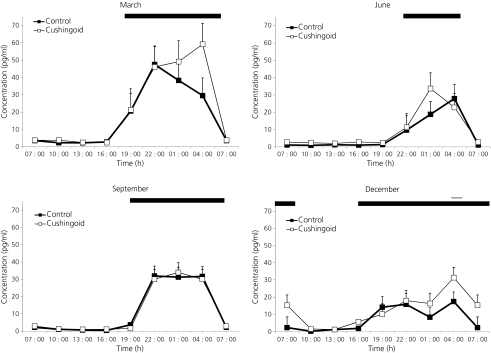
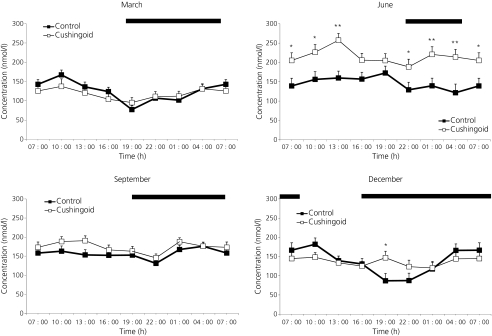
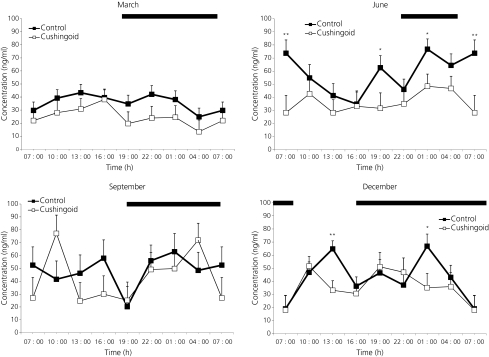
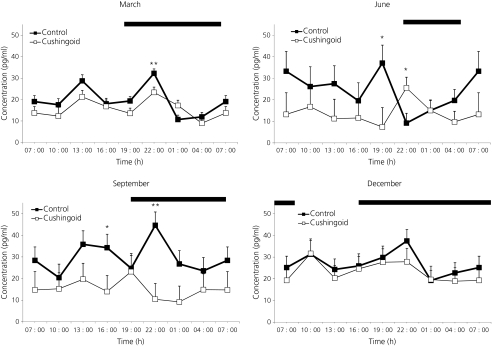
Equine pituitary pars intermedia dysfunction (PPID) is a common and serious condition that gives rise to Cushing's disease. In the older horse, it results in hyperadrenocorticism and disrupted energy metabolism, the severity of which varies with the time of year. To gain insight into the mechanism of its pathogenesis, 24-h profiles for peripheral plasma melatonin, serotonin, dopamine and cortisol concentrations were determined at the winter and summer solstices, and the autumn and spring equinoxes in six horses diagnosed with Cushing's disease and six matched controls. The nocturnal rises in plasma melatonin concentrations, although different across seasons, were broadly of the same duration and similar amplitude in both groups of animals (P > 0.05). The plasma concentrations of cortisol did not show seasonal variation and were different in diseased horses only in the summer when they were higher across the entire 24-h period (P < 0.05). Serotonin concentrations were not significantly affected by time of year but tended to be lower in Cushingoid horses (P = 0.07). By contrast, dopamine output showed seasonal variation and was significantly lower in the Cushing's group in the summer and autumn (P < 0.05). The finding that the profiles of circulating melatonin are similar in Cushingoid and control horses reveals that the inability to read time of year by animals suffering from Cushing's syndrome is an unlikely reason for the disease. In addition, the results provide evidence that alterations in the dopaminergic and serotoninergic systems may participate in the pathogenesis of PPID.
马垂体中间叶功能障碍(PPID)是一种常见且严重的病症,可引发库欣病。在老年马中,它会导致肾上腺皮质功能亢进和能量代谢紊乱,其严重程度随季节变化。为深入了解其发病机制,在冬至、夏至以及秋分、春分时,对6匹被诊断为库欣病的马和6匹匹配的对照马测定了外周血浆褪黑素、血清素、多巴胺和皮质醇浓度的24小时变化情况。两组动物血浆褪黑素浓度的夜间升高,尽管随季节不同,但持续时间大致相同,幅度也相似(P>0.05)。皮质醇的血浆浓度没有季节性变化,仅在夏季患病马的血浆皮质醇浓度在整个24小时期间都较高(P<0.05)。血清素浓度不受一年中时间的显著影响,但在患库欣病的马中往往较低(P = 0.07)。相比之下,多巴胺分泌呈现季节性变化,在夏季和秋季,库欣病组的多巴胺分泌显著较低(P<0.05)。患库欣病的马和对照马循环褪黑素变化情况相似这一发现表明,库欣综合征患畜无法感知一年中的时间不太可能是该病的病因。此外,结果提供了证据表明多巴胺能和血清素能系统的改变可能参与了PPID的发病机制。