Bilal Erhan, Rabadan Raul, Alexe Gabriela, Fuku Noriyuki, Ueno Hitomi, Nishigaki Yutaka, Fujita Yasunori, Ito Masafumi, Arai Yasumichi, Hirose Nobuyoshi, Ruckenstein Andrei, Bhanot Gyan, Tanaka Masashi
BioMaPS Institute, Rutgers University, Piscataway, New Jersey, United States of America.
PLoS One. 2008 Jun 11;3(6):e2421. doi: 10.1371/journal.pone.0002421.
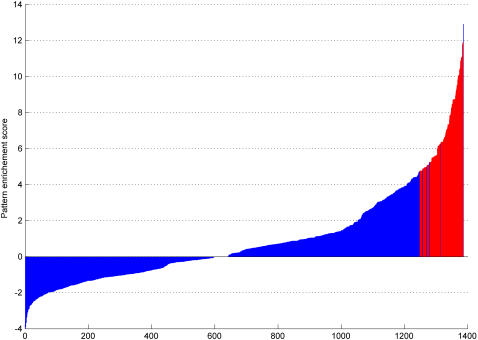
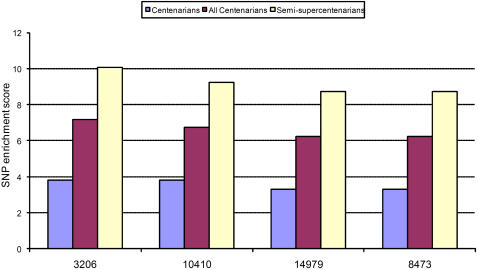
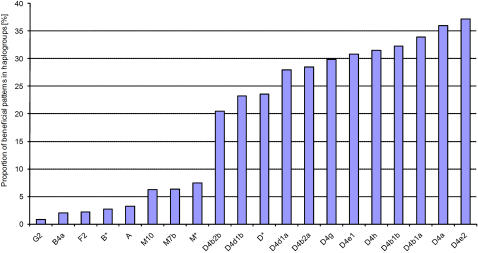
We report results from the analysis of complete mitochondrial DNA (mtDNA) sequences from 112 Japanese semi-supercentenarians (aged above 105 years) combined with previously published data from 96 patients in each of three non-disease phenotypes: centenarians (99-105 years of age), healthy non-obese males, obese young males and four disease phenotypes, diabetics with and without angiopathy, and Alzheimer's and Parkinson's disease patients. We analyze the correlation between mitochondrial polymorphisms and the longevity phenotype using two different methods. We first use an exhaustive algorithm to identify all maximal patterns of polymorphisms shared by at least five individuals and define a significance score for enrichment of the patterns in each phenotype relative to healthy normals. Our study confirms the correlations observed in a previous study showing enrichment of a hierarchy of haplogroups in the D clade for longevity. For the extreme longevity phenotype we see a single statistically significant signal: a progressive enrichment of certain "beneficial" patterns in centenarians and semi-supercentenarians in the D4a haplogroup. We then use Principal Component Spectral Analysis of the SNP-SNP Covariance Matrix to compare the measured eigenvalues to a Null distribution of eigenvalues on Gaussian datasets to determine whether the correlations in the data (due to longevity) arises from some property of the mutations themselves or whether they are due to population structure. The conclusion is that the correlations are entirely due to population structure (phylogenetic tree). We find no signal for a functional mtDNA SNP correlated with longevity. The fact that the correlations are from the population structure suggests that hitch-hiking on autosomal events is a possible explanation for the observed correlations.
我们报告了对112名日本半超级百岁老人(年龄超过105岁)的完整线粒体DNA(mtDNA)序列分析结果,并结合了先前发表的来自三种非疾病表型(百岁老人(99 - 105岁)、健康非肥胖男性、肥胖年轻男性)中每组96名患者以及四种疾病表型(有和没有血管病变的糖尿病患者、阿尔茨海默病和帕金森病患者)的数据。我们使用两种不同方法分析线粒体多态性与长寿表型之间的相关性。我们首先使用穷举算法识别至少五个人共有的所有最大多态性模式,并为每种表型相对于健康正常人的模式富集定义一个显著性分数。我们的研究证实了先前研究中观察到的相关性,即D支系中一组单倍群在长寿人群中富集。对于极端长寿表型,我们看到一个单一的统计学显著信号:D4a单倍群中某些“有益”模式在百岁老人和半超级百岁老人中逐渐富集。然后,我们使用SNP - SNP协方差矩阵的主成分谱分析,将测量的特征值与高斯数据集上特征值的零分布进行比较,以确定数据中的相关性(由于长寿)是源于突变本身的某些特性还是由于群体结构。结论是这些相关性完全是由于群体结构(系统发育树)。我们没有发现与长寿相关的功能性mtDNA SNP的信号。相关性源于群体结构这一事实表明,搭伴于常染色体事件可能是观察到的相关性的一种解释。