Schuermann Jonathan P, Jiang Jianwen, Cuellar Jorge, Llorca Oscar, Wang Liping, Gimenez Luis E, Jin Suping, Taylor Alexander B, Demeler Borries, Morano Kevin A, Hart P John, Valpuesta Jose M, Lafer Eileen M, Sousa Rui
Department of Biochemistry, University of Texas Health Science Center, San Antonio, TX 78229-3900, USA.
Mol Cell. 2008 Jul 25;31(2):232-43. doi: 10.1016/j.molcel.2008.05.006. Epub 2008 Jun 12.
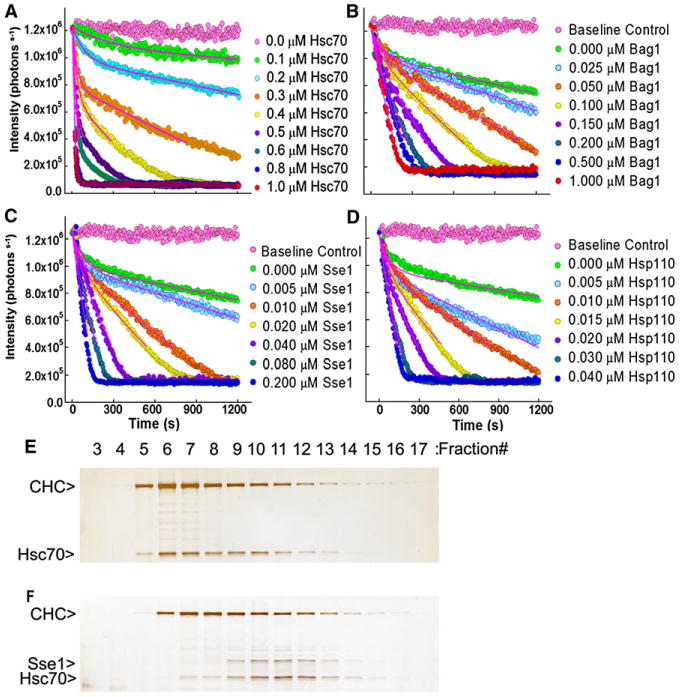
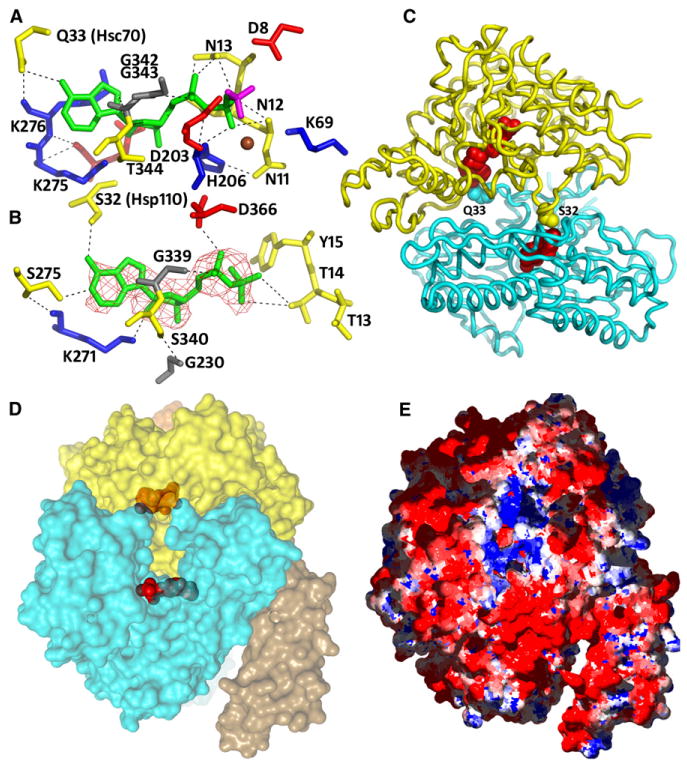
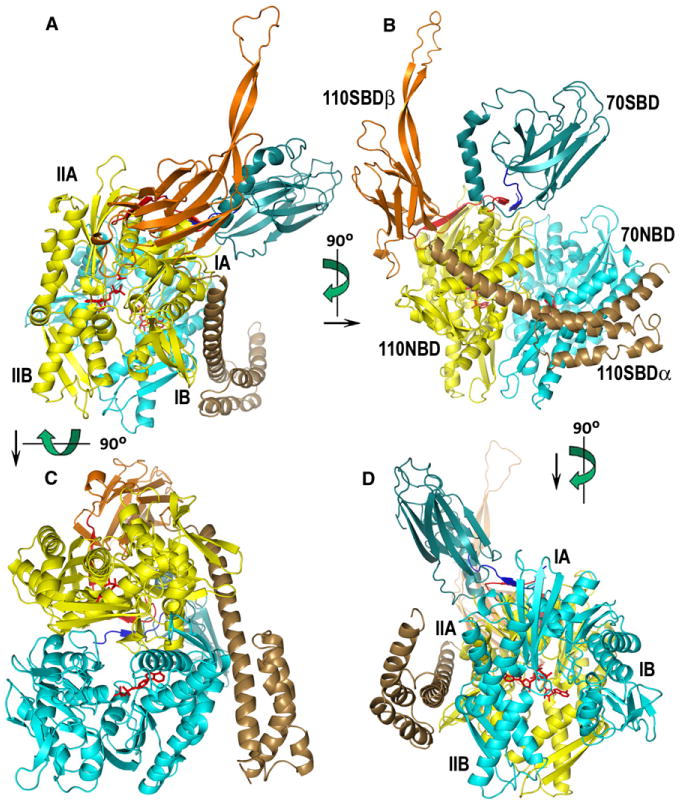
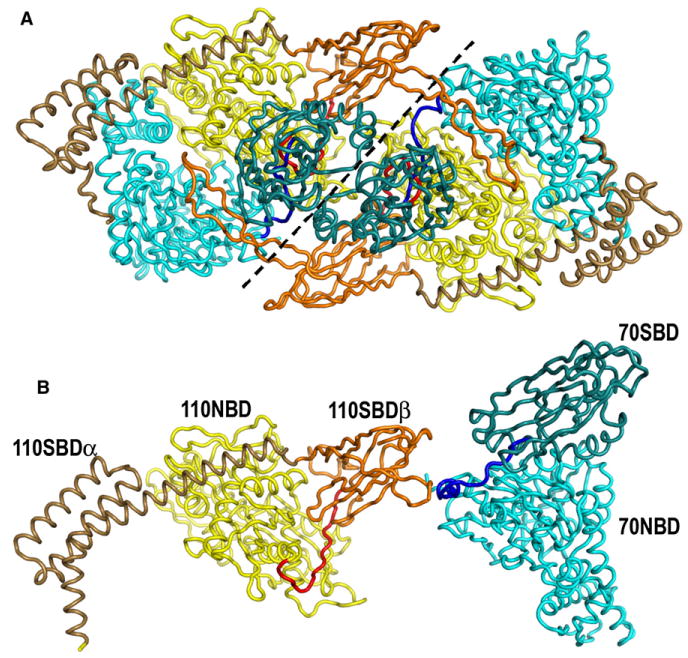
Hsp70s mediate protein folding, translocation, and macromolecular complex remodeling reactions. Their activities are regulated by proteins that exchange ADP for ATP from the nucleotide-binding domain (NBD) of the Hsp70. These nucleotide exchange factors (NEFs) include the Hsp110s, which are themselves members of the Hsp70 family. We report the structure of an Hsp110:Hsc70 nucleotide exchange complex. The complex is characterized by extensive protein:protein interactions and symmetric bridging interactions between the nucleotides bound in each partner protein's NBD. An electropositive pore allows nucleotides to enter and exit the complex. The role of nucleotides in complex formation and dissociation, and the effects of the protein:protein interactions on nucleotide exchange, can be understood in terms of the coupled effects of the nucleotides and protein:protein interactions on the open-closed isomerization of the NBDs. The symmetrical interactions in the complex may model other Hsp70 family heterodimers in which two Hsp70s reciprocally act as NEFs.
热休克蛋白70(Hsp70s)介导蛋白质折叠、转运以及大分子复合物重塑反应。它们的活性受蛋白质调控,这些蛋白质能将热休克蛋白70核苷酸结合结构域(NBD)中的二磷酸腺苷(ADP)换成三磷酸腺苷(ATP)。这些核苷酸交换因子(NEFs)包括热休克蛋白110(Hsp110s),其本身就是热休克蛋白70家族的成员。我们报道了热休克蛋白110:热休克蛋白70伴侣蛋白(Hsc70)核苷酸交换复合物的结构。该复合物的特征是存在广泛的蛋白质-蛋白质相互作用以及每个伴侣蛋白NBD中结合的核苷酸之间的对称桥连相互作用。一个带正电的孔允许核苷酸进出复合物。核苷酸在复合物形成和解离中的作用,以及蛋白质-蛋白质相互作用对核苷酸交换的影响,可以从核苷酸和蛋白质-蛋白质相互作用对NBDs开闭异构化的耦合效应来理解。复合物中的对称相互作用可能为其他热休克蛋白70家族异二聚体提供模型,其中两个热休克蛋白70相互充当核苷酸交换因子。