State Key Laboratory of Southwestern Chinese Medicine Resources, Hospital of Chengdu University of Traditional Chinese Medicine, School of Pharmacy, Chengdu University of Traditional Chinese Medicine, Chengdu, 611137, China.
School of Basic Medical Sciences, Chengdu University of Traditional Chinese Medicine, Chengdu, 611137, China.
J Hematol Oncol. 2024 Sep 4;17(1):81. doi: 10.1186/s13045-024-01601-1.
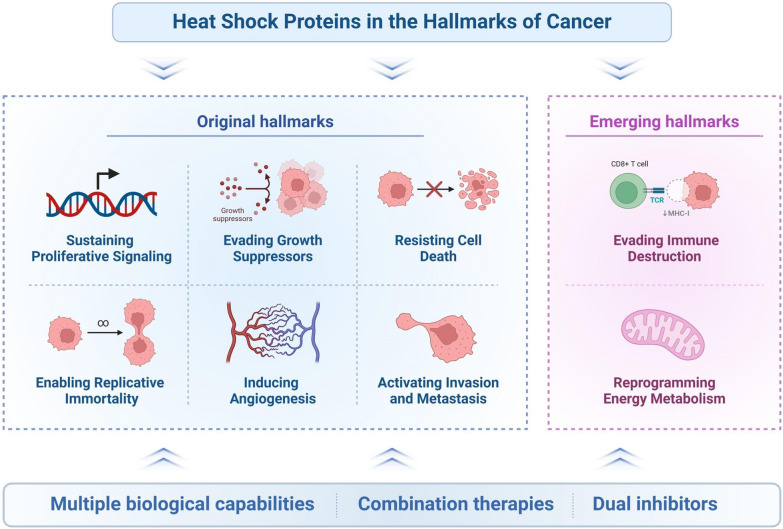
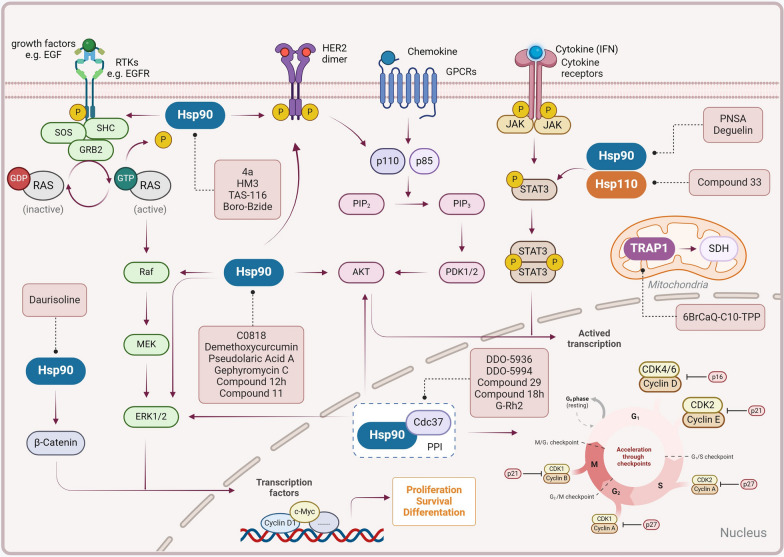
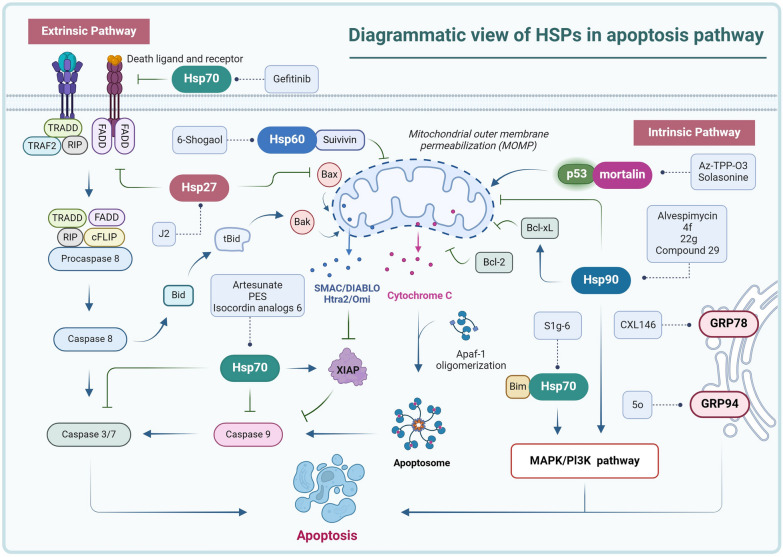
Heat shock proteins are essential molecular chaperones that play crucial roles in stabilizing protein structures, facilitating the repair or degradation of damaged proteins, and maintaining proteostasis and cellular functions. Extensive research has demonstrated that heat shock proteins are highly expressed in cancers and closely associated with tumorigenesis and progression. The "Hallmarks of Cancer" are the core features of cancer biology that collectively define a series of functional characteristics acquired by cells as they transition from a normal state to a state of tumor growth, including sustained proliferative signaling, evasion of growth suppressors, resistance to cell death, enabled replicative immortality, the induction of angiogenesis, and the activation of invasion and metastasis. The pivotal roles of heat shock proteins in modulating the hallmarks of cancer through the activation or inhibition of various signaling pathways has been well documented. Therefore, this review provides an overview of the roles of heat shock proteins in vital biological processes from the perspective of the hallmarks of cancer and summarizes the small-molecule inhibitors that target heat shock proteins to regulate various cancer hallmarks. Moreover, we further discuss combination therapy strategies involving heat shock proteins and promising dual-target inhibitors to highlight the potential of targeting heat shock proteins for cancer treatment. In summary, this review highlights how targeting heat shock proteins could regulate the hallmarks of cancer, which will provide valuable information to better elucidate and understand the roles of heat shock proteins in oncology and the mechanisms of cancer occurrence and development and aid in the development of more efficacious and less toxic novel anticancer agents.
热休克蛋白是重要的分子伴侣,在稳定蛋白质结构、促进受损蛋白质的修复或降解以及维持蛋白质平衡和细胞功能方面发挥着关键作用。大量研究表明,热休克蛋白在癌症中高度表达,与肿瘤发生和进展密切相关。“癌症的标志”是癌症生物学的核心特征,它们共同定义了一系列细胞从正常状态向肿瘤生长状态转变时获得的功能特征,包括持续的增殖信号、逃避生长抑制物、对细胞死亡的抵抗、复制性永生、诱导血管生成以及侵袭和转移的激活。热休克蛋白通过激活或抑制各种信号通路来调节癌症标志的关键作用已得到充分证实。因此,本综述从癌症标志的角度概述了热休克蛋白在重要生物学过程中的作用,并总结了靶向热休克蛋白以调节各种癌症标志的小分子抑制剂。此外,我们进一步讨论了涉及热休克蛋白的联合治疗策略和有前途的双靶抑制剂,以强调针对热休克蛋白治疗癌症的潜力。总之,本综述强调了靶向热休克蛋白如何调节癌症标志,这将为更好地阐明和理解热休克蛋白在肿瘤学中的作用以及癌症发生和发展的机制提供有价值的信息,并有助于开发更有效和毒性更低的新型抗癌药物。