Shen Ling, Tso Patrick, Woods Stephen C, Clegg Deborah J, Barber Kyna L, Carey Katherine, Liu Min
Cincinnati Obesity Research Center, University of Cincinnati College of Medicine, Cincinnati, Ohio, USA.
Diabetes. 2008 Aug;57(8):2092-8. doi: 10.2337/db08-0291. Epub 2008 Jun 16.
The worldwide prevalence of obesity is increasing at an alarming rate, along with the associated increased rates of type 2 diabetes, heart disease, and some cancers. While efforts to address environmental factors responsible for the recent epidemic must continue, investigation into the anorectic functions of potential molecules we present here, such as apolipoprotein (apo)E, offers exciting possibilities for future development of successful anti-obesity therapies.
Changes in feeding behavior after intracerebroventricular injection of apoE, the regulation of hypothalamic apoE gene expression by energy status, and the interaction of hypothalamic apoE with other neuropeptides were studied.
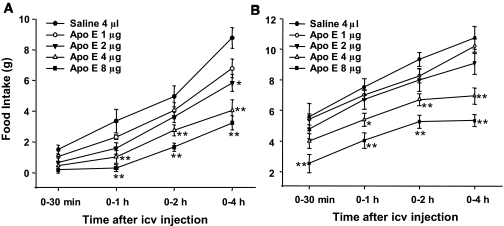
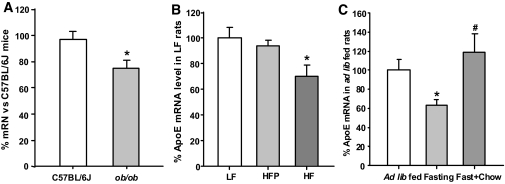
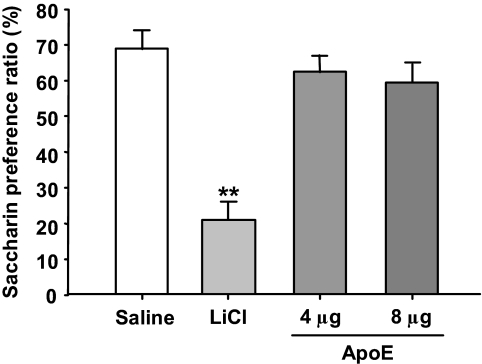
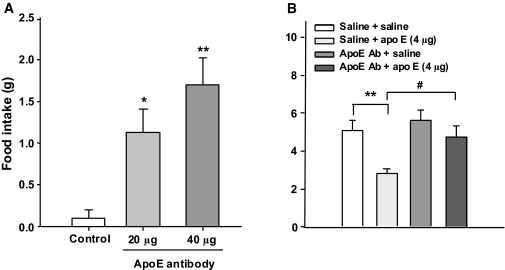
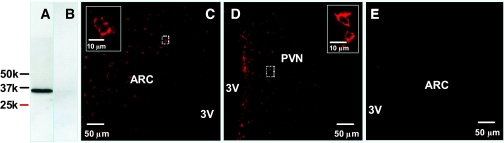
Intracerebroventricular apoE significantly decreased food intake without causing malaise, whereas intracerebroventricular infusion of apoE antiserum stimulated feeding, implying that endogenous apoE tonically inhibits food intake. Consistent with this, apoE was present in the hypothalamus, a brain site intimately involved in the integration of signals for energy homeostasis. Fasted rats exhibited significantly decreased apoE gene expression in the hypothalamus, and refeeding of these rats for 4 h evoked a significant increase of hypothalamic apoE mRNA levels. Both genetically obese (ob/ob) mice and rats with high-fat diet-induced obesity had significantly reduced hypothalamic apoE mRNA levels compared with their lean control counterparts, suggesting that decreased apoE may contribute to hyperphagia in these obese animals. Additionally, apoE-stimulated hypothalamic proopiomelanocortin gene expression and SHU9119, a melanocortin 3/4 receptor antagonist, attenuated the inhibitory function of apoE on feeding.
These data demonstrate that apoE suppresses food intake via a mechanism enhancing melanocortin signaling in the hypothalamus.
全球肥胖患病率正以惊人的速度上升,同时2型糖尿病、心脏病和某些癌症的发病率也随之增加。虽然必须继续努力解决导致近期肥胖流行的环境因素,但对我们在此介绍的潜在分子(如载脂蛋白E)的厌食功能进行研究,为未来成功开发抗肥胖疗法提供了令人兴奋的可能性。
研究了脑室内注射载脂蛋白E后进食行为的变化、能量状态对下丘脑载脂蛋白E基因表达的调节以及下丘脑载脂蛋白E与其他神经肽的相互作用。
脑室内注射载脂蛋白E可显著减少食物摄入量且不会引起不适,而脑室内注入载脂蛋白E抗血清则刺激进食,这意味着内源性载脂蛋白E持续抑制食物摄入。与此一致的是,载脂蛋白E存在于下丘脑,下丘脑是一个与能量稳态信号整合密切相关的脑区。禁食大鼠下丘脑载脂蛋白E基因表达显著降低,对这些大鼠重新喂食4小时可使下丘脑载脂蛋白E mRNA水平显著升高。与瘦对照动物相比,遗传性肥胖(ob/ob)小鼠和高脂饮食诱导肥胖的大鼠下丘脑载脂蛋白E mRNA水平均显著降低,这表明载脂蛋白E减少可能导致这些肥胖动物食欲亢进。此外,载脂蛋白E刺激下丘脑阿黑皮素原基因表达,而黑皮质素3/4受体拮抗剂SHU9119减弱了载脂蛋白E对进食的抑制作用。
这些数据表明,载脂蛋白E通过增强下丘脑黑皮质素信号传导的机制抑制食物摄入。