McDermott Shannon R, Kliman Richard M
Department of Biological Sciences, Cedar Crest College, Allentown, Pennsylvania, United States of America.
PLoS One. 2008 Jun 18;3(6):e2442. doi: 10.1371/journal.pone.0002442.
The Drosophila simulans species complex continues to serve as an important model system for the study of new species formation. The complex is comprised of the cosmopolitan species, D. simulans, and two island endemics, D. mauritiana and D. sechellia. A substantial amount of effort has gone into reconstructing the natural history of the complex, in part to infer the context in which functional divergence among the species has arisen. In this regard, a key parameter to be estimated is the initial isolation time (t) of each island species. Loci in regions of low recombination have lower divergence within the complex than do other loci, yet divergence from D. melanogaster is similar for both classes. This might reflect gene flow of the low-recombination loci subsequent to initial isolation, but it might also reflect differential effects of changing population size on the two recombination classes of loci when the low-recombination loci are subject to genetic hitchhiking or pseudohitchhiking
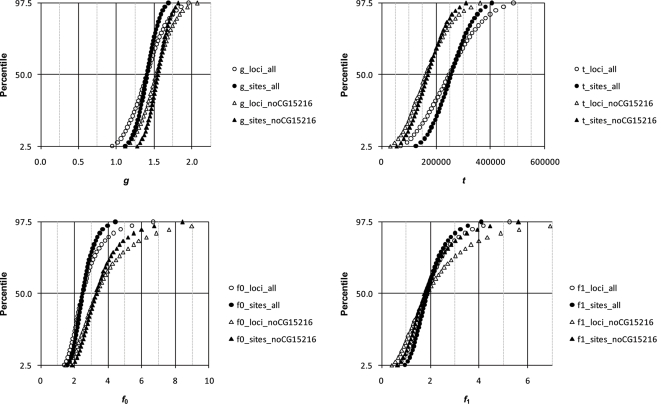
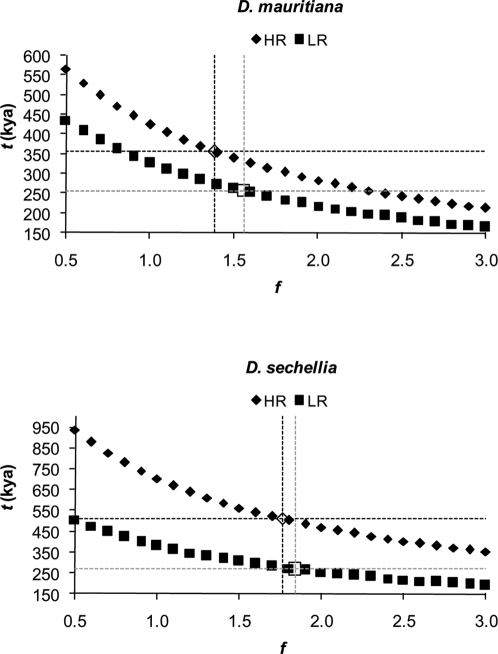
METHODOLOGY/PRINCIPAL FINDINGS: New DNA sequence variation data for 17 loci corroborate the prior observation from 13 loci that DNA sequence divergence is reduced in genes of low recombination. Two models are presented to estimate t and other relevant parameters (substitution rate correction factors in lineages leading to the island species and, in the case of the 4-parameter model, the ratio of ancestral to extant effective population size) from the multilocus DNA sequence data.
CONCLUSIONS/SIGNIFICANCE: In general, it appears that both island species were isolated at about the same time, here estimated at approximately 250,000 years ago. It also appears that the difference in divergence patterns of genes in regions of low and higher recombination can be reconciled by allowing a modestly larger effective population size for the ancestral population than for extant D. simulans.
拟暗果蝇物种复合体仍是研究新物种形成的重要模型系统。该复合体由世界性分布的拟暗果蝇物种以及两种岛屿特有种——毛里求斯果蝇和塞舌尔果蝇组成。人们已投入大量精力来重建该复合体的自然历史,部分目的是推断物种间功能分化出现的背景。在这方面,一个关键的待估参数是每个岛屿物种的初始隔离时间(t)。与其他位点相比,低重组区域的位点在复合体内部的分化程度更低,但这两类位点与黑腹果蝇的分化程度相似。这可能反映了初始隔离后低重组位点的基因流动,但也可能反映了在低重组位点受到遗传搭便车或假搭便车影响时,种群大小变化对这两类重组位点的不同影响。
方法/主要发现:17个位点的新DNA序列变异数据证实了之前13个位点的观察结果,即低重组基因中的DNA序列分化降低。提出了两种模型,用于从多位点DNA序列数据估计t和其他相关参数(导致岛屿物种的谱系中的替代率校正因子,以及在四参数模型中,祖先有效种群大小与现存有效种群大小的比率)。
结论/意义:总体而言,似乎两个岛屿物种大约在同一时间被隔离,此处估计约为25万年前。此外,通过允许祖先种群的有效种群大小比现存拟暗果蝇的有效种群大小略大,似乎可以解释低重组和高重组区域基因分化模式的差异。