Rosado Carlos J, Kondos Stephanie, Bull Tara E, Kuiper Michael J, Law Ruby H P, Buckle Ashley M, Voskoboinik Ilia, Bird Phillip I, Trapani Joseph A, Whisstock James C, Dunstone Michelle A
Department of Biochemistry, Monash University, Clayton, Victoria 3800, Australia.
Cell Microbiol. 2008 Sep;10(9):1765-74. doi: 10.1111/j.1462-5822.2008.01191.x. Epub 2008 Jun 28.
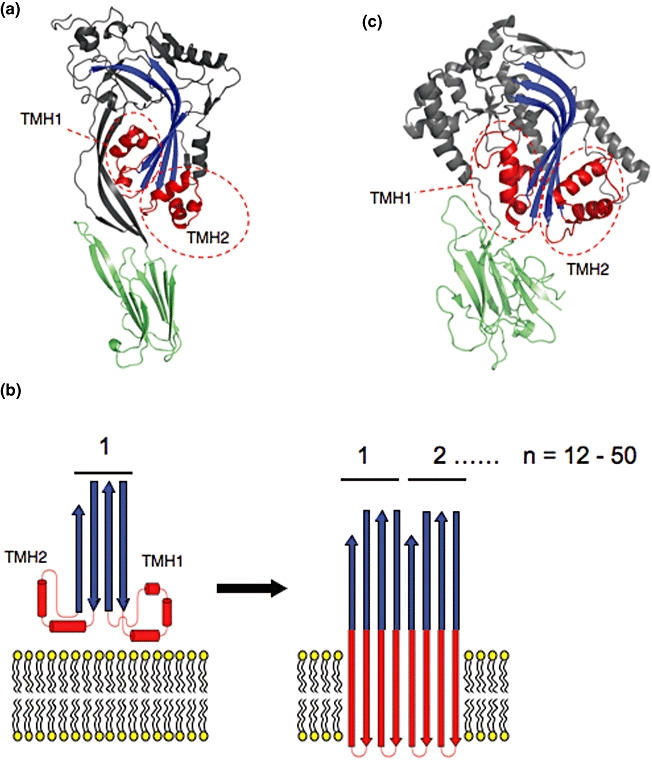
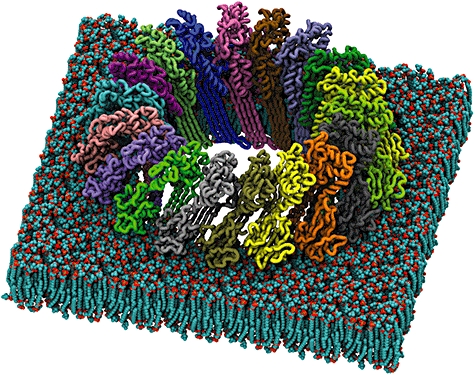
Pore-forming toxins (PFTs) are commonly associated with bacterial pathogenesis. In eukaryotes, however, PFTs operate in the immune system or are deployed for attacking prey (e.g. venoms). This review focuses upon two families of globular protein PFTs: the cholesterol-dependent cytolysins (CDCs) and the membrane attack complex/perforin superfamily (MACPF). CDCs are produced by Gram-positive bacteria and lyse or permeabilize host cells or intracellular organelles during infection. In eukaryotes, MACPF proteins have both lytic and non-lytic roles and function in immunity, invasion and development. The structure and molecular mechanism of several CDCs are relatively well characterized. Pore formation involves oligomerization and assembly of soluble monomers into a ring-shaped pre-pore which undergoes conformational change to insert into membranes, forming a large amphipathic transmembrane beta-barrel. In contrast, the structure and mechanism of MACPF proteins has remained obscure. Recent crystallographic studies now reveal that although MACPF and CDCs are extremely divergent at the sequence level, they share a common fold. Together with biochemical studies, these structural data suggest that lytic MACPF proteins use a CDC-like mechanism of membrane disruption, and will help understand the roles these proteins play in immunity and development.
成孔毒素(PFTs)通常与细菌致病性相关。然而,在真核生物中,PFTs在免疫系统中发挥作用或用于攻击猎物(如毒液)。本综述聚焦于两类球状蛋白PFTs:胆固醇依赖细胞毒素(CDCs)和膜攻击复合物/穿孔素超家族(MACPF)。CDCs由革兰氏阳性菌产生,在感染过程中可使宿主细胞或细胞内细胞器裂解或通透。在真核生物中,MACPF蛋白兼具裂解和非裂解作用,在免疫、侵袭和发育过程中发挥功能。几种CDCs的结构和分子机制已得到较好的表征。孔形成涉及可溶性单体寡聚化并组装成环形前体孔,该前体孔发生构象变化以插入膜中,形成大型两亲性跨膜β桶。相比之下,MACPF蛋白的结构和机制仍不清楚。最近的晶体学研究表明,尽管MACPF和CDCs在序列水平上差异极大,但它们具有共同的折叠结构。结合生化研究,这些结构数据表明,具有裂解作用的MACPF蛋白采用类似CDC的膜破坏机制,这将有助于理解这些蛋白在免疫和发育中的作用。