Gray Robert D, Chaires Jonathan B
James Graham Brown Cancer Center, University of Louisville, 529 S. Jackson Street, Louisville, KY 40202, USA.
Nucleic Acids Res. 2008 Jul;36(12):4191-203. doi: 10.1093/nar/gkn379. Epub 2008 Jun 21.
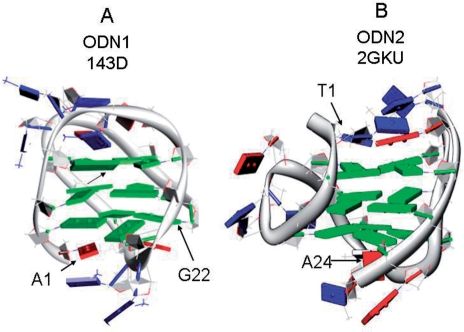
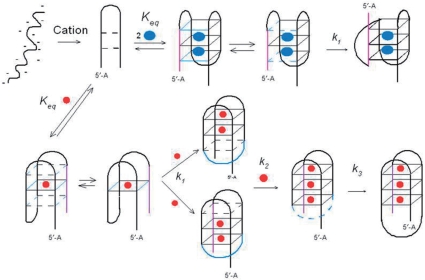
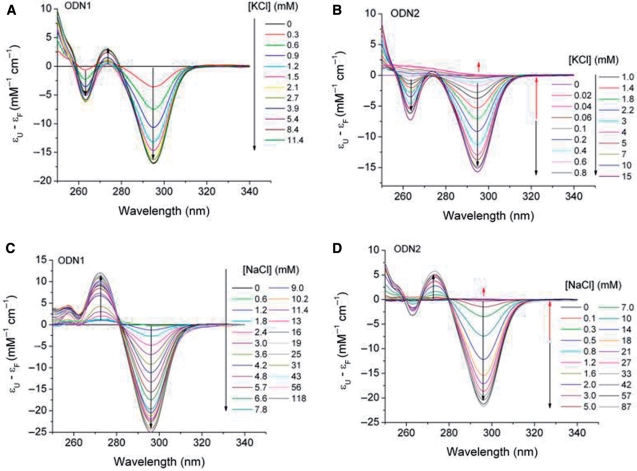
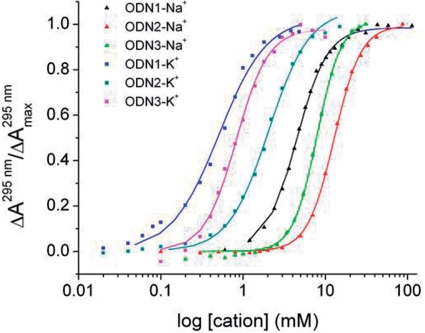
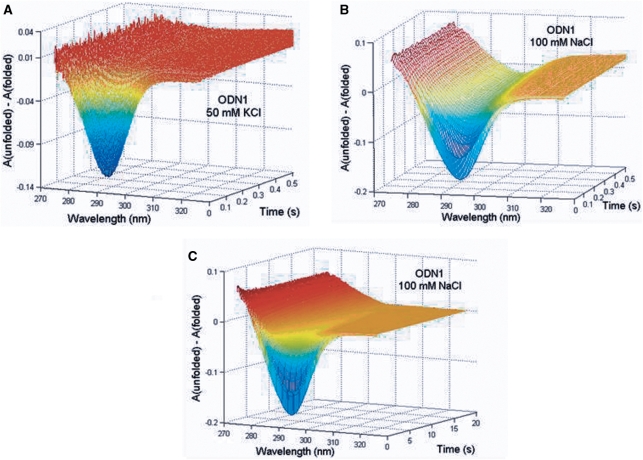
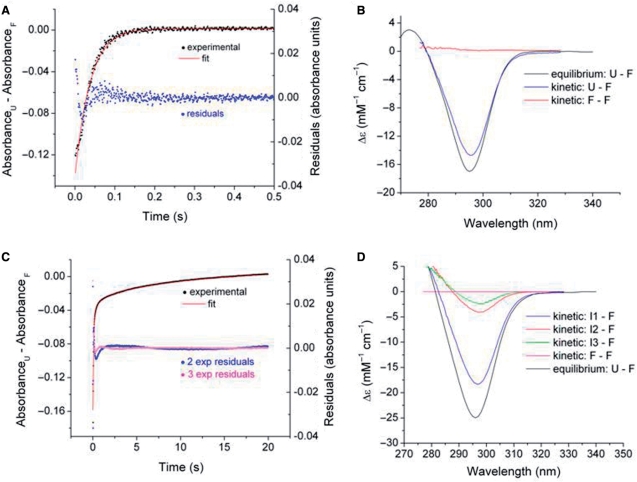
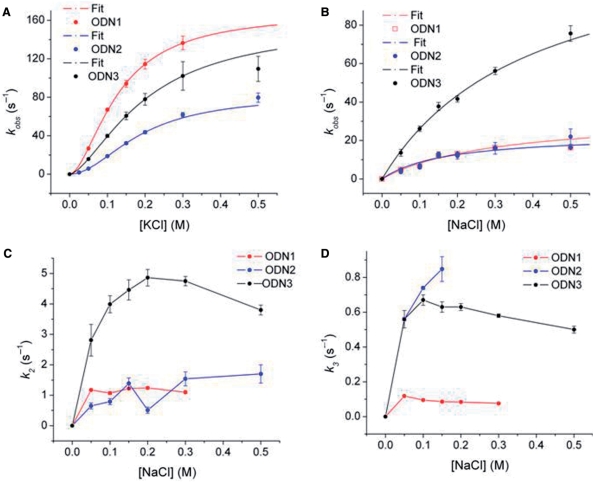
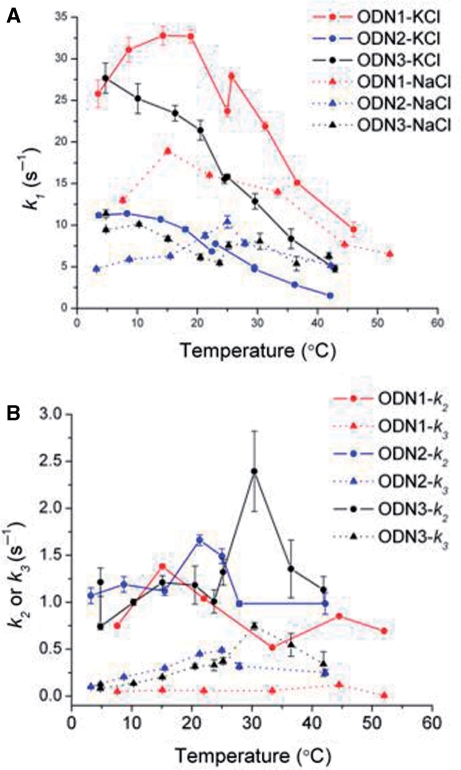
Cation-induced folding into quadruplex structures for three model human telomeric oligonucleotides, d[AGGG(TTAGGG)(3)], d[TTGGG(TTAGGG)(3)A] and d[TTGGG(TTAGGG)(3)], was characterized by equilibrium titrations with KCl and NaCl and by multiwavelength stopped flow kinetics. Cation binding was cooperative with Hill coefficients of 1.5-2.2 in K(+) and 2.4-2.9 in Na(+) with half-saturation concentrations of 0.5-1 mM for K(+) and 4-13 mM for Na(+) depending on the oligonucleotide sequence. Oligonucleotide folding in 50 mM KCl at 25 degrees C consisted of single exponential processes with relaxation times tau of 20-60 ms depending on the sequence. In contrast, folding in100 mM NaCl consisted of three exponentials with tau-values of 40-85 ms, 250-950 ms and 1.5-10.5 s. The folding rate constants approached limiting values with increasing cation concentration; in addition, the rates of folding decreased with increasing temperature over the range 15-45 degrees C. Taken together, these results suggest that folding of G-rich oligonucleotides into quadruplex structures proceeds via kinetically significant intermediates. These intermediates may consist of antiparallel hairpins in rapid equilibrium with less ordered structures. The hairpins may subsequently form nascent G-quartets stabilized by H-bonding and cation binding followed by relatively slow strand rearrangements to form the final completely folded topologies. Fewer kinetic intermediates were evident with K(+) than Na(+), suggesting a simpler folding pathway in K(+) solutions.
通过用氯化钾和氯化钠进行平衡滴定以及多波长停流动力学,对三种模型人类端粒寡核苷酸d[AGGG(TTAGGG)(3)]、d[TTGGG(TTAGGG)(3)A]和d[TTGGG(TTAGGG)(3)]阳离子诱导折叠成四链体结构进行了表征。阳离子结合具有协同性,在钾离子中希尔系数为1.5 - 2.2,在钠离子中为2.4 - 2.9,钾离子的半饱和浓度为0.5 - 1 mM,钠离子为4 - 13 mM,这取决于寡核苷酸序列。在25℃下于50 mM氯化钾中寡核苷酸折叠由单指数过程组成,弛豫时间τ为20 - 60 ms,取决于序列。相比之下,在100 mM氯化钠中折叠由三个指数组成,τ值分别为40 - 85 ms、250 - 950 ms和1.5 - 10.5 s。随着阳离子浓度增加,折叠速率常数接近极限值;此外,在15 - 45℃范围内,折叠速率随温度升高而降低。综上所述,这些结果表明富含鸟嘌呤的寡核苷酸折叠成四链体结构是通过动力学上显著的中间体进行的。这些中间体可能由与较无序结构处于快速平衡的反平行发夹组成。发夹随后可能形成通过氢键和阳离子结合稳定的新生鸟嘌呤四联体,接着是相对缓慢的链重排以形成最终完全折叠的拓扑结构。钾离子存在时明显比钠离子存在时动力学中间体少,这表明在钾离子溶液中有更简单的折叠途径。