Pearl Esther J, Barker Donna, Day Robert C, Beck Caroline W
Department of Zoology, University of Otago, P.O. Box 56, Dunedin 9054, New Zealand.
BMC Dev Biol. 2008 Jun 23;8:66. doi: 10.1186/1471-213X-8-66.
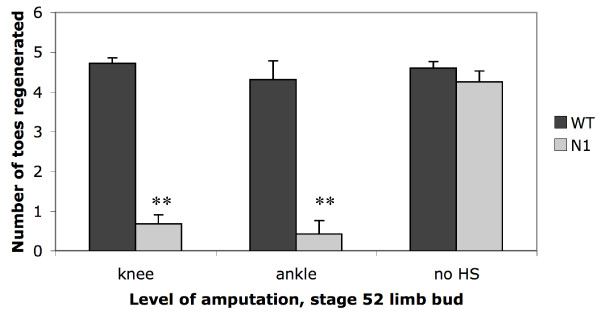
Epimorphic regeneration is the process by which complete regeneration of a complex structure such as a limb occurs through production of a proliferating blastema. This type of regeneration is rare among vertebrates but does occur in the African clawed frog Xenopus laevis, traditionally a model organism for the study of early development. Xenopus tadpoles can regenerate their tails, limb buds and the lens of the eye, although the ability of the latter two organs to regenerate diminishes with advancing developmental stage. Using a heat shock inducible transgene that remains silent unless activated, we have established a stable line of transgenic Xenopus (strain N1) in which the BMP inhibitor Noggin can be over-expressed at any time during development. Activation of this transgene blocks regeneration of the tail and limb of Xenopus tadpoles.
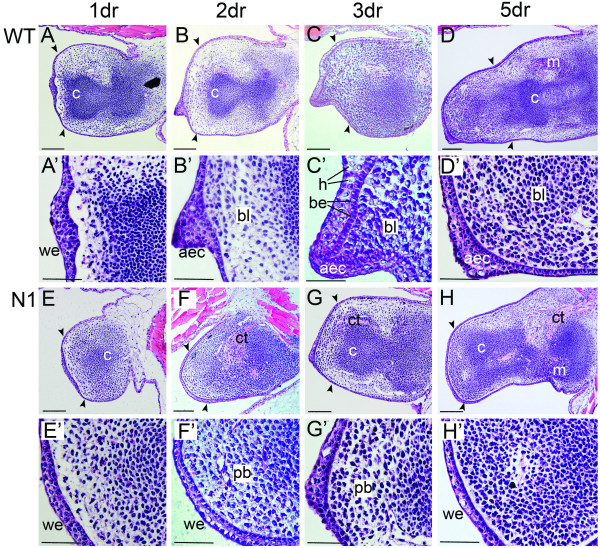
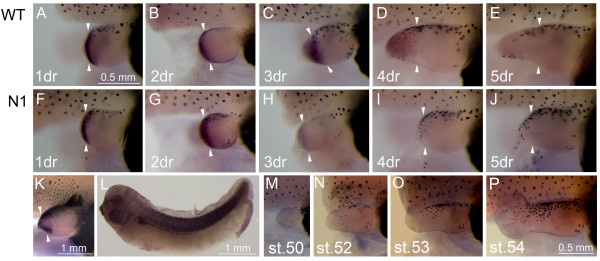
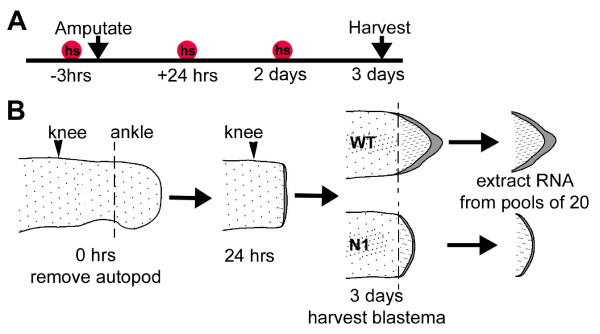
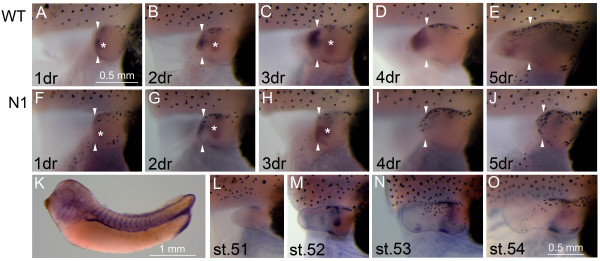
In the current study, we have taken advantage of the N1 transgenic line to directly compare morphology and gene expression in same stage regenerating vs. BMP signalling deficient non-regenerating hindlimb buds. The wound epithelium of N1 transgenic hindlimb buds, which forms over the cut surface of the limb bud after amputation, does not transition normally into the distal thickened apical epithelial cap. Instead, a basement membrane and dermis form, indicative of mature skin. Furthermore, the underlying mesenchyme remains rounded and does not expand to form a cone shaped blastema, a normal feature of successful regeneration. Using Affymetrix Gene Chip analysis, we have identified genes linked to regenerative success downstream of BMP signalling, including the BMP inhibitor Gremlin and the stress protein Hsp60 (no blastema in zebrafish). Gene Ontology analysis showed that genes involved in embryonic development and growth are significantly over-represented in regenerating early hindlimb buds and that successful regeneration in the Xenopus hindlimb correlates with the induction of stress response pathways.
N1 transgenic hindlimbs, which do not regenerate, do not form an apical epithelial cap or cone shaped blastema following amputation. Comparison of gene expression in stage matched N1 vs. wild type hindlimb buds has revealed several new targets for regeneration research.
形态发生再生是指诸如肢体等复杂结构通过增殖性芽基的产生实现完全再生的过程。这种再生类型在脊椎动物中较为罕见,但在非洲爪蟾非洲爪蟾(Xenopus laevis)中确实会发生,它传统上是用于早期发育研究的模式生物。非洲爪蟾蝌蚪能够再生其尾巴、肢芽和晶状体,尽管后两个器官的再生能力会随着发育阶段的推进而减弱。利用一种热休克诱导型转基因,该转基因在未激活时保持沉默,我们建立了一个稳定的转基因非洲爪蟾品系(N1品系),其中骨形态发生蛋白(BMP)抑制剂头蛋白(Noggin)在发育过程中的任何时候都可以过度表达。该转基因的激活会阻断非洲爪蟾蝌蚪尾巴和肢体的再生。
在当前研究中,我们利用N1转基因品系直接比较了相同发育阶段正在再生的与BMP信号缺陷的非再生后肢芽的形态和基因表达。N1转基因后肢芽的伤口上皮在截肢后在肢芽的切割表面形成,它不会正常转变为远端增厚的顶端上皮帽。相反,形成了基底膜和真皮,这表明是成熟皮肤。此外,其下方的间充质保持圆形,不会扩展形成锥形芽基,而锥形芽基是成功再生的正常特征。使用Affymetrix基因芯片分析,我们鉴定出了与BMP信号下游再生成功相关的基因,包括BMP抑制剂Gremlin和应激蛋白Hsp60(斑马鱼中无芽基)。基因本体分析表明,参与胚胎发育和生长的基因在早期再生后肢芽中显著富集,并且非洲爪蟾后肢的成功再生与应激反应途径的诱导相关。
不发生再生的N1转基因后肢在截肢后不会形成顶端上皮帽或锥形芽基。对N1品系与野生型后肢芽在相同发育阶段的基因表达比较揭示了几个再生研究的新靶点。