De Backer I C, Vreugdenhil G, Nijziel M R, Kester A D, van Breda E, Schep G
Department of Sports Medicine, Máxima Medical Centre, Veldhoven, The Netherlands.
Br J Cancer. 2008 Jul 8;99(1):30-6. doi: 10.1038/sj.bjc.6604433. Epub 2008 Jun 24.
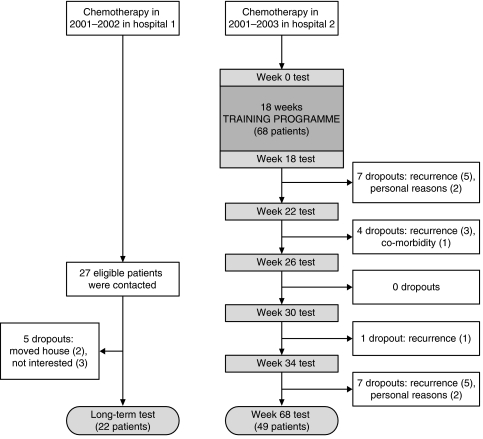
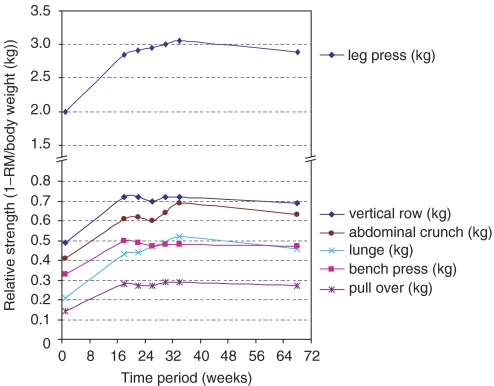
The short-term beneficial effects of physical rehabilitation programmes after cancer treatment have been described. However, little is known regarding the long-term effects. The purpose of this study was to investigate the long-term effects of high-intensity resistance training compared with traditional recovery. A total of 68 cancer survivors who completed an 18-week resistance training programme were followed for 1 year. During the 1-year follow-up, 19 patients dropped out (14 due to recurrence of cancer). The remaining 49 patients of the intervention group were compared with a group of 22 patients treated with chemotherapy in the same period but not participating in any rehabilitation programme. Outcome measures were muscle strength, cardiopulmonary function, fatigue, and health-related quality of life. One year after completion of the rehabilitation programme, the outcome measures in the intervention group were still at the same level as immediately after rehabilitation. Muscle strength at 1 year was significantly higher in patients who completed the resistance training programme than in the comparison group. High-intensity resistance training has persistent effects on muscle strength, cardiopulmonary function, quality of life, and fatigue. Rehabilitation programmes for patients treated with chemotherapy with a curative intention should include high-intensity resistance training in their programme.
癌症治疗后身体康复计划的短期有益效果已有描述。然而,关于其长期效果却知之甚少。本研究的目的是调查高强度抗阻训练相较于传统康复方式的长期效果。共有68名完成了为期18周抗阻训练计划的癌症幸存者被随访了1年。在1年的随访期间,19名患者退出(14名因癌症复发)。将干预组剩余的49名患者与同期接受化疗但未参与任何康复计划的22名患者组成的对照组进行比较。观察指标包括肌肉力量、心肺功能、疲劳程度以及与健康相关的生活质量。康复计划完成1年后,干预组的观察指标仍与康复刚结束时处于同一水平。完成抗阻训练计划的患者1年后的肌肉力量显著高于对照组。高强度抗阻训练对肌肉力量、心肺功能、生活质量和疲劳程度具有持续影响。针对有治愈意向的化疗患者的康复计划应在其方案中纳入高强度抗阻训练。