Bonventre J V, Sukhatme V P, Bamberger M, Ouellette A J, Brown D
Medical Service, Massachusetts General Hospital, Boston 02114.
Cell Regul. 1991 Mar;2(3):251-60. doi: 10.1091/mbc.2.3.251.
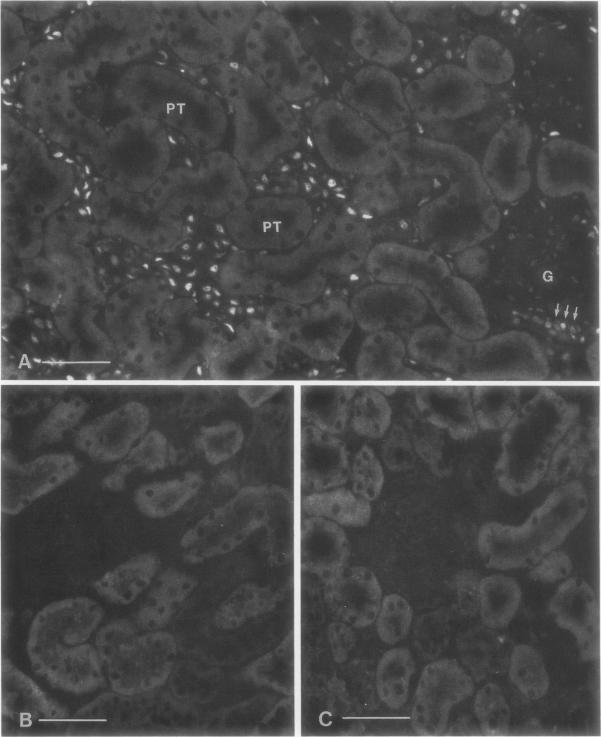
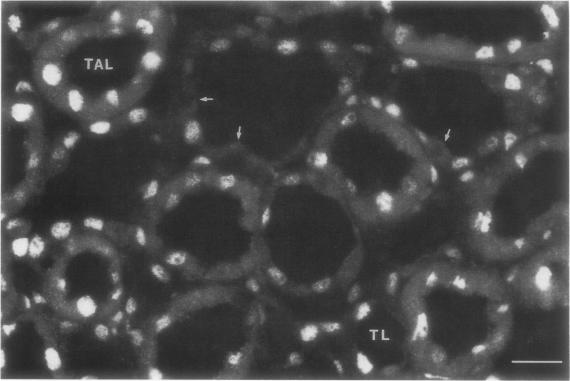
Egr-1 is an "immediate early" gene that is induced by growth factors and agents that induce differentiation and encodes a protein with a "zinc-finger" motif. This protein is believed to be involved in transcriptional regulation. Because the fate of the kidney, and hence the organism, after an ischemic insult is dependent upon cellular repair, differentiation, and proliferation, we examined whether there was expression of the Egr-1 protein after an ischemic insult to the rat kidney. We have previously reported that Egr-1 mRNA accumulates to high levels in mouse kidneys after 30 min of ischemia and 1 h of reperfusion. In the present study, performed in rats, we show that Egr-1 mRNA transiently accumulates to very high levels after 40 min of ischemia and 1 h of reperfusion, is decreased by 3 h, and is nondetectable by 24 h of reperfusion. Reperfusion is required for Egr-1 protein accumulation to occur. The Egr-1 protein was localized by immunohistochemical techniques primarily to the nuclei of the thick ascending limbs and principal cells of the collecting ducts in the cortex and medulla. The subcellular localization was exclusively nuclear. There was some staining of the glomerular tuft and staining was particularly prominent in the parietal epithelial cells. In parallel to the accumulation of Egr-1 mRNA, the expression of the protein was transient and was no longer apparent after 5 h of reperfusion. The Egr-1 protein may play an important role in regulation of the response to ischemia of those segments of the nephron that are highly susceptible to oxygen deprivation and have a high level of intrinsic plasticity. It is possible that this protein may modulate cellular processes important for the ultimate ability of these critical nephron segments to recover from an ischemic insult.
Egr-1是一种“即刻早期”基因,可由生长因子和诱导分化的因子诱导产生,并编码一种具有“锌指”基序的蛋白质。这种蛋白质被认为参与转录调控。由于肾脏在缺血性损伤后的命运,进而整个机体的命运,取决于细胞修复、分化和增殖,我们研究了大鼠肾脏缺血性损伤后是否有Egr-1蛋白表达。我们之前报道过,缺血30分钟和再灌注1小时后,Egr-1 mRNA在小鼠肾脏中积累至高水平。在本研究中,我们用大鼠进行实验,结果表明,缺血40分钟和再灌注1小时后,Egr-1 mRNA短暂积累至非常高的水平,3小时后下降,再灌注24小时后无法检测到。Egr-1蛋白积累需要再灌注。通过免疫组织化学技术,Egr-1蛋白主要定位于皮质和髓质中集合管的厚升支和主细胞的细胞核。亚细胞定位仅在细胞核。肾小球毛细血管丛有一些染色,在壁层上皮细胞中染色尤为明显。与Egr-1 mRNA的积累平行,该蛋白的表达是短暂的,再灌注5小时后不再明显。Egr-1蛋白可能在调节对缺血的反应中发挥重要作用,这些反应发生在对缺氧高度敏感且具有高度内在可塑性的肾单位节段。这种蛋白质可能调节对这些关键肾单位节段从缺血性损伤中最终恢复能力至关重要的细胞过程。