Gruninger Todd R, Gualberto Daisy G, Garcia L Rene
Department of Biology, Texas A&M University, College Station, Texas, United States of America.
PLoS Genet. 2008 Jul 4;4(7):e1000117. doi: 10.1371/journal.pgen.1000117.
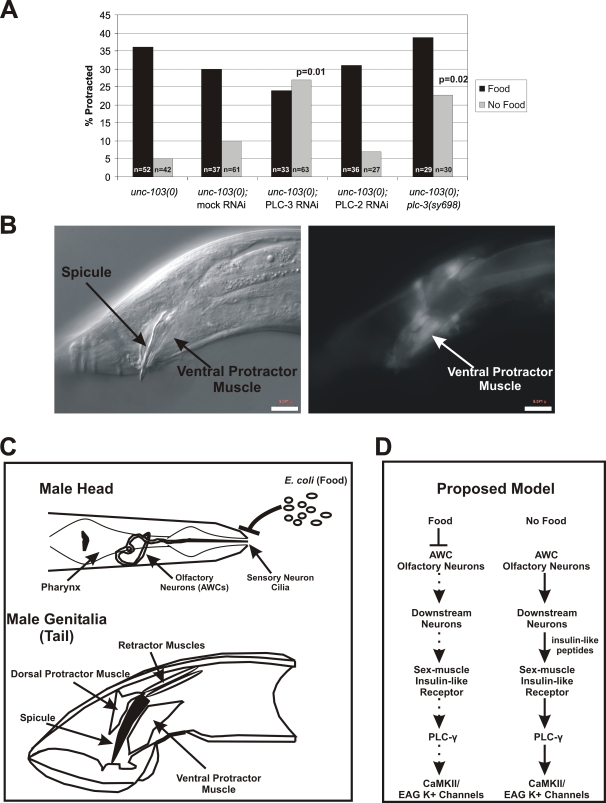
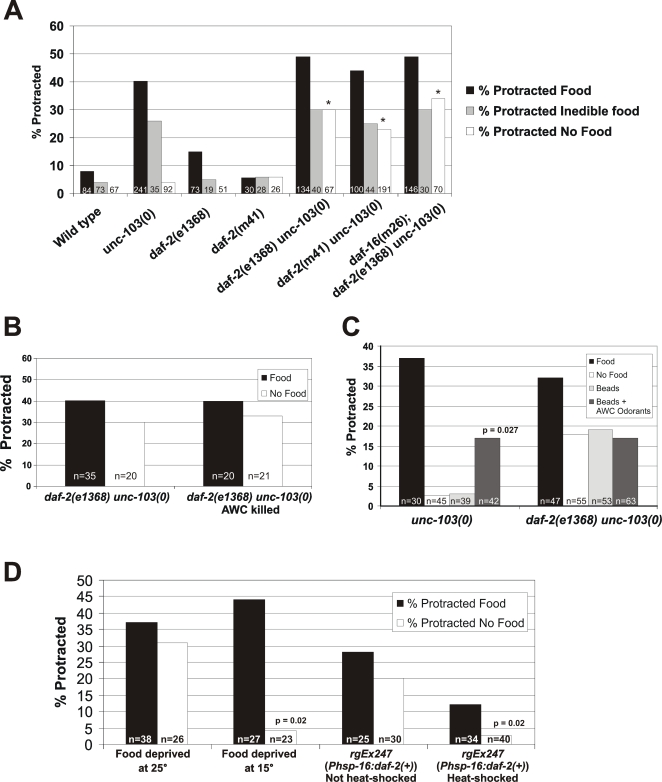
Food deprivation is known to affect physiology and behavior. Changes that occur could be the result of the organism's monitoring of internal and external nutrient availability. In C. elegans, male mating is dependent on food availability; food-deprived males mate with lower efficiency compared to their well-fed counterparts, suggesting that the mating circuit is repressed in low-food environments. This behavioral response could be mediated by sensory neurons exposed to the environment or by internal metabolic cues. We demonstrated that food-deprivation negatively regulates sex-muscle excitability through the activity of chemosensory neurons and insulin-like signaling. Specifically, we found that the repressive effects of food deprivation on the mating circuit can be partially blocked by placing males on inedible food, E. coli that can be sensed but not eaten. We determined that the olfactory AWC neurons actively suppress sex-muscle excitability in response to food deprivation. In addition, we demonstrated that loss of insulin-like receptor (DAF-2) signaling in the sex muscles blocks the ability of food deprivation to suppress the mating circuit. During low-food conditions, we propose that increased activity by specific olfactory neurons (AWCs) leads to the release of neuroendocrine signals, including insulin-like ligands. Insulin-like receptor signaling in the sex muscles then reduces cell excitability via activation of downstream molecules, including PLC-gamma and CaMKII.
已知食物剥夺会影响生理和行为。发生的变化可能是生物体监测内部和外部营养可用性的结果。在秀丽隐杆线虫中,雄性交配取决于食物供应;与喂食良好的雄性相比,食物剥夺的雄性交配效率较低,这表明在低食物环境中交配回路受到抑制。这种行为反应可能由暴露于环境的感觉神经元或内部代谢线索介导。我们证明,食物剥夺通过化学感觉神经元的活动和胰岛素样信号传导对性肌肉兴奋性产生负调节。具体而言,我们发现将雄性置于不可食用的食物(可感知但不能食用的大肠杆菌)上,可以部分阻断食物剥夺对交配回路的抑制作用。我们确定嗅觉AWC神经元在食物剥夺时会积极抑制性肌肉兴奋性。此外,我们证明性肌肉中胰岛素样受体(DAF-2)信号的丧失会阻断食物剥夺抑制交配回路的能力。在低食物条件下,我们提出特定嗅觉神经元(AWC)的活动增加会导致神经内分泌信号的释放,包括胰岛素样配体。然后,性肌肉中的胰岛素样受体信号通过激活下游分子(包括PLC-γ和CaMKII)来降低细胞兴奋性。