Neurosciences Graduate Program, University of California San Diego, La Jolla, CA, 92093, USA.
Molecular Neurobiology Laboratory, Salk Institute for Biological Studies, La Jolla, CA, 92037, USA.
Cell Mol Life Sci. 2024 Jun 8;81(1):252. doi: 10.1007/s00018-024-05223-1.
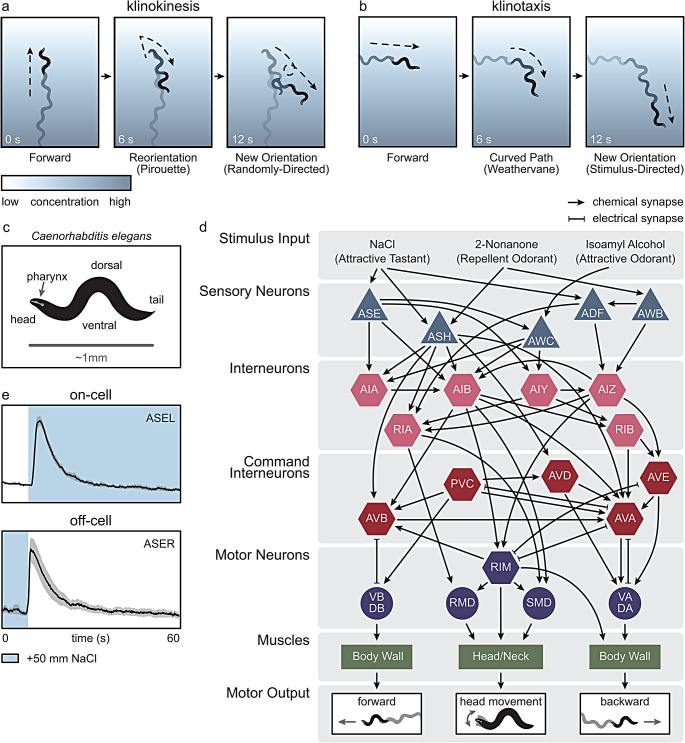
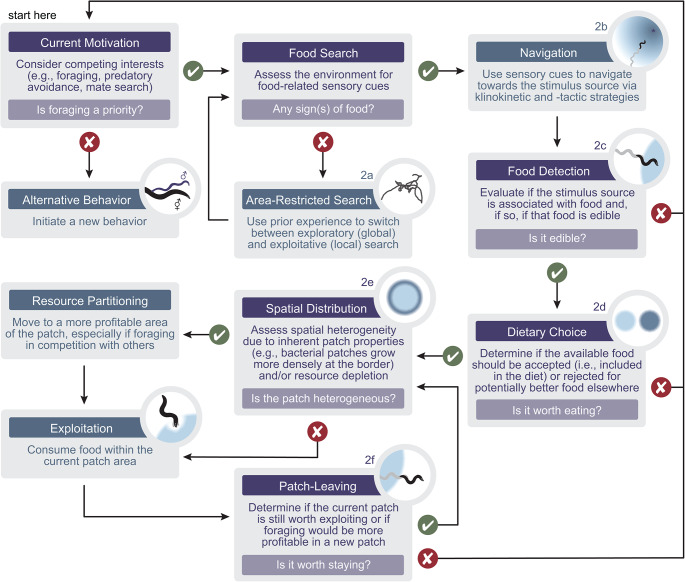
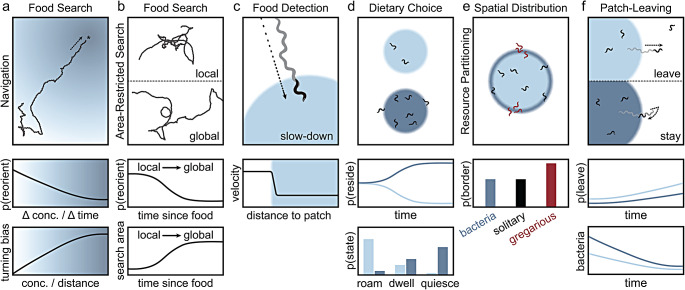
Animals have evolved to seek, select, and exploit food sources in their environment. Collectively termed foraging, these ubiquitous behaviors are necessary for animal survival. As a foundation for understanding foraging, behavioral ecologists established early theoretical and mathematical frameworks which have been subsequently refined and supported by field and laboratory studies of foraging animals. These simple models sought to explain how animals decide which strategies to employ when locating food, what food items to consume, and when to explore the environment for new food sources. These foraging decisions involve integration of prior experience with multimodal sensory information about the animal's current environment and internal state. We suggest that the nematode Caenorhabditis elegans is well-suited for a high-resolution analysis of complex goal-oriented behaviors such as foraging. We focus our discussion on behavioral studies highlighting C. elegans foraging on bacteria and summarize what is known about the underlying neuronal and molecular pathways. Broadly, we suggest that this simple model system can provide a mechanistic understanding of decision-making and present additional avenues for advancing our understanding of complex behavioral processes.
动物进化出了在其环境中寻找、选择和利用食物资源的能力。这些普遍存在的行为统称为觅食,是动物生存的必要条件。作为理解觅食行为的基础,行为生态学家建立了早期的理论和数学框架,这些框架随后通过对觅食动物的实地和实验室研究得到了完善和支持。这些简单的模型试图解释动物在寻找食物时如何决定采用哪种策略,选择哪些食物,以及何时探索环境以寻找新的食物来源。这些觅食决策涉及到将先前的经验与关于动物当前环境和内部状态的多模态感官信息进行整合。我们认为,秀丽隐杆线虫是一种非常适合分析复杂目标导向行为(如觅食)的生物。我们将重点讨论突出秀丽隐杆线虫在细菌上觅食的行为研究,并总结有关潜在神经元和分子途径的知识。总的来说,我们认为这个简单的模型系统可以提供对决策制定的机制理解,并为我们理解复杂行为过程提供了额外的途径。