de Souza Russell J, Swain Janis F, Appel Lawrence J, Sacks Frank M
Department of Nutrition, Harvard School of Public Health, Boston, MA 02215, USA.
Am J Clin Nutr. 2008 Jul;88(1):1-11. doi: 10.1093/ajcn/88.1.1.
Enhancements to current dietary advice to prevent chronic disease are of great clinical and public health importance. The OmniHeart Trial compared 3 diets designed to reduce cardiovascular disease (CVD) risk-one high in carbohydrate and 2 that replaced carbohydrate with either unsaturated fat or protein. The lower carbohydrate diets improved the CVD risk factors. Several popular diets claiming health benefits emphasize carbohydrate, fat, or protein or various combined approaches.
The objective of this study was to compare the macronutrient contents of the OmniHeart trial diets to those of several popular diets and to evaluate each diet for consistency with national health guidelines.
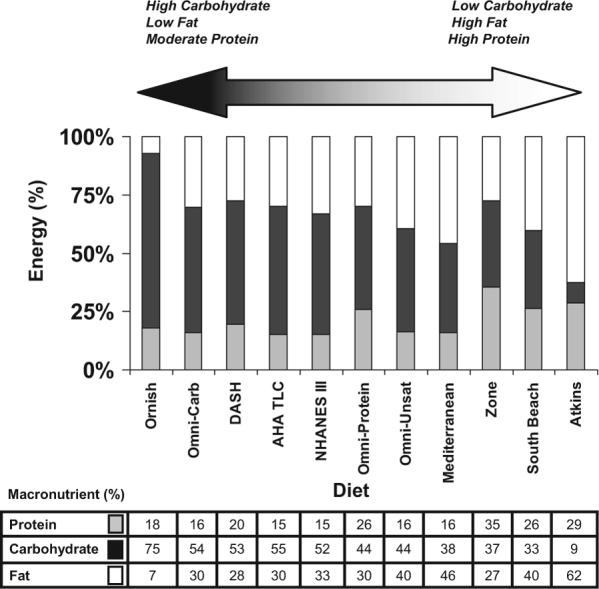
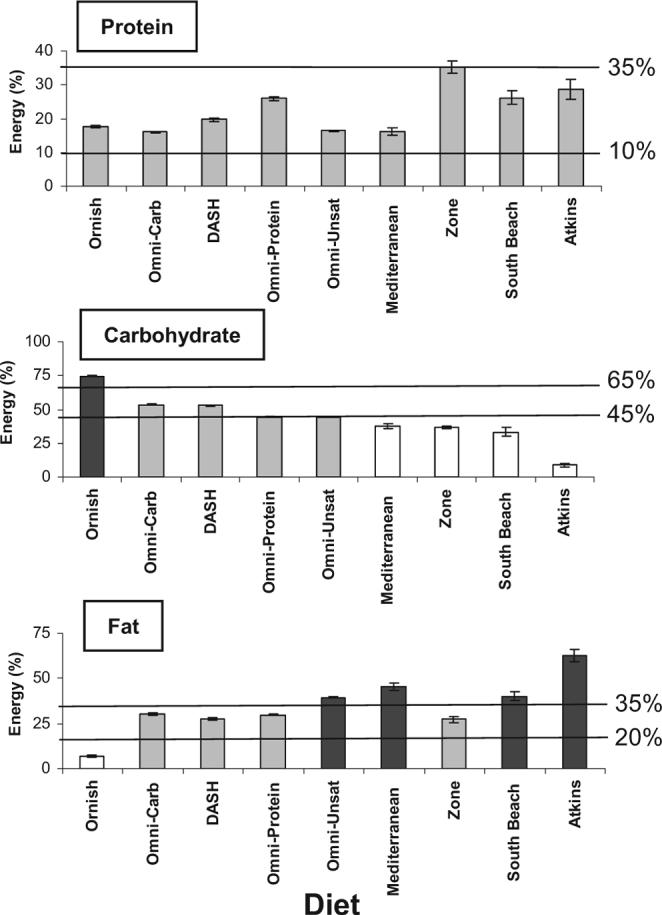
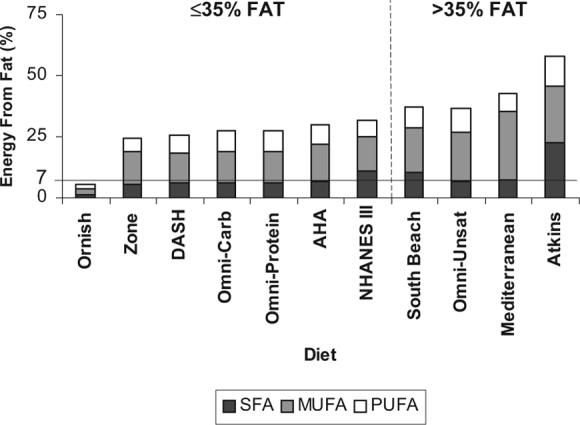
The macronutrient contents of 7-d menu plans from the OmniHeart Study, Dietary Approaches to Stop Hypertension (DASH), Zone, Atkins, Mediterranean, South Beach, and Ornish diets were evaluated for consistency with the US Food and Nutrition Board's Acceptable Macronutrient Distribution Ranges (AMDRs) and with the dietary recommendations of several health organizations.
The OmniHeart diets fulfilled the major AMDRs, but, of the popular diets, only the Zone diet did. The OmniHeart diets were generally consistent with national guidelines to prevent cancer, diabetes, and heart disease, whereas most popular diets had limitations for fulfilling one or more guidelines.
Although the OmniHeart protein and unsaturated fat diets were superior to the carbohydrate diet in improving CVD risk, all 3 study diets were consistent with national guidelines to reduce chronic disease risk, which suggests that the guidelines might now be fine-tuned to optimize disease prevention. Popular diets vary in their nutritional adequacy and consistency with guidelines for risk reduction.
加强当前预防慢性病的饮食建议具有重大的临床和公共卫生意义。OmniHeart试验比较了3种旨在降低心血管疾病(CVD)风险的饮食——一种高碳水化合物饮食和另外两种分别用不饱和脂肪或蛋白质替代碳水化合物的饮食。低碳水化合物饮食改善了心血管疾病风险因素。几种声称有益健康的流行饮食强调碳水化合物、脂肪或蛋白质,或各种组合方式。
本研究的目的是比较OmniHeart试验饮食与几种流行饮食的宏量营养素含量,并评估每种饮食与国家健康指南的一致性。
评估了OmniHeart研究、饮食预防高血压法(DASH)、Zone饮食、阿特金斯饮食、地中海饮食、南滩饮食和奥尼什饮食的7天菜单计划中的宏量营养素含量,以确定其与美国食品和营养委员会的可接受宏量营养素分布范围(AMDRs)以及几个健康组织的饮食建议的一致性。
OmniHeart饮食符合主要的AMDRs,但在流行饮食中,只有Zone饮食做到了这一点。OmniHeart饮食总体上与预防癌症、糖尿病和心脏病的国家指南一致,而大多数流行饮食在满足一项或多项指南方面存在局限性。
尽管OmniHeart蛋白质和不饱和脂肪饮食在改善心血管疾病风险方面优于碳水化合物饮食,但所有3种研究饮食都与降低慢性病风险的国家指南一致,这表明现在可能需要对指南进行微调以优化疾病预防。流行饮食在营养充足性和与降低风险指南的一致性方面各不相同。