Iannotti Lora L, Zavaleta Nelly, León Zulema, Shankar Anuraj H, Caulfield Laura E
International Food Policy Research Institute and the George Washington University School of Public Health and Health Services, Washington, DC, USA.
Am J Clin Nutr. 2008 Jul;88(1):154-60. doi: 10.1093/ajcn/88.1.154.
Little is known about how maternal zinc intake influences growth in utero and in postnatal life in humans.
We aimed to assess the effect of maternal zinc supplementation during pregnancy on infant growth through age 1 y.
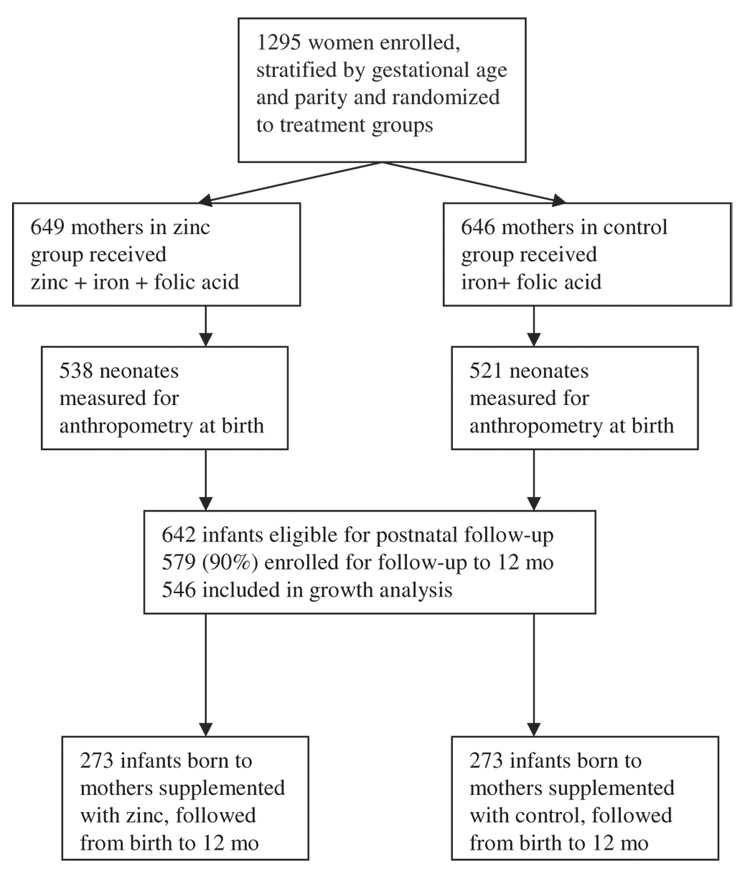
A double-blind, randomized controlled trial of prenatal zinc supplementation was conducted from 1995 to 1997 in Lima, Peru. Women (n = 1295) were enrolled at 15.6 +/- 4.6 wk gestation and assigned to receive daily supplements with zinc (15 mg Zn + 60 mg Fe + 250 microg folic acid) or without zinc (60 Fe + 250 microg folic acid) through pregnancy to 1 mo after delivery. At birth, 546 infants were followed for 12 mo to assess growth. Anthropometric measures of body size and composition were collected monthly, and morbidity and dietary intake surveillance was carried out weekly.
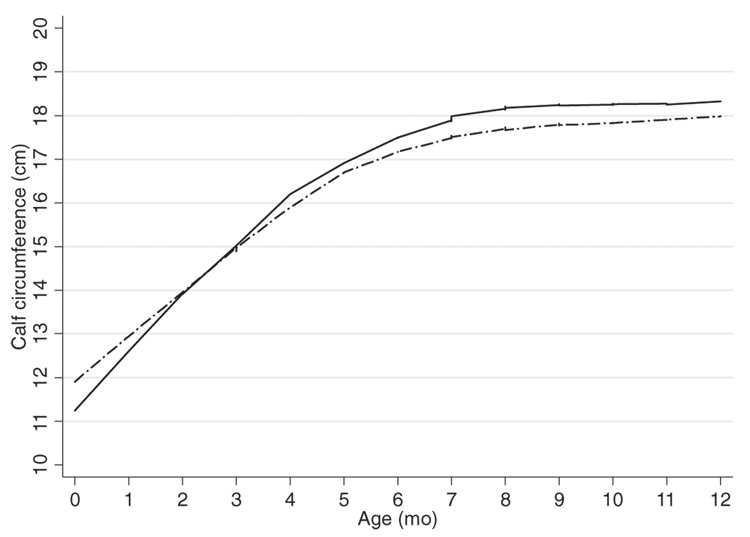
No differences in maternal socioeconomic characteristics by treatment group or follow-up period were found. Infants born to mothers prenatally supplemented with zinc had significantly (P < 0.05) larger average growth measures beginning in month 4 and continuing through month 12. In longitudinal regression modeling, prenatal zinc was associated with greater weight (by 0.58 +/- 0.12 kg; P < 0.001), calf circumference (by 1.01 +/- 0.21 cm; P < 0.001), chest circumference (by 0.60 +/- 0.20 cm; P = 0.002), and calf muscle area (by 35.78 +/- 14.75 mm(2); P = 0.01) after adjustment for a range of covariates. No effect was observed for linear growth.
Maternal zinc supplementation in this population was associated with offspring growth, which is suggestive of lean tissue mass accretion.
关于孕期锌摄入量如何影响人类子宫内及出生后生长的情况,人们了解甚少。
我们旨在评估孕期补充锌对1岁以内婴儿生长的影响。
1995年至1997年在秘鲁利马进行了一项关于产前补充锌的双盲随机对照试验。1295名女性在妊娠15.6±4.6周时入组,被分配在孕期至产后1个月每日接受含锌补充剂(15毫克锌+60毫克铁+250微克叶酸)或不含锌补充剂(60毫克铁+250微克叶酸)。出生时,对546名婴儿进行了12个月的随访以评估生长情况。每月收集身体大小和组成的人体测量指标,每周进行发病率和饮食摄入监测。
未发现治疗组或随访期间产妇社会经济特征存在差异。产前补充锌的母亲所生婴儿从第4个月开始直至第12个月平均生长指标显著更大(P<0.05)。在纵向回归模型中,调整一系列协变量后,产前补锌与更大的体重(增加0.58±0.12千克;P<0.001)、小腿围(增加1.01±0.21厘米;P<0.001)、胸围(增加0.60±0.20厘米;P = 0.002)和小腿肌肉面积(增加35.78±14.75平方毫米;P = 0.01)相关。未观察到对线性生长的影响。
该人群中孕期补充锌与后代生长相关,提示瘦组织量增加。