Department of Cardiology, CARIM, University Hospital Maastricht, The Netherlands.
Eur Heart J. 2008 Sep;29(17):2073-82. doi: 10.1093/eurheartj/ehn296. Epub 2008 Jul 9.
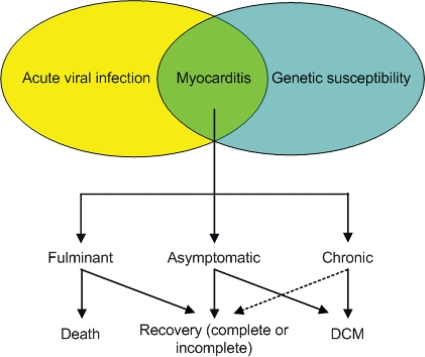
Acute myocarditis is one of the most challenging diagnosis in cardiology. At present, no diagnostic gold standard is generally accepted, due to the insensitivity of traditional diagnostic tests. This leads to the need for new diagnostic approaches, which resulted in the emergence of new molecular tests and a more detailed immunohistochemical analysis of endomyocardial biopsies. Recent findings using these new diagnostic tests resulted in increased interest in inflammatory cardiomyopathies and a better understanding of its pathophysiology, the recognition in overlap of virus-mediated damage, inflammation, and autoimmune dysregulation. Novel results also pointed towards a broader spectrum of viral genomes responsible for acute myocarditis, indicating a shift of enterovirus and adenovirus to parvovirus B19 and human herpes virus 6. The present review proposes a general diagnostic approach, focuses on the viral aetiology and associated autoimmune processes, and reviews treatment options for patients with acute viral myocarditis.
急性心肌炎是心脏病学中最具挑战性的诊断之一。目前,由于传统诊断测试的不敏感性,尚未普遍接受诊断的金标准。这导致需要新的诊断方法,从而出现了新的分子测试和对心肌活检的更详细的免疫组织化学分析。使用这些新的诊断测试的最新发现增加了对炎症性心肌病的兴趣,并更好地了解其病理生理学,认识到病毒介导的损伤、炎症和自身免疫失调的重叠。新的结果还指出,负责急性心肌炎的病毒基因组范围更广,表明肠道病毒和腺病毒向细小病毒 B19 和人类疱疹病毒 6 转移。本综述提出了一种一般诊断方法,重点关注病毒病因和相关的自身免疫过程,并回顾了急性病毒性心肌炎患者的治疗选择。