Ha Chang Hoon, Jhun Bong Sook, Kao Hung-Ying, Jin Zheng-Gen
Department of Medicine, Aab Cardiovascular Research Institute, University of Rochester Medical Center, Rochester, New York 14642, USA.
Arterioscler Thromb Vasc Biol. 2008 Oct;28(10):1782-8. doi: 10.1161/ATVBAHA.108.172528. Epub 2008 Jul 10.
Histone acetylation/deacetylation plays an important role in the control of gene expression, tissue growth, and development. In particular, histone deacetylases 7 (HDAC7), a member of class IIa HDACs, is crucial in maintaining vascular integrity. However, whether HDAC7 is involved in the processes of vascular endothelial signaling and angiogenesis remains unclear. Here, we investigated the role of HDAC7 in vascular endothelial growth factor (VEGF) signaling and angiogenesis.
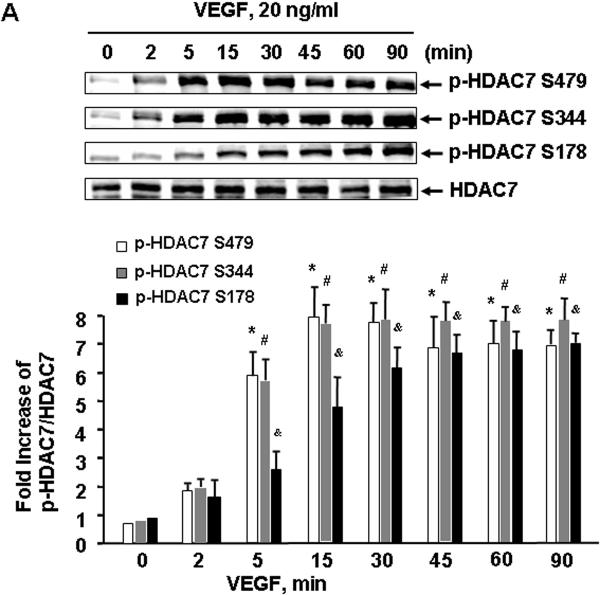
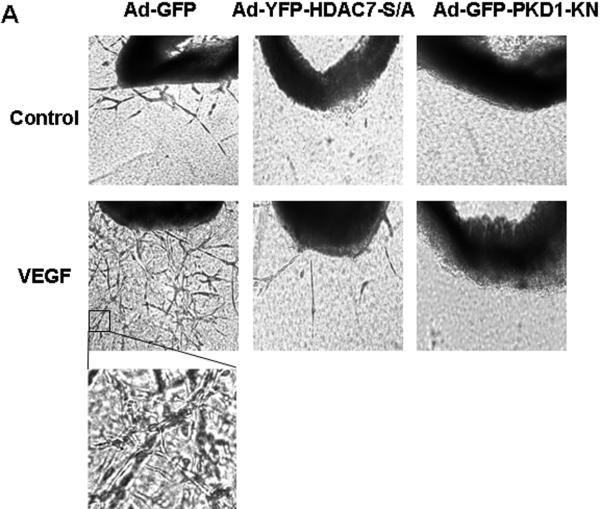
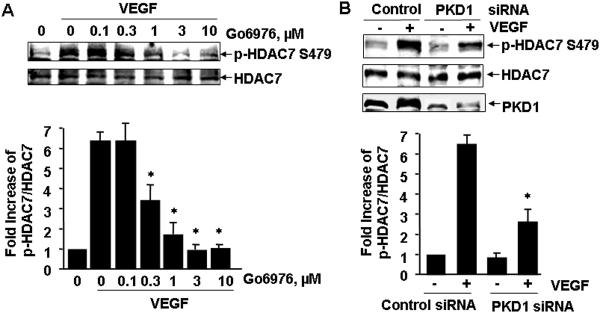
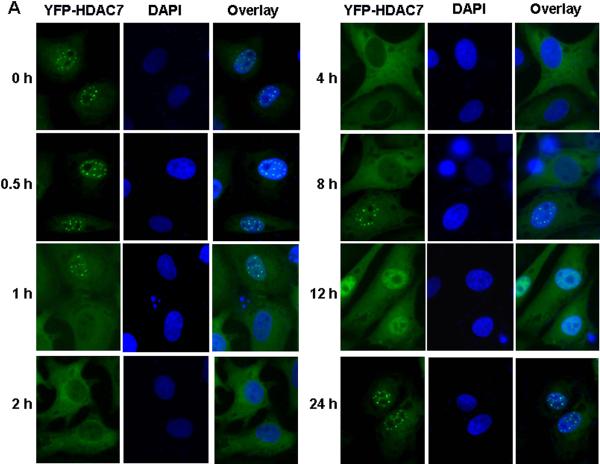
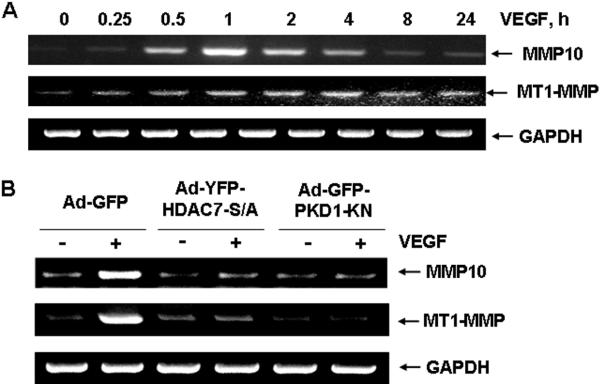
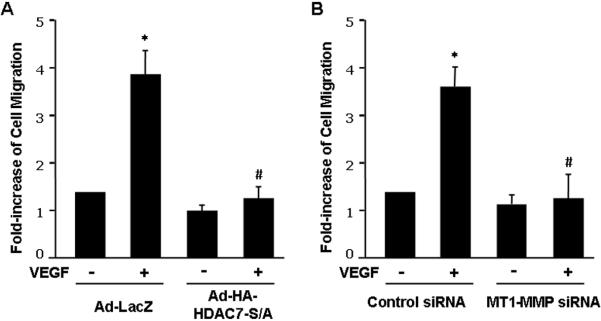
We show for the first time that VEGF stimulated phosphorylation of HDAC7 at the sites of Ser178, Ser344, and Ser479 in a dose- and time-dependent manner, which leads to the cytoplasmic accumulation of HDAC7. Using pharmacological inhibitors, siRNA, and adenoviruses carrying dominant-negative mutants, we found that phospholipase Cgamma/protein kinase C/protein kinase D1 (PKD1)-dependent signal pathway mediated HDAC7 phosphorylation and cytoplasmic accumulation by VEGF. Infection of ECs with adenoviruses encoding a mutant of HDAC7 specifically deficient in PKD1-dependent phosphorylation inhibited VEGF-induced angiogenic gene expression, including matrix metalloproteinases MT1-matrix metalloproteinase (MMP) and MMP10. Moreover, HDAC7 and its targeting genes were involved in VEGF-stimulated endothelial cell migration, tube formation, and microvessel sprouting.
Our results demonstrate that VEGF stimulates PKD1-dependent HDAC7 phosphorylation and cytoplasmic accumulation in endothelial cells modulating gene expression and angiogenesis.
组蛋白乙酰化/去乙酰化在基因表达调控、组织生长和发育中发挥重要作用。特别是,IIa类组蛋白去乙酰化酶7(HDAC7)在维持血管完整性方面至关重要。然而,HDAC7是否参与血管内皮信号传导和血管生成过程仍不清楚。在此,我们研究了HDAC7在血管内皮生长因子(VEGF)信号传导和血管生成中的作用。
我们首次表明,VEGF以剂量和时间依赖性方式刺激HDAC7在Ser178、Ser344和Ser479位点的磷酸化,这导致HDAC7在细胞质中积累。使用药理学抑制剂、小干扰RNA(siRNA)和携带显性负性突变体的腺病毒,我们发现磷脂酶Cγ/蛋白激酶C/蛋白激酶D1(PKD1)依赖性信号通路介导VEGF诱导的HDAC7磷酸化和细胞质积累。用编码特异性缺乏PKD1依赖性磷酸化的HDAC7突变体的腺病毒感染内皮细胞,可抑制VEGF诱导的血管生成基因表达,包括基质金属蛋白酶MT1-基质金属蛋白酶(MMP)和MMP10。此外,HDAC7及其靶向基因参与VEGF刺激的内皮细胞迁移、管腔形成和微血管芽生。
我们的结果表明,VEGF刺激内皮细胞中PKD1依赖性HDAC7磷酸化和细胞质积累,从而调节基因表达和血管生成。