de la Roche Marc, Worm Jesper, Bienz Mariann
MRC Laboratory of Molecular Biology, Hills Road, Cambridge CB2 0QH, UK.
BMC Cancer. 2008 Jul 15;8:199. doi: 10.1186/1471-2407-8-199.
Most cases of colorectal cancer are initiated by hyperactivation of the Wnt/beta-catenin pathway due to mutations in the APC tumour suppressor, or in beta-catenin itself. A recently discovered component of this pathway is Legless, which is essential for Wnt-induced transcription during Drosophila development. Limited functional information is available for its two mammalian relatives, BCL9 and B9L/BCL9-2: like Legless, these proteins bind to beta-catenin, and RNAi-mediated depletion of B9L/BCL9-2 has revealed that this protein is required for efficient beta-catenin-mediated transcription in mammalian cell lines. No loss-of-function data are available for BCL9.
We have used overexpression of dominant-negative forms of BCL9, and RNAi-mediated depletion, to study its function in human cell lines with elevated Wnt pathway activity, including colorectal cancer cells.
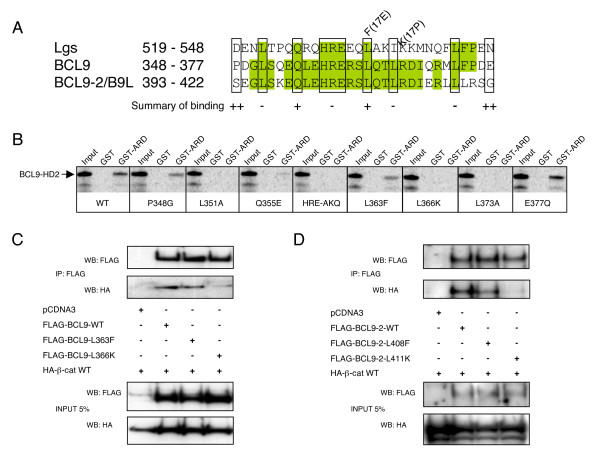
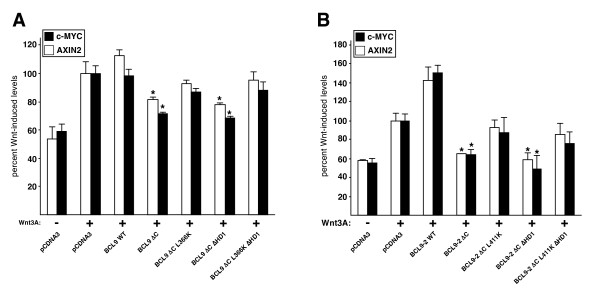
We found that BCL9 is required for efficient beta-catenin-mediated transcription in Wnt-stimulated HEK 293 cells, and in the SW480 colorectal cancer cell line whose Wnt pathway is active due to APC mutation. Dominant-negative mutants of BCL9 indicated that its function depends not only on its beta-catenin ligand, but also on an unknown ligand of its C-terminus. Finally, we show that BCL9 and B9L are both Wnt-inducible genes, hyperexpressed in colorectal cancer cell lines, indicating that they are part of a positive feedback loop.
BCL9 is required for efficient beta-catenin-mediated transcription in human cell lines whose Wnt pathway is active, including colorectal cancer cells, indicating its potential as a drug target in colorectal cancer.
大多数结直肠癌病例是由于APC肿瘤抑制基因或β-连环蛋白自身发生突变,导致Wnt/β-连环蛋白信号通路过度激活所致。该信号通路最近发现的一个组成部分是无腿蛋白(Legless),它在果蝇发育过程中对Wnt诱导的转录至关重要。关于其两个哺乳动物同源物BCL9和B9L/BCL9-2的功能信息有限:与无腿蛋白一样,这些蛋白质与β-连环蛋白结合,RNA干扰介导的B9L/BCL9-2缺失表明,该蛋白在哺乳动物细胞系中是β-连环蛋白介导的有效转录所必需的。目前尚无关于BCL9功能丧失的数据。
我们使用了BCL9显性负性形式的过表达以及RNA干扰介导的缺失,来研究其在Wnt信号通路活性升高的人类细胞系(包括结肠癌细胞)中的功能。
我们发现,在Wnt刺激的HEK 293细胞以及由于APC突变而Wnt信号通路活跃的SW480结肠癌细胞系中,BCL9是β-连环蛋白介导的有效转录所必需的。BCL9的显性负性突变体表明,其功能不仅取决于其β-连环蛋白配体,还取决于其C末端的一个未知配体。最后,我们表明BCL9和B9L都是Wnt诱导基因,在结肠癌细胞系中过度表达,表明它们是正反馈环的一部分。
在Wnt信号通路活跃的人类细胞系(包括结肠癌细胞)中,BCL9是β-连环蛋白介导的有效转录所必需的,这表明它有潜力成为结直肠癌的药物靶点。