Nadler Yasmine, Camp Robert L, Schwartz Candice, Rimm David L, Kluger Harriet M, Kluger Yuval
Department of Medicine and Pathology, Yale University School of Medicine, New Haven, Connecticut, USA.
Clin Cancer Res. 2008 Jul 15;14(14):4455-62. doi: 10.1158/1078-0432.CCR-07-5268.
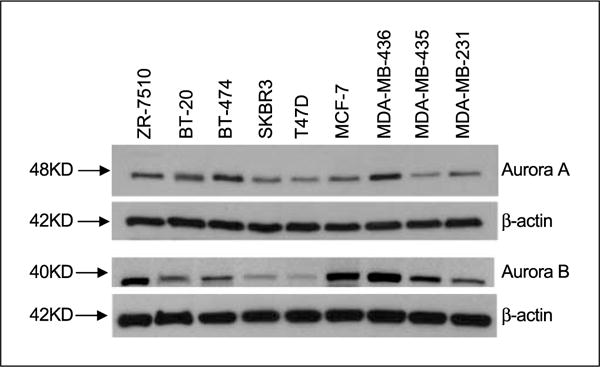
The cell cycle mediators Aurora A and B are targets of drugs currently in clinical development. As with other targeted therapies in breast cancer, response to therapy might be associated with target expression in tumors. We therefore assessed expression of Aurora A and B in breast tumors and studied associations with clinical/pathologic variables.
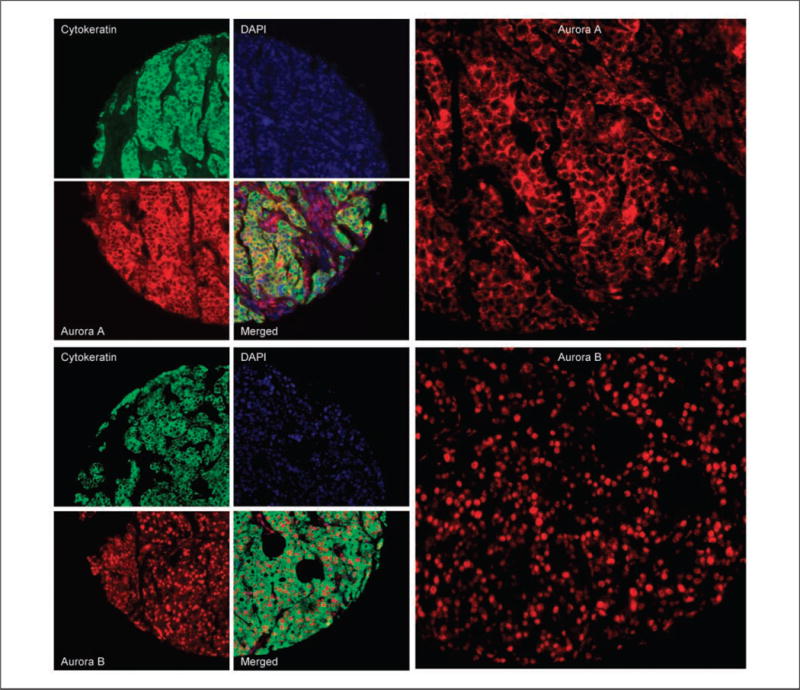
Tissue microarrays containing primary specimens from 638 patients with 15-year follow-up were employed to assess expression of Aurora A and B using our automated quantitative analysis method; we used cytokeratin to define pixels as breast cancer (tumor mask) within the array spot and measured Aurora A and B expression within the mask using Cy5-conjugated antibodies.
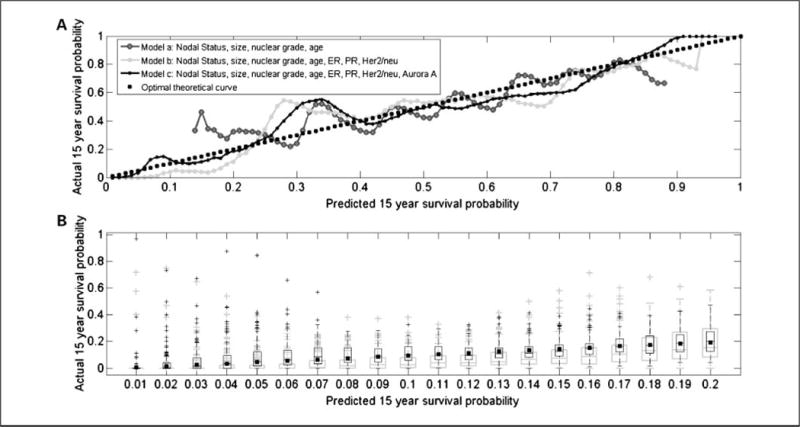
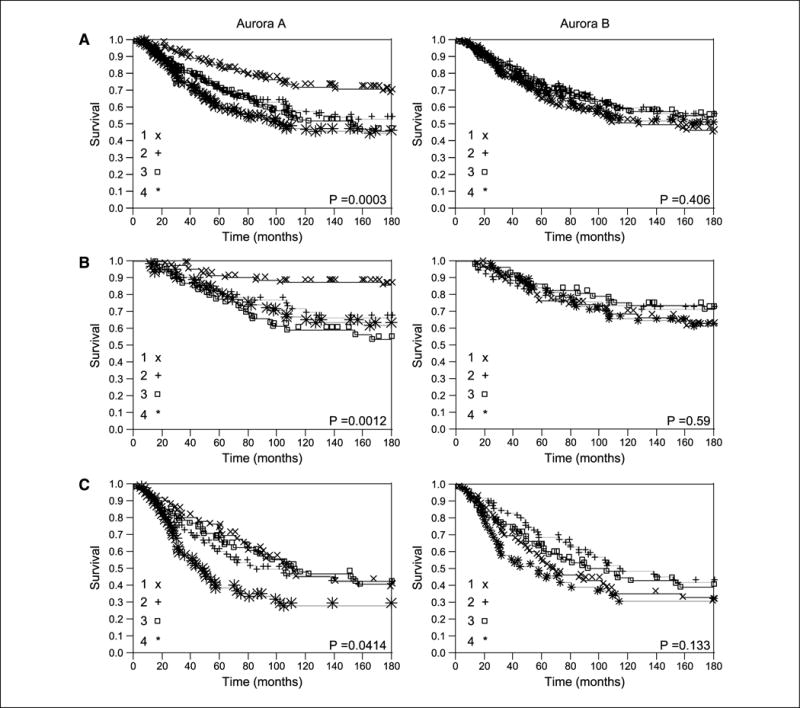
Aurora A and B expression was variable in primary breast tumors. High Aurora A expression was strongly associated with decreased survival (P = 0.0005). On multivariable analysis, it remained an independent prognostic marker. High Aurora A expression was associated with high nuclear grade and high HER-2/neu and progesterone receptor expression. Aurora B expression was not associated with survival.
Aurora A expression defines a population of patients with decreased survival, whereas Aurora B expression does not, suggesting that Aurora A might be the preferred drug target in breast cancer. Aurora A expression in early-stage breast cancer may identify a subset of patients requiring more aggressive or pathway-targeted treatment. Prospective studies are needed to confirm the prognostic role of Aurora A as well as the predictive role of Aurora A expression in patients treated with Aurora A inhibitors.
细胞周期调节因子Aurora A和B是目前正处于临床开发阶段药物的靶点。与乳腺癌的其他靶向治疗一样,治疗反应可能与肿瘤中的靶点表达有关。因此,我们评估了Aurora A和B在乳腺肿瘤中的表达,并研究了其与临床/病理变量的相关性。
使用包含来自638例患者的原发性标本且有15年随访数据的组织微阵列,采用我们的自动定量分析方法评估Aurora A和B的表达;我们使用细胞角蛋白将阵列点内的像素定义为乳腺癌(肿瘤掩膜),并使用Cy5偶联抗体测量掩膜内Aurora A和B的表达。
原发性乳腺肿瘤中Aurora A和B的表达存在差异。Aurora A高表达与生存率降低密切相关(P = 0.0005)。在多变量分析中,它仍然是一个独立的预后标志物。Aurora A高表达与高核分级、高HER-2/neu和孕激素受体表达相关。Aurora B表达与生存率无关。
Aurora A表达确定了一组生存率降低的患者群体,而Aurora B表达则不然,这表明Aurora A可能是乳腺癌中更理想的药物靶点。早期乳腺癌中Aurora A的表达可能识别出需要更积极或通路靶向治疗的患者亚组。需要进行前瞻性研究以证实Aurora A的预后作用以及Aurora A表达在接受Aurora A抑制剂治疗患者中的预测作用。