Hofkamp Luke, Bradley Sarahann, Tresguerres Jesus, Lichtensteiger Walter, Schlumpf Margret, Timms Barry
Division of Basic Biomedical Sciences, Sanford School of Medicine, University of South Dakota, Vermillion, South Dakota 57069, USA.
Environ Health Perspect. 2008 Jul;116(7):867-72. doi: 10.1289/ehp.10983.
Exposure to environmental endocrine disruptors is a potential risk factor for humans. Many of these chemicals have been shown to exhibit disruption of normal cellular and developmental processes in animal models. Ultraviolet (UV) filters used as sunscreens in cosmetics have previously been shown to exhibit estrogenic activity in in vitro and in vivo assays. We examined the effects of two UV filters, 4-methylbenzylidene camphor (4-MBC) and 3-benzylidene camphor (3-BC), in the developing prostate of the fetal rat.
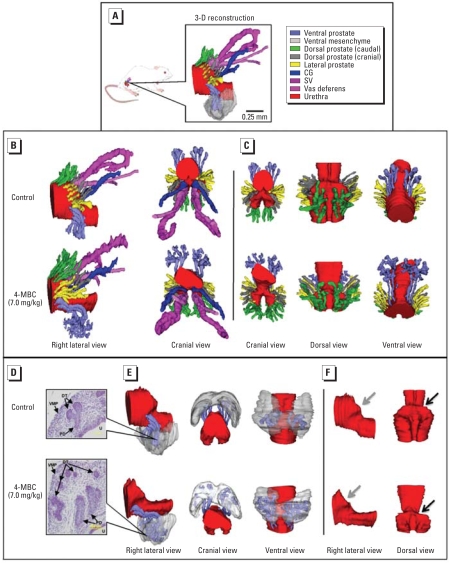
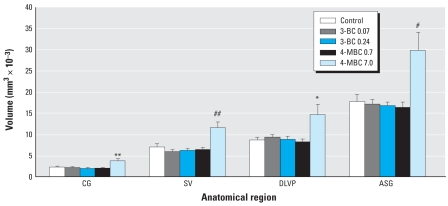
Pregnant Long Evans rats were fed diets containing doses of 4-MBC and 3-BC that resulted in average daily intakes of these chemicals corresponding to the lowest observed adverse effects level (LOAEL) and the no observed adverse effects level (NOAEL) doses in prior developmental toxicity studies. Using digital photographs of serial sections from postnatal day 1 animals, we identified, contoured, and aligned the epithelial ducts from specific regions of the developing prostate, plus the accessory sex glands and calculated the total volume for each region from three-dimensional, surface-rendered models.
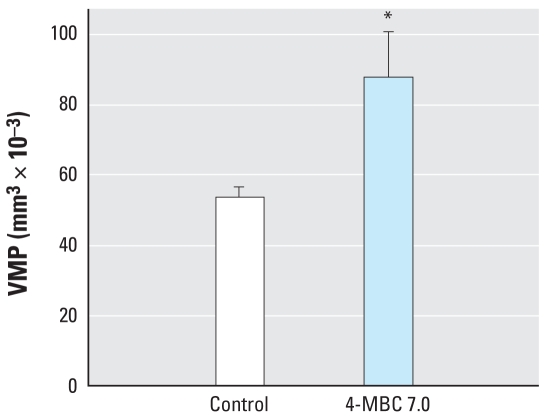
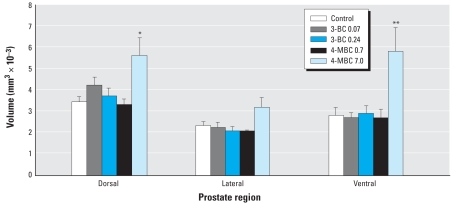
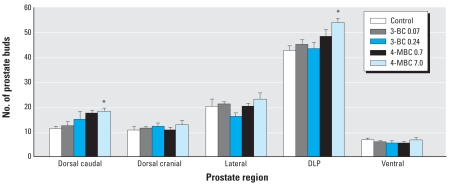
Fetal exposure to 4-MBC (7.0 mg/kg body weight/day) resulted in a significant increase (p < 0.05) in tissue volume in the prostate and accessory sex glands. Treated males exhibited a 62% increase in the number of ducts in the caudal dorsal prostate. Increased distal branching morphogenesis appears to be a consequence of exposure in the ventral region, resulting in a 106% increase in ductal volume.
4-MBC exposure during development of the male reproductive accessory sex glands exhibited classical growth effects associated with estrogenic endocrine disruptors. The different regional responses suggest that the two developmental processes of ductal outgrowth and branching morphogenesis are affected independently by exposure to the environmental chemicals.
接触环境内分泌干扰物对人类而言是一个潜在风险因素。其中许多化学物质已被证明在动物模型中会干扰正常细胞和发育过程。化妆品中用作防晒剂的紫外线(UV)滤光剂此前已在体外和体内试验中显示出雌激素活性。我们研究了两种紫外线滤光剂,4-甲基亚苄基樟脑(4-MBC)和3-亚苄基樟脑(3-BC),对胎鼠发育中的前列腺的影响。
给怀孕的Long Evans大鼠喂食含有一定剂量4-MBC和3-BC的饲料,这些剂量导致这些化学物质的平均每日摄入量与先前发育毒性研究中的最低观察到有害作用水平(LOAEL)和未观察到有害作用水平(NOAEL)剂量相对应。利用出生后第1天动物的连续切片数码照片,我们识别、勾勒并对齐了发育中前列腺特定区域以及附属性腺的上皮导管,并从三维表面渲染模型计算每个区域的总体积。
胎儿暴露于4-MBC(7.0毫克/千克体重/天)导致前列腺和附属性腺的组织体积显著增加(p<0.05)。接受处理的雄性大鼠尾背侧前列腺的导管数量增加了62%。远端分支形态发生增加似乎是腹侧区域暴露的结果,导致导管体积增加了106%。
在雄性生殖附属性腺发育过程中暴露于4-MBC表现出与雌激素内分泌干扰物相关的典型生长效应。不同区域的反应表明,导管生长和分支形态发生这两个发育过程受到环境化学物质暴露的独立影响。