Duval Simon, Ducluzeau Anne-Lise, Nitschke Wolfgang, Schoepp-Cothenet Barbara
Laboratoire de Bioénergétique et Ingénierie des Protéines UPR 9036, Institut de Biologie Structurale et Microbiologie, CNRS, F-13402 Marseille Cedex 20, France.
BMC Evol Biol. 2008 Jul 16;8:206. doi: 10.1186/1471-2148-8-206.
Phylogenies of certain bioenergetic enzymes have proved to be useful tools for deducing evolutionary ancestry of bioenergetic pathways and their relationship to geochemical parameters of the environment. Our previous phylogenetic analysis of arsenite oxidase, the molybdopterin enzyme responsible for the biological oxidation of arsenite to arsenate, indicated its probable emergence prior to the Archaea/Bacteria split more than 3 billion years ago, in line with the geochemical fact that arsenite was present in biological habitats on the early Earth. Respiratory arsenate reductase (Arr), another molybdopterin enzyme involved in microbial arsenic metabolism, serves as terminal oxidase, and is thus situated at the opposite end of bioenergetic electron transfer chains as compared to arsenite oxidase. The evolutionary history of the Arr-enzyme has not been studied in detail so far.
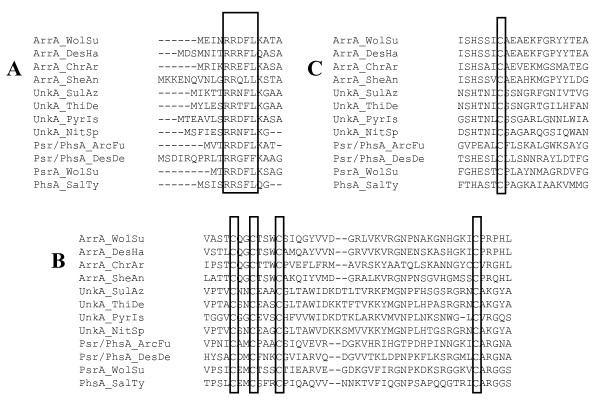
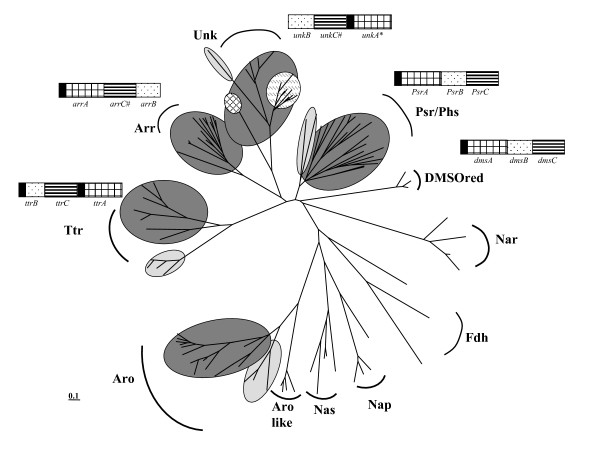
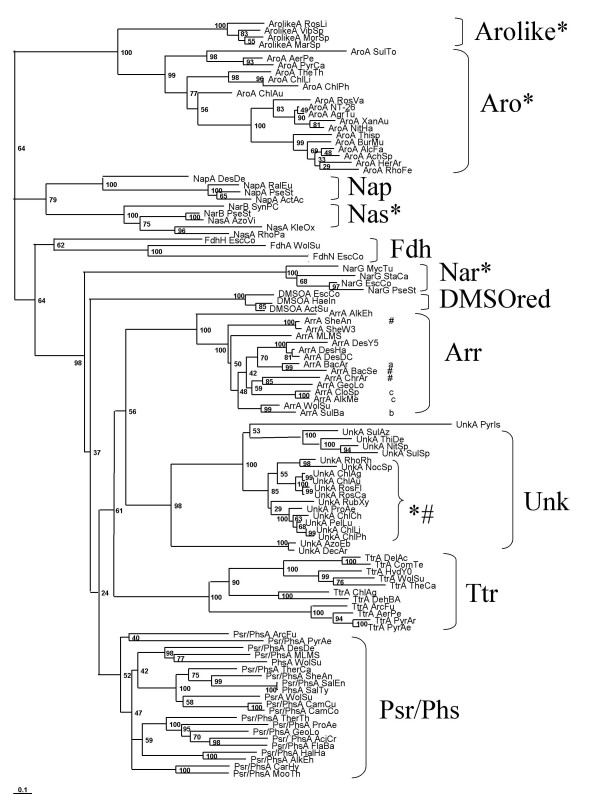
We performed a genomic search of genes related to arrA coding for the molybdopterin subunit. The multiple alignment of the retrieved sequences served to reconstruct a neighbor-joining phylogeny of Arr and closely related enzymes. Our analysis confirmed the previously proposed proximity of Arr to the cluster of polysulfide/thiosulfate reductases but also unravels a hitherto unrecognized clade even more closely related to Arr. The obtained phylogeny strongly suggests that Arr originated after the Bacteria/Archaea divergence in the domain Bacteria, and was subsequently laterally distributed within this domain. It further more indicates that, as a result of accumulation of arsenate in the environment, an enzyme related to polysulfide reductase and not to arsenite oxidase has evolved into Arr.
These findings are paleogeochemically rationalized by the fact that the accumulation of arsenate over arsenite required the increase in oxidation state of the environment brought about by oxygenic photosynthesis.
某些生物能量酶的系统发育已被证明是推断生物能量途径的进化谱系及其与环境地球化学参数关系的有用工具。我们之前对亚砷酸盐氧化酶(一种负责将亚砷酸盐生物氧化为砷酸盐的钼蝶呤酶)的系统发育分析表明,它可能在30多亿年前古菌/细菌分化之前就已出现,这与早期地球上生物栖息地中存在亚砷酸盐这一地球化学事实相符。呼吸性砷酸盐还原酶(Arr)是另一种参与微生物砷代谢的钼蝶呤酶,作为末端氧化酶,因此与亚砷酸盐氧化酶相比,它位于生物能量电子传递链的另一端。到目前为止,Arr酶的进化历史尚未得到详细研究。
我们对与编码钼蝶呤亚基的arrA相关的基因进行了基因组搜索。检索到的序列的多序列比对用于重建Arr和密切相关酶的邻接法系统发育。我们的分析证实了之前提出的Arr与多硫化物/硫代硫酸盐还原酶簇的接近性,但也揭示了一个迄今未被认识的与Arr关系更密切的进化枝。所获得的系统发育强烈表明,Arr起源于细菌域中细菌/古菌分化之后,随后在该域内横向分布。它还进一步表明,由于环境中砷酸盐的积累,一种与多硫化物还原酶相关而非与亚砷酸盐氧化酶相关的酶进化成了Arr。
这些发现从古地球化学角度来看是合理的,因为砷酸盐相对于亚砷酸盐的积累需要有氧光合作用导致的环境氧化态增加。