Kinnersley Paul, Edwards Adrian, Hood Kerry, Ryan Rebecca, Prout Hayley, Cadbury Naomi, MacBeth Fergus, Butow Phyllis, Butler Christopher
Neuadd Meirionydd, School of Medicine, Cardiff University, Cardiff CF14 4XN.
BMJ. 2008 Jul 16;337:a485. doi: 10.1136/bmj.a485.
To assess the effects on patients, clinicians, and the healthcare system of interventions before consultations to help patients or their representatives gather information in consultations by question asking.
Systematic review with meta-analysis.
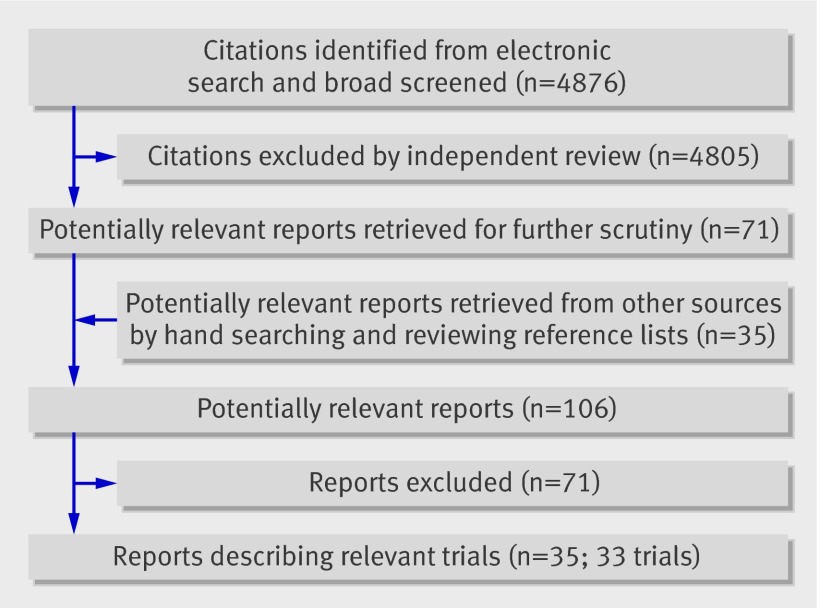
Electronic literature searches of seven databases and hand searching of one journal and bibliographies of relevant articles. Review methods Inclusion criteria included randomised controlled trials.
Primary outcomes were question asking; patients' anxiety, knowledge, and satisfaction; and length of consultation.
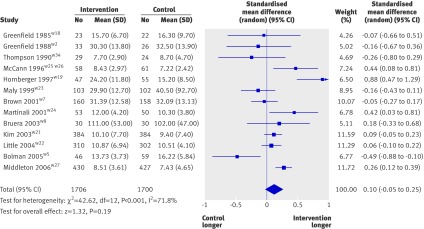
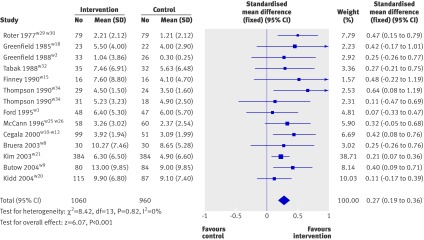
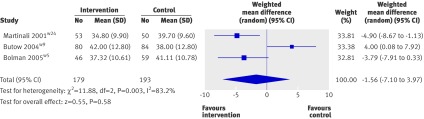
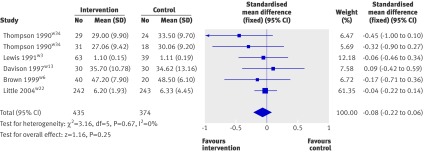
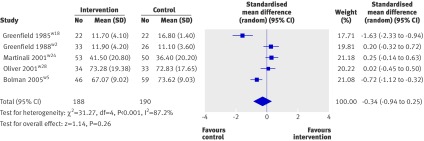
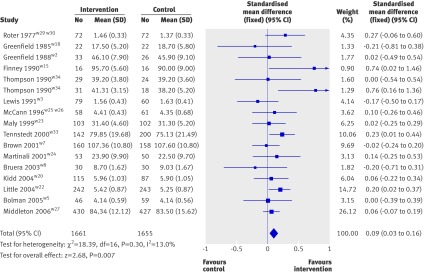
33 randomised trials of variable quality involving 8244 patients were identified. A few studies showed positive effects. Meta-analyses showed small and statistically significantly increases in question asking (standardised mean difference 0.27, 95% confidence interval 0.19 to 0.36) and patients' satisfaction (0.09, 0.03 to 0.16). Non-statistically significant changes occurred in patients' anxiety before consultations (weighted mean difference -1.56, -7.10 to 3.97), patients' anxiety after consultations (standardised mean difference -0.08, -0.22 to 0.06), patients' knowledge (-0.34, -0.94 to 0.25), and length of consultation (0.10, -0.05 to 0.25). Interventions comprising written materials had similar effects on question asking, consultation length, and patients' satisfaction as those comprising the coaching of patients. Interventions with additional training of clinicians had little further effect than those targeted at patients alone for patients' satisfaction and consultation length.
Interventions for patients before consultations produce small benefits for patients. This may be because patients and clinicians have established behaviours in consultations that are difficult to change. Alternatively small increases in question asking may not be sufficient to make notable changes to other outcomes.
评估在会诊前进行干预对患者、临床医生及医疗保健系统的影响,这些干预旨在帮助患者或其代表通过提问在会诊中收集信息。
系统评价并进行荟萃分析。
对七个数据库进行电子文献检索,手工检索一份期刊及相关文章的参考文献。综述方法纳入标准包括随机对照试验。
主要结局为提问情况;患者的焦虑程度、知识水平及满意度;以及会诊时长。
共识别出33项质量参差不齐的随机试验,涉及8244名患者。少数研究显示出积极效果。荟萃分析表明,提问情况(标准化均数差0.27,95%置信区间0.19至0.36)和患者满意度(0.09,0.03至0.16)有小幅且具有统计学意义的增加。会诊前患者的焦虑程度(加权均数差-1.56,-7.10至3.97)、会诊后患者的焦虑程度(标准化均数差-0.08,-0.22至0.06)、患者的知识水平(-0.34,-0.94至0.25)以及会诊时长(0.10,-0.05至0.25)出现了无统计学意义的变化。包含书面材料的干预措施在提问情况、会诊时长和患者满意度方面的效果与对患者进行指导的干预措施相似。针对临床医生进行额外培训的干预措施,在患者满意度和会诊时长方面,相比仅针对患者的干预措施,进一步改善的效果甚微。
会诊前对患者进行的干预对患者有微小益处。这可能是因为患者和临床医生在会诊中已形成难以改变的行为模式。或者,提问的小幅增加可能不足以对其他结局产生显著改变。