Huang Zheng, Xu Heping, Meyers Arlen D, Musani Ali I, Wang Luowei, Tagg Randall, Barqawi Al B, Chen Yang K
University of Colorado Denver, Aurora Campus, CO, USA.
Technol Cancer Res Treat. 2008 Aug;7(4):309-20. doi: 10.1177/153303460800700405.
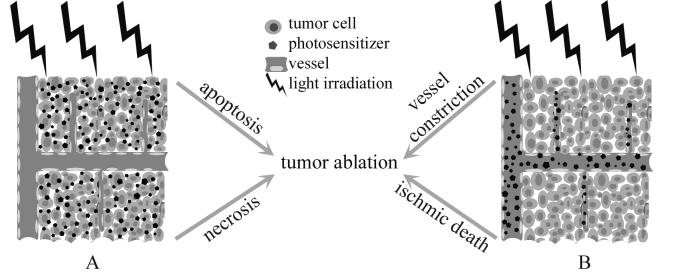
Photodynamic therapy (PDT) involves the administration of photosensitizer followed by local illumination with visible light of specific wavelength(s). In the presence of oxygen molecules, the light illumination of photosensitizer can lead to a series of photochemical reactions and consequently the generation of cytotoxic species. The quantity and location of PDT-induced cytotoxic species determine the nature and consequence of PDT. Much progress has been seen in both basic research and clinical application in recent years. Although the majority of approved PDT clinical protocols have primarily been used for the treatment of superficial lesions of both malignant and non-malignant diseases, interstitial PDT for the ablation of deep-seated solid tumors are now being investigated worldwide. The complexity of the geometry and non-homogeneity of solid tumor pose a great challenge on the implementation of minimally invasive interstitial PDT and the estimation of PDT dosimetry. This review will discuss the recent progress and technical challenges of various forms of interstitial PDT for the treatment of parenchymal and/or stromal tissues of solid tumors.
光动力疗法(PDT)包括给予光敏剂,随后用特定波长的可见光进行局部照射。在氧分子存在的情况下,光敏剂的光照可引发一系列光化学反应,进而产生细胞毒性物质。PDT诱导的细胞毒性物质的数量和位置决定了PDT的性质和后果。近年来,基础研究和临床应用都取得了很大进展。尽管大多数已获批的PDT临床方案主要用于治疗恶性和非恶性疾病的浅表病变,但目前全球正在研究用于深部实体瘤消融的间质PDT。实体瘤几何形状的复杂性和非均质性对微创间质PDT的实施以及PDT剂量学的估计构成了巨大挑战。本综述将讨论各种形式的间质PDT在治疗实体瘤实质和/或间质组织方面的最新进展和技术挑战。