Driemeyer Joenna, Boyke Janina, Gaser Christian, Büchel Christian, May Arne
Department of Systems Neuroscience, University of Hamburg (UKE), Hamburg, Germany.
PLoS One. 2008 Jul 23;3(7):e2669. doi: 10.1371/journal.pone.0002669.
Recently, activation-dependant structural brain plasticity in humans has been demonstrated in adults after three months of training a visio-motor skill. Learning three-ball cascade juggling was associated with a transient and highly selective increase in brain gray matter in the occipito-temporal cortex comprising the motion sensitive area hMT/V5 bilaterally. However, the exact time-scale of usage-dependant structural changes occur is still unknown. A better understanding of the temporal parameters may help to elucidate to what extent this type of cortical plasticity contributes to fast adapting cortical processes that may be relevant to learning.
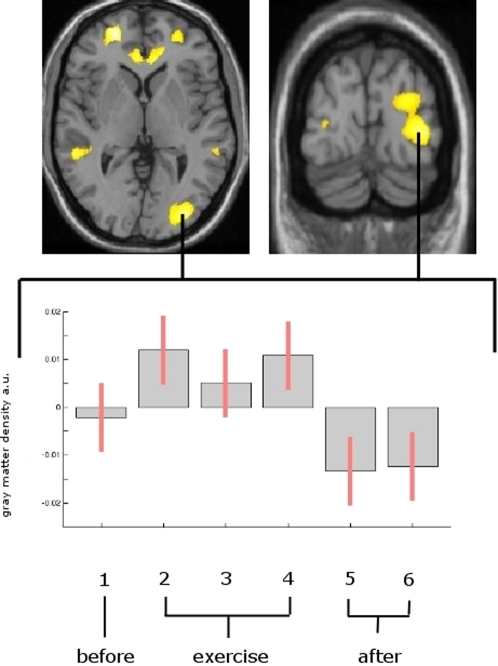
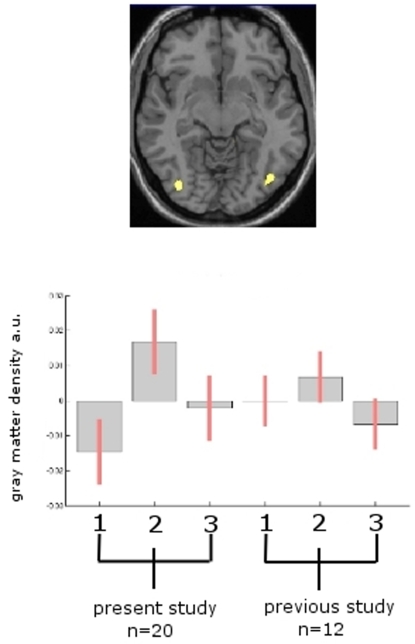
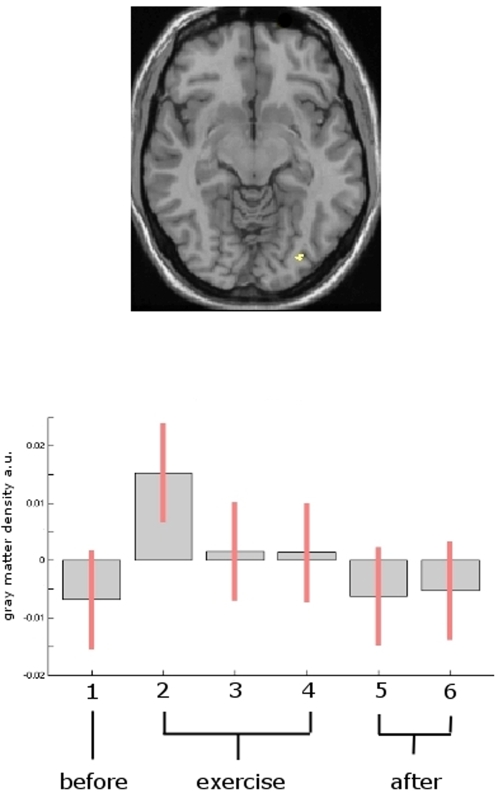
Using a 3 Tesla scanner and monitoring whole brain structure we repeated and extended our original study in 20 healthy adult volunteers, focussing on the temporal aspects of the structural changes and investigated whether these changes are performance or exercise dependant. The data confirmed our earlier observation using a mean effects analysis and in addition showed that learning to juggle can alter gray matter in the occipito-temporal cortex as early as after 7 days of training. Neither performance nor exercise alone could explain these changes.
We suggest that the qualitative change (i.e. learning of a new task) is more critical for the brain to change its structure than continued training of an already-learned task.
最近,在成年人经过三个月视觉运动技能训练后,已证明人类大脑存在依赖激活的结构可塑性。学习三球级联杂耍与双侧枕颞叶皮质(包括运动敏感区域hMT/V5)的脑灰质短暂且高度选择性增加有关。然而,使用依赖的结构变化发生的确切时间尺度仍不清楚。更好地理解时间参数可能有助于阐明这种类型的皮质可塑性在多大程度上有助于快速适应可能与学习相关的皮质过程。
我们使用3特斯拉扫描仪并监测全脑结构,在20名健康成年志愿者中重复并扩展了我们最初的研究,重点关注结构变化的时间方面,并研究这些变化是依赖于表现还是锻炼。数据通过平均效应分析证实了我们早期的观察结果,此外还表明,早在训练7天后,学习杂耍就能改变枕颞叶皮质的灰质。单独的表现或锻炼都无法解释这些变化。
我们认为,定性变化(即学习新任务)对大脑改变其结构比持续训练已学任务更为关键。