Schulz Emily, Holt Cheryl L, Caplan Lee, Blake Victor, Southward Penny, Buckner Ayanna, Lawrence Hope
School of Medicine, Division of Preventive Medicine, University of Alabama at Birmingham, 1717 11th Avenue South, Birmingham, AL 35294-4410, USA.
J Cancer Surviv. 2008 Jun;2(2):104-15. doi: 10.1007/s11764-008-0050-5. Epub 2008 Apr 30.
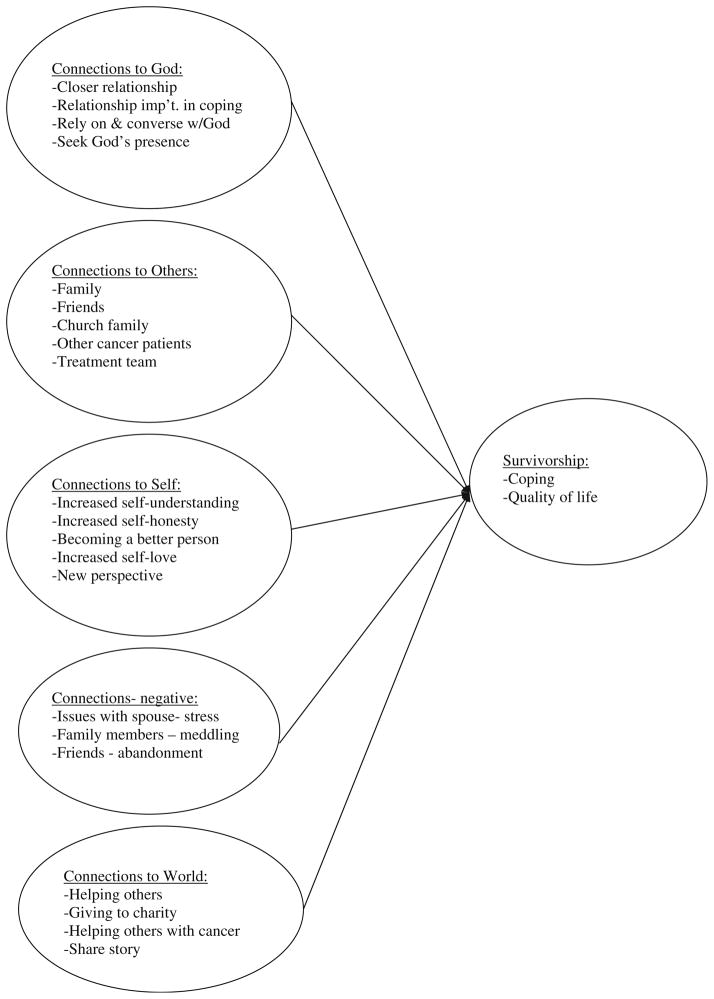
This study used qualitative methods to examine whether, and if so how, African American cancer survivors use spirituality in coping with the disease. Spirituality was defined using a model involving connectedness to self, others, a higher power, and the world.
Twenty-three African American patients with various forms of cancer were recruited from physician offices and completed 1-1.5 h interviews. Data were coded by multiple coders using an inductive process and open-coding.
Themes that emerged included, but were not limited to the aforementioned types of connectedness, one theme being connections to God. Given the important role of social support in the cancer experience, participants also emphasized their connectedness to others, which is in support of the spirituality model. Participants also articulated the notion that connections with others were not always positive, indicating that some perceived certain connections as having a detrimental impact on their well-being. Participants also expressed the desire to share their cancer story with others, often gained a new perspective on life, and obtained new self-understanding as a result of their illness experience.
DISCUSSION/CONCLUSIONS: Findings indicate that African Americans perceive that spirituality plays a strong role in their cancer coping and survivorship. Spirituality may address a human need for certitude in crisis. Further research is warranted for model testing, and to examine the role of spirituality in cancer coping among those of different backgrounds and cancer types/stages.
These themes may have utility for the development of support interventions for cancer survivors.
本研究采用定性方法,以检验非裔美国癌症幸存者是否以及如何运用精神信仰来应对疾病。精神信仰是根据一个涉及与自我、他人、更高力量及世界的联系的模型来定义的。
从医生办公室招募了23名患有各种癌症的非裔美国患者,并完成了1至1.5小时的访谈。数据由多名编码员采用归纳法和开放式编码进行编码。
出现的主题包括但不限于上述各类联系,其中一个主题是与上帝的联系。鉴于社会支持在癌症经历中的重要作用,参与者还强调了他们与他人的联系,这支持了精神信仰模型。参与者还明确表示,与他人的联系并不总是积极的,这表明有些人认为某些联系对他们的幸福有不利影响。参与者还表达了与他人分享自己癌症经历的愿望,他们常常因此对生活有了新的认识,并获得了新的自我认知。
讨论/结论:研究结果表明,非裔美国人认为精神信仰在他们应对癌症和生存过程中发挥着重要作用。精神信仰可能满足了人类在危机中对确定性的需求。有必要进行进一步研究以测试该模型,并考察精神信仰在不同背景以及不同癌症类型/阶段的人群应对癌症过程中的作用。
这些主题可能有助于为癌症幸存者制定支持性干预措施。