Chandel Anil, Dhindsa Sandeep, Topiwala Shehzad, Chaudhuri Ajay, Dandona Paresh
Division of Endocrinology, Diabetes and Metabolism, State University of New York at Buffalo, Buffalo, New York, USA.
Diabetes Care. 2008 Oct;31(10):2013-7. doi: 10.2337/dc08-0851. Epub 2008 Jul 23.
We have previously shown that hypogonadotrophic hypogonadism is common in middle-aged patients with type 2, but not with type 1, diabetes. We have now investigated the total and free testosterone concentrations in young (aged 18-35 years) type 1 and type 2 diabetic patients.
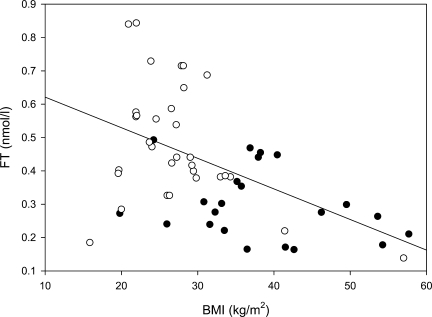
In this study carried out in a tertiary referral center, serum concentrations of total and free testosterone were measured in 38 type 1 diabetic (mean age 26.45 +/- 0.89 years) and 24 type 2 diabetic (mean age 27.87 +/- 0.97 years) subjects. The mean BMI of type 1 and type 2 diabetic patients was 27.41 +/- 1.18 and 38.55 +/- 2.04 kg/m(2), respectively (P < 0.001).
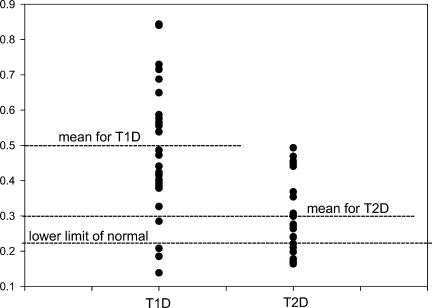
The mean total testosterone concentration of type 1 and type 2 diabetic patients was 22.89 +/- 1.23 and 11.14 +/- 0.99 nmol/l, respectively (P < 0.001). The mean free testosterone concentration of type 1 and type 2 diabetic patients was 0.489 +/- 0.030 and 0.296 +/- 0.022 nmol/l, respectively (P < 0.001). Eight of 24 (33%) type 2 diabetic patients had subnormal free testosterone concentrations (<0.225 nmol/l). Using an age-based reference range, 14 of 24 (58%) type 2 diabetic patients had low free testosterone concentrations (<0.278 nmol/l). Three of 38 (8%) type 1 diabetic patients had free testosterone concentrations below the lower limit of normal (P = 0.02 when compared with type 2 diabetes). Luteinizing hormone (LH) and follicle-stimulating hormone (FSH) concentrations in type 2 diabetic patients with low free testosterone concentrations were in the normal range and were similar to those in type 1 diabetic patients.
Young type 2 diabetic patients have significantly lower plasma concentrations of total and free testosterone and inappropriately low LH and FSH concentrations with a very high prevalence of hypogonadotrophic hypogonadism, when compared with type 1 diabetic patients of a comparable age. The potential implications for their sexual and reproductive function during prime reproductive years are profound.
我们之前已经表明,低促性腺激素性性腺功能减退在中年2型糖尿病患者中很常见,但在1型糖尿病患者中并非如此。我们现在研究了年轻(18 - 35岁)的1型和2型糖尿病患者的总睾酮和游离睾酮浓度。
在一家三级转诊中心进行的这项研究中,测量了38名1型糖尿病患者(平均年龄26.45 +/- 0.89岁)和24名2型糖尿病患者(平均年龄27.87 +/- 0.97岁)的血清总睾酮和游离睾酮浓度。1型和2型糖尿病患者的平均体重指数分别为27.41 +/- 1.18和38.55 +/- 2.04 kg/m²(P < 0.001)。
1型和2型糖尿病患者的平均总睾酮浓度分别为22.89 +/- 1.23和11.14 +/- 0.99 nmol/l(P < 0.001)。1型和2型糖尿病患者的平均游离睾酮浓度分别为0.489 +/- 0.030和0.296 +/- 0.022 nmol/l(P < 0.001)。24名2型糖尿病患者中有8名(33%)游离睾酮浓度低于正常水平(<0.225 nmol/l)。使用基于年龄的参考范围,24名2型糖尿病患者中有14名(58%)游离睾酮浓度较低(<0.278 nmol/l)。38名1型糖尿病患者中有3名(8%)游离睾酮浓度低于正常下限(与2型糖尿病相比,P = 0.02)。游离睾酮浓度低的2型糖尿病患者的促黄体生成素(LH)和促卵泡生成素(FSH)浓度在正常范围内,与1型糖尿病患者相似。
与年龄相当的1型糖尿病患者相比,年轻的2型糖尿病患者血浆总睾酮和游离睾酮浓度显著降低,LH和FSH浓度异常低,低促性腺激素性性腺功能减退的患病率非常高。这对他们在生殖黄金时期的性和生殖功能可能产生深远影响。