Hoffmann Steve, Cepok Sabine, Grummel Verena, Lehmann-Horn Klaus, Hackermüller Jörg, Stadler Peter F, Hartung Hans-Peter, Berthele Achim, Deisenhammer Florian, Wassmuth Ralf, Hemmer Bernhard
Department of Bioinformatics, Interdisciplinary Center for Bioinformatics, University Leipzig, Leipzig, Germany.
Am J Hum Genet. 2008 Aug;83(2):219-27. doi: 10.1016/j.ajhg.2008.07.006. Epub 2008 Jul 24.
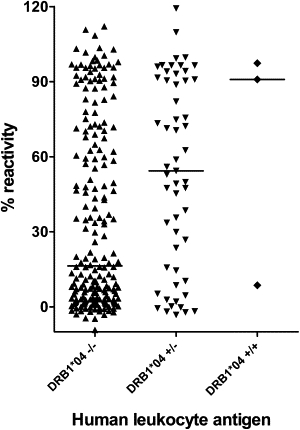
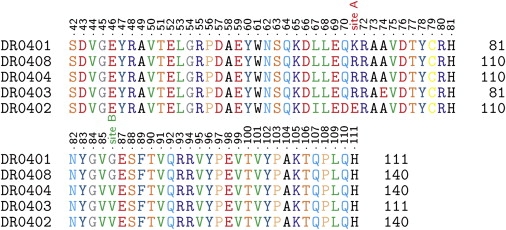
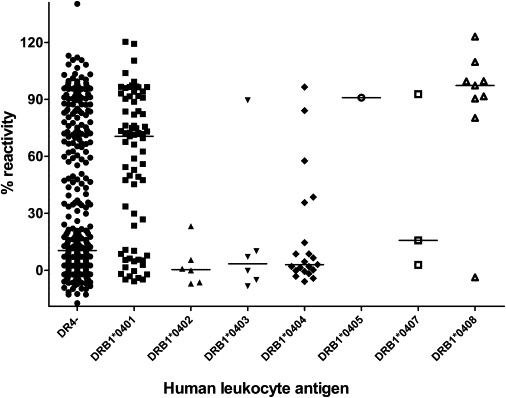
The formation of antibodies to interferon-beta (IFN-beta), a protein-based disease-modifying agent for multiple sclerosis (MS), is a problem in clinical practice. These antibodies may neutralize the biological effects of the protein drug, potentially decreasing its therapeutic effects. By high-resolution HLA class I and II typing we identified two HLA class II alleles associated with the development of antibodies to IFN-beta. In two independent continuous and binary-trait association studies, HLA-DRB10401 and HLA-DRB10408 (odds ratio: 5.15)--but not other HLA alleles--were strongly associated with the development of binding and neutralizing antibodies to IFN-beta. The associated HLA-DRB104 alleles differ from nonassociated HLA-DRB104 alleles by a glycine-to-valine substitution in position 86 of the epitope-binding alpha-helix of the HLA class II molecule. The peptide-binding motif of HLA-DRB1*0401 and *0408 might promote binding and presentation of an immunogenic peptide, which may eventually break T cell tolerance and facilitate antibody development to IFN-beta. In summary, we identified genetic factors determining the immunogenicity of IFN-beta, a protein-based disease-modifying agent for the treatment of MS.
干扰素β(IFN-β)是一种用于治疗多发性硬化症(MS)的基于蛋白质的疾病改善药物,在临床实践中,针对它产生抗体是一个问题。这些抗体可能会中和这种蛋白质药物的生物学效应,从而可能降低其治疗效果。通过高分辨率的HLA I类和II类分型,我们鉴定出了两个与IFN-β抗体产生相关的HLA II类等位基因。在两项独立的连续性和二元性状关联研究中,HLA-DRB10401和HLA-DRB10408(优势比:5.15)——而非其他HLA等位基因——与IFN-β结合和中和抗体的产生密切相关。相关的HLA-DRB104等位基因与非相关的HLA-DRB104等位基因的区别在于,HLA II类分子表位结合α螺旋第86位上的甘氨酸被缬氨酸取代。HLA-DRB10401和0408的肽结合基序可能会促进免疫原性肽的结合和呈递,这最终可能会打破T细胞耐受性,并促进针对IFN-β的抗体产生。总之,我们鉴定出了决定IFN-β免疫原性的遗传因素,IFN-β是一种用于治疗MS的基于蛋白质的疾病改善药物。