Link Jenny, Lundkvist Ryner Malin, Fink Katharina, Hermanrud Christina, Lima Izaura, Brynedal Boel, Kockum Ingrid, Hillert Jan, Fogdell-Hahn Anna
Department of Clinical Neuroscience, Karolinska Institutet, Stockholm, Sweden.
Institute of Environmental Medicine, Karolinska Institutet, Stockholm, Sweden.
PLoS One. 2014 Mar 7;9(3):e90479. doi: 10.1371/journal.pone.0090479. eCollection 2014.
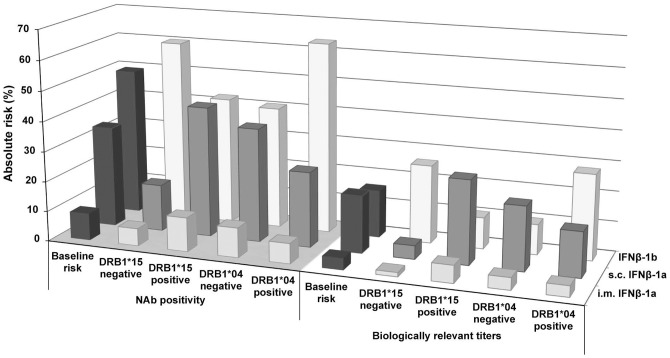
A significant proportion of patients with multiple sclerosis who receive interferon beta (IFNβ) therapy develop neutralizing antibodies (NAbs) that reduce drug efficacy. To investigate if HLA class I and II alleles are associated with development of NAbs against IFNβ we analyzed whether NAb status and development of NAb titers high enough to be biologically relevant (>150 tenfold reduction units/ml) correlated with the HLA allele group carriage in a cohort of 903 Swedish patients with multiple sclerosis treated with either intramuscular IFNβ-1a, subcutaneous IFNβ-1a or subcutaneous IFNβ-1b. Carriage of HLA-DRB115 was associated with increased risk of developing NAbs and high NAb titers. After stratification based on type of IFNβ preparation, HLA-DRB115 carriage was observed to increase the risk of developing NAbs as well as high NAb titers against both subcutaneous and intramuscular IFNβ-1a. Furthermore, in patients receiving subcutaneous IFNβ-1a carriage of HLA-DQA105 decreased the risk for high NAb titers. In IFNβ-1b treated patients, HLA-DRB104 increased the risk of developing high NAb titers, and in a subgroup analysis of DRB104 alleles the risk for NAbs was increased in DRB104:01 carriers. In conclusion, there is a preparation-specific genetically determined risk to develop NAbs against IFNβ high enough to be clinically relevant in treatment decisions for patients with multiple sclerosis if confirmed in future studies. However, choice of IFNβ preparation still remains the single most significant determinant for the risk of developing NAbs.
接受β-干扰素(IFNβ)治疗的多发性硬化症患者中,有很大一部分会产生中和抗体(NAbs),从而降低药物疗效。为了研究人类白细胞抗原(HLA)I类和II类等位基因是否与抗IFNβ的NAbs产生有关,我们分析了在一组903例接受肌肉注射IFNβ-1a、皮下注射IFNβ-1a或皮下注射IFNβ-1b治疗的瑞典多发性硬化症患者中,NAb状态以及高到具有生物学相关性的NAb滴度(>150倍降低单位/毫升)的产生是否与HLA等位基因组携带情况相关。携带HLA-DRB115与产生NAbs及高NAb滴度的风险增加有关。根据IFNβ制剂类型进行分层后,观察到携带HLA-DRB115会增加产生NAbs以及针对皮下和肌肉注射IFNβ-1a的高NAb滴度的风险。此外,在接受皮下注射IFNβ-1a的患者中,携带HLA-DQA105会降低高NAb滴度的风险。在接受IFNβ-1b治疗的患者中,HLA-DRB104会增加产生高NAb滴度的风险,并且在DRB104等位基因的亚组分析中,DRB104:01携带者产生NAbs的风险增加。总之,如果在未来研究中得到证实,对于多发性硬化症患者的治疗决策而言,存在一种由基因决定的、与制剂相关的风险,即产生高到具有临床相关性的抗IFNβ的NAbs。然而,IFNβ制剂的选择仍然是产生NAbs风险的最重要单一决定因素。