Gil Mariana, Menzel Randolf, De Marco Rodrigo J
Free University of Berlin, Department of Biology/Chemistry/Pharmacy, Institute of Biology/Neurobiology, Berlin, Germany.
PLoS One. 2008 Jul 30;3(7):e2810. doi: 10.1371/journal.pone.0002810.
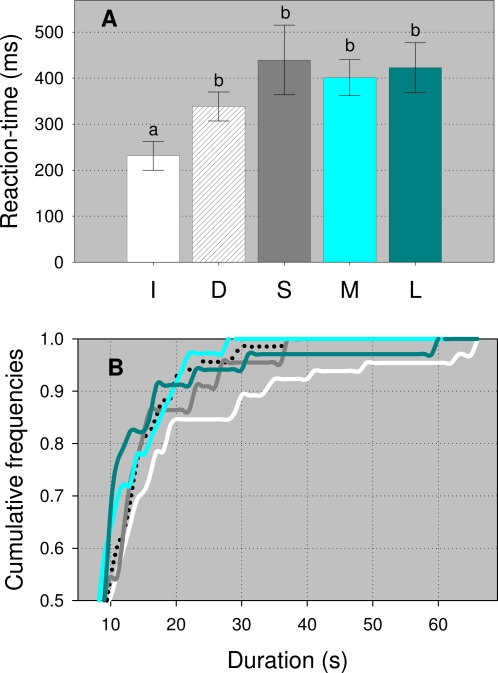
We asked whether and how a sequence of a honeybee's experience with different reward magnitudes changes its subsequent unconditioned proboscis extension response (PER) to sucrose stimulation of the antennae, 24 hours after training, in the absence of reward, and under otherwise similar circumstances. We found that the bees that had experienced an increasing reward schedule extended their probosces earlier and during longer periods in comparison to bees that had experienced either decreasing or constant reward schedules, and that these effects at a later time depend upon the activation of memories formed on the basis of a specific property of the experienced reward, namely, that its magnitude increased over time. An anticipatory response to reward is typically thought of as being rooted in a subject's expectations of reward. Therefore our results make us wonder to what extent a long-term 'anticipatory' adjustment of a honeybee's PER is based upon an expectation of reward. Further experiments will aim to elucidate the neural substrates underlying reward anticipation in harnessed honeybees.
我们研究了在训练24小时后,无奖励且其他条件相似的情况下,蜜蜂对不同奖励量的体验序列是否以及如何改变其随后对触角蔗糖刺激的非条件伸吻反射(PER)。我们发现,与经历过奖励量递减或恒定奖励序列的蜜蜂相比,经历过奖励量递增序列的蜜蜂伸吻更早且持续时间更长,并且这些后期效应取决于基于所经历奖励的特定属性(即奖励量随时间增加)形成的记忆的激活。对奖励的预期反应通常被认为源于主体对奖励的期望。因此,我们的结果让我们思考蜜蜂的PER的长期“预期”调整在多大程度上基于对奖励的期望。进一步的实验旨在阐明被束缚蜜蜂奖励预期背后的神经基础。