Kalaria Raj N, Maestre Gladys E, Arizaga Raul, Friedland Robert P, Galasko Doug, Hall Kathleen, Luchsinger José A, Ogunniyi Adesola, Perry Elaine K, Potocnik Felix, Prince Martin, Stewart Robert, Wimo Anders, Zhang Zhen-Xin, Antuono Piero
Institute for Ageing and Health, Newcastle General Hospital, Newcastle upon Tyne, UK.
Lancet Neurol. 2008 Sep;7(9):812-26. doi: 10.1016/S1474-4422(08)70169-8. Epub 2008 Jul 28.
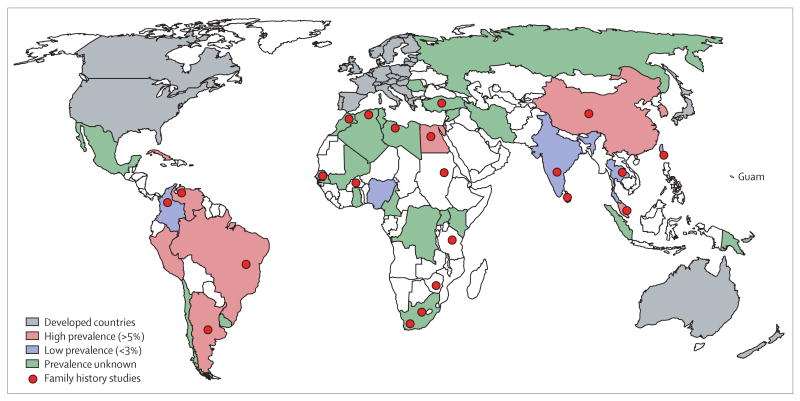
Despite mortality due to communicable diseases, poverty, and human conflicts, dementia incidence is destined to increase in the developing world in tandem with the ageing population. Current data from developing countries suggest that age-adjusted dementia prevalence estimates in 65 year olds are high (>or=5%) in certain Asian and Latin American countries, but consistently low (1-3%) in India and sub-Saharan Africa; Alzheimer's disease accounts for 60% whereas vascular dementia accounts for approximately 30% of the prevalence. Early-onset familial forms of dementia with single-gene defects occur in Latin America, Asia, and Africa. Illiteracy remains a risk factor for dementia. The APOE epsilon4 allele does not influence dementia progression in sub-Saharan Africans. Vascular factors, such as hypertension and type 2 diabetes, are likely to increase the burden of dementia. Use of traditional diets and medicinal plant extracts might aid prevention and treatment. Dementia costs in developing countries are estimated to be US$73 billion yearly, but care demands social protection, which seems scarce in these regions.
尽管存在传染病、贫困和人类冲突导致的死亡情况,但随着发展中世界人口老龄化,痴呆症发病率注定会上升。来自发展中国家的现有数据表明,在某些亚洲和拉丁美洲国家,65岁人群中经年龄调整后的痴呆症患病率估计很高(≥5%),但在印度和撒哈拉以南非洲地区一直很低(1%-3%);阿尔茨海默病占患病率的60%,而血管性痴呆约占30%。拉丁美洲、亚洲和非洲出现了具有单基因缺陷的早发性家族性痴呆形式。文盲仍然是痴呆症的一个风险因素。APOE ε4等位基因对撒哈拉以南非洲人的痴呆症进展没有影响。高血压和2型糖尿病等血管因素可能会增加痴呆症负担。食用传统饮食和药用植物提取物可能有助于预防和治疗。发展中国家痴呆症的年成本估计为730亿美元,但护理需要社会保护,而这些地区的社会保护似乎很匮乏。