Zhen Huiling, Lawson Andrew B, McDermott Suzanne, Lamichhane Archana Pande, Aelion Marjorie
Department of Epidemiology & Biostatistics, University of South Carolina, Columbia, SC 292029, USA.
Geospat Health. 2008 May;2(2):173-82. doi: 10.4081/gh.2008.241.
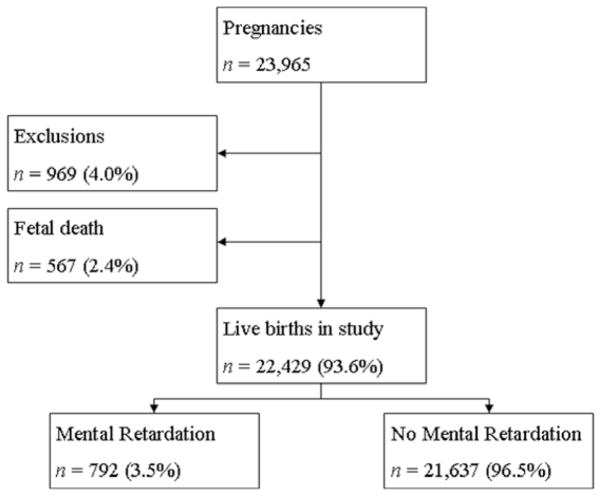
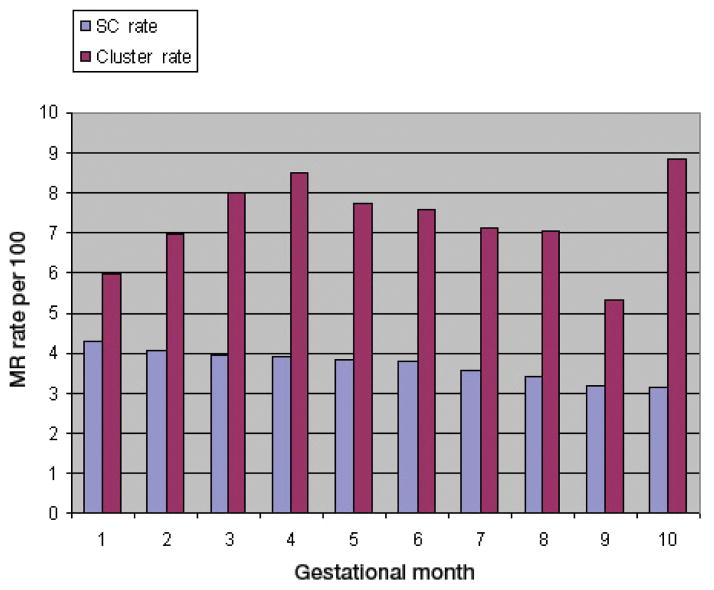
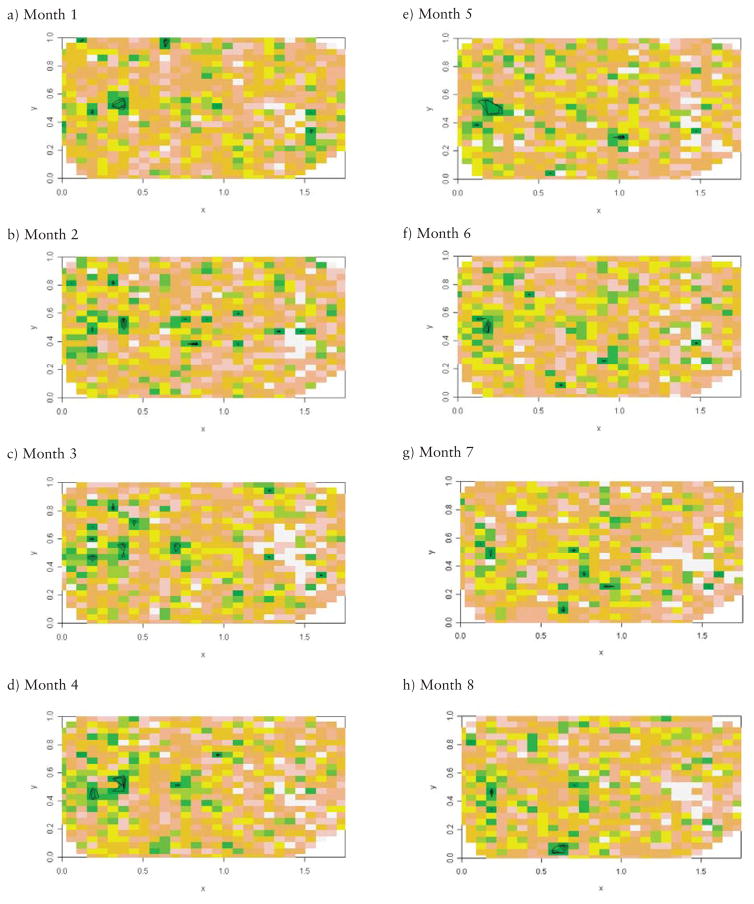
Spatial analysis is useful for the identification of areas of elevated risk of adverse health outcomes and generation of hypotheses. Identification of clusters based on maternal residence during pregnancy provides an important tool to investigate risk exposures. However, even though mental retardation (MR) is a substantial public health problem, there are no previous analyses of spatial clustering of childhood MR using individual case data. In this paper, we examine the use of the Bayesian hierarchical modeling approach in the analysis of MR clustering. We used data from South Carolina Medicaid and birth certificates, in which address codes for each month of pregnancy are available. MR cases with unknown cause were identified in the study population. A Bayesian local likelihood cluster modeling technique was applied to compute the relative risk of MR and its corresponding P-value for each geo-coded location, and the P-value surface was contoured as a heat image to identify the MR clusters. The characteristics of the study population were analyzed using chi-square tests and the results confirm that clustering does occur for MR. The shapes of the identified MR clusters were found to be irregular and the observed MR rate in the identified MR cluster area was found to be double the rate for the larger South Carolina region. The descriptive analysis of study population characteristics showed that the children with MR were more likely to be male and had mothers who were older than 34 years at the time of birth as well as being African American, preterm and of low birth weight compared to children without MR.
空间分析对于识别不良健康结局风险升高的区域以及生成假设很有用。基于孕期母亲居住地识别聚集区为调查风险暴露提供了一个重要工具。然而,尽管智力发育迟缓(MR)是一个重大的公共卫生问题,但此前尚无使用个体病例数据对儿童MR进行空间聚集分析的研究。在本文中,我们研究了贝叶斯分层建模方法在MR聚集分析中的应用。我们使用了南卡罗来纳州医疗补助计划和出生证明的数据,其中提供了孕期每个月的地址编码。在研究人群中识别出病因不明的MR病例。应用贝叶斯局部似然聚集建模技术计算每个地理编码位置的MR相对风险及其相应的P值,并将P值表面绘制成热图像以识别MR聚集区。使用卡方检验分析研究人群的特征,结果证实MR确实存在聚集现象。发现所识别出的MR聚集区形状不规则,且在所识别出的MR聚集区观察到的MR发生率是南卡罗来纳州较大区域发生率的两倍。对研究人群特征的描述性分析表明,与无MR的儿童相比,患有MR的儿童更可能为男性,其母亲在分娩时年龄大于34岁,并且是非洲裔美国人、早产且出生体重低。