Forbes Monica M, Steinberg Ryan L, O'Brien William D
Department of Bioengineering, University of Illinois at Urbana-Champaign, Urbana, IL, USA.
Ultrasound Med Biol. 2008 Dec;34(12):2009-18. doi: 10.1016/j.ultrasmedbio.2008.05.003. Epub 2008 Aug 9.
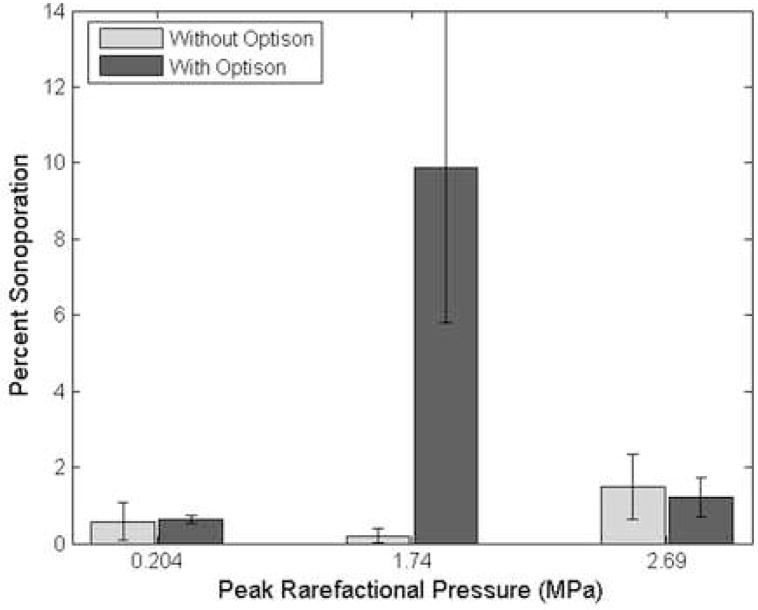
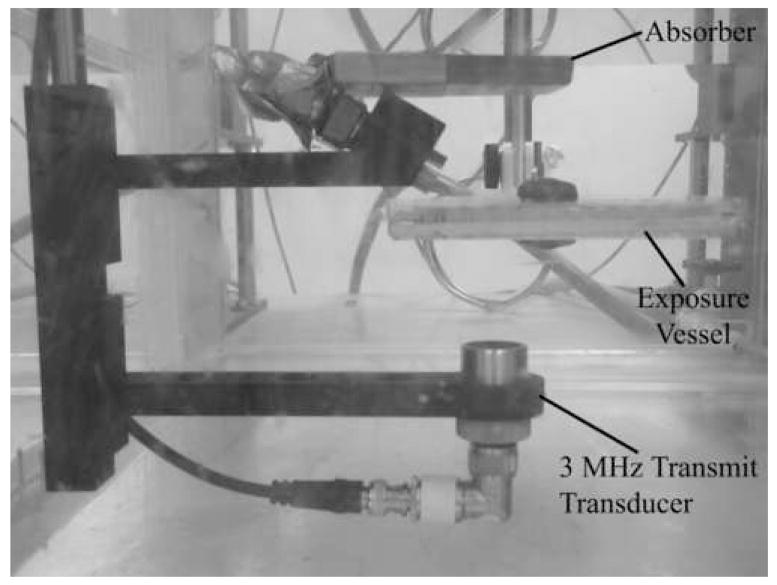
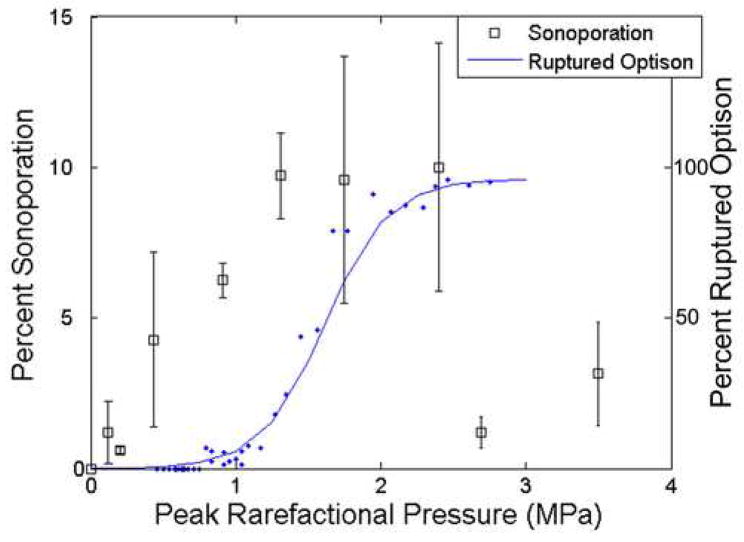
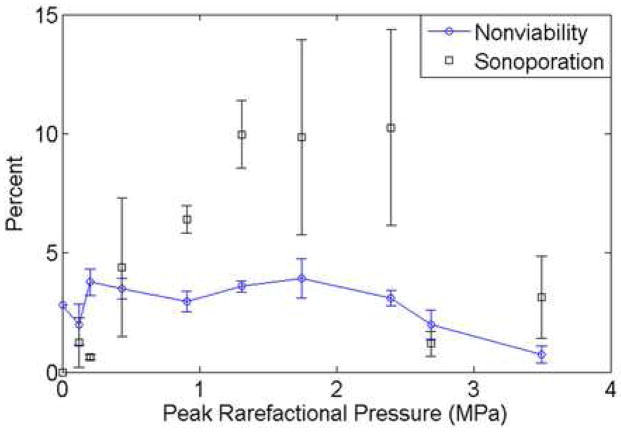
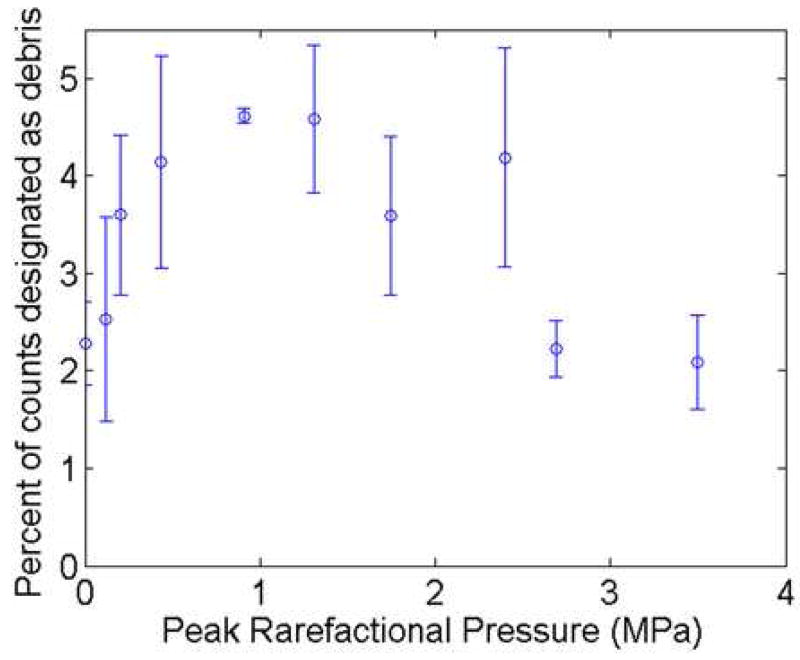
The objective of this project was to elucidate the relationship between ultrasound contrast agents (UCAs) and sonoporation. Sonoporation is an ultrasound-induced, transient cell membrane permeability change that allows for the uptake of normally impermeable macromolecules. Specifically, this study will determine the role that inertial cavitation plays in eliciting sonoporation. The inertial cavitation thresholds of the UCA, Optison, are compared directly with the results of sonoporation to determine the involvement of inertial cavitation in sonoporation. Chinese hamster ovary (CHO) cells were exposed as a monolayer in a solution of Optison, 500,000 Da fluorescein isothiocyanate-dextran (FITC-dextran), and phosphate-buffered saline (PBS) to 30 s of pulsed ultrasound at 3.15-MHz center frequency, 5-cycle pulse duration and 10-Hz pulse repetition frequency. The peak rarefactional pressure (P(r)) was varied over a range from 120 kPa-3.5 MPa, and five independent replicates were performed at each pressure. As the P(r) was increased, from 120 kPa-3.5 MPa, the fraction of sonoporated cells among the total viable population increased from 0.63-10.21%, with the maximum occurring at 2.4 MPa. The inertial cavitation threshold for Optison at these exposure conditions has previously been shown to be in the range 0.77-0.83 MPa, at which sonoporation activity was found to be 50% of its maximum level. Furthermore, significant sonoporation activity was observed at pressure levels below the threshold for inertial cavitation of Optison. Above 2.4 MPa, a significant drop in sonoporation activity occurred, corresponding to pressures where >95% of the Optison was collapsing. These results demonstrate that sonoporation is not directly a result of inertial cavitation of the UCA, rather that the effect is related to linear and/or nonlinear oscillation of the UCA occurring at pressure levels below the inertial cavitation threshold.
本项目的目的是阐明超声造影剂(UCA)与声孔效应之间的关系。声孔效应是一种由超声诱导的、短暂的细胞膜通透性变化,它使得通常无法透过的大分子得以摄取。具体而言,本研究将确定惯性空化在引发声孔效应中所起的作用。将超声造影剂Optison的惯性空化阈值直接与声孔效应的结果进行比较,以确定惯性空化在声孔效应中的参与情况。中国仓鼠卵巢(CHO)细胞以单层形式暴露于含有Optison、500,000道尔顿异硫氰酸荧光素 - 葡聚糖(FITC - 葡聚糖)和磷酸盐缓冲盐水(PBS)的溶液中,接受中心频率为3.15 MHz、脉冲持续时间为5个周期且脉冲重复频率为10 Hz的30秒脉冲超声作用。峰值稀疏压力(P(r))在120 kPa至3.5 MPa的范围内变化,并且在每个压力下进行了五次独立重复实验。随着P(r)从120 kPa增加到3.5 MPa,在总存活细胞群体中发生声孔效应的细胞比例从0.63%增加到10.21%,最大值出现在2.4 MPa处。先前已表明,在这些暴露条件下Optison的惯性空化阈值在0.77 - 0.83 MPa范围内,在该阈值下声孔效应活性为其最大水平的50%。此外,在低于Optison惯性空化阈值的压力水平下观察到了显著的声孔效应活性。在2.4 MPa以上,声孔效应活性显著下降,这对应于超过95%的Optison发生崩溃的压力。这些结果表明,声孔效应并非直接是超声造影剂惯性空化的结果,而是该效应与在低于惯性空化阈值的压力水平下发生的超声造影剂的线性和/或非线性振荡有关。