Palmer Christina G S, Mallery Erin, Turunen Joni A, Hsieh Hsin-Ju, Peltonen Leena, Lonnqvist Jouko, Woodward J Arthur, Sinsheimer Janet S
Department of Psychiatry & Biobehavioral Sciences, University of California, Los Angeles, CA, 90095, USA.
Schizophr Res. 2008 Sep;104(1-3):135-45. doi: 10.1016/j.schres.2008.06.022. Epub 2008 Aug 9.
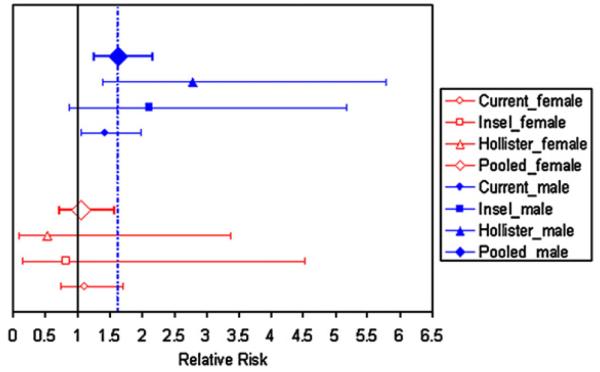
Rhesus D incompatibility increases risk for schizophrenia, with some evidence that risk is limited to male offspring. The purpose of this study is to determine whether risk for schizophrenia due to Rhesus D incompatibility differs by offspring sex using a nuclear family-based candidate gene approach and a meta-analysis approach. The genetic study is based on a sample of 277 nuclear families with RHD genotype data on at least one parent and at least one child diagnosed with schizophrenia or related disorder. Meta-analysis inclusion criteria were (1) well-defined sample of schizophrenia patients with majority born before 1970, (2) Rhesus D incompatibility phenotype or genotype data available on mother and offspring, and by offspring sex. Two of ten studies, plus the current genetic study sample, fulfilled these criteria, for a total of 358 affected males and 226 affected females. The genetic study found that schizophrenia risk for incompatible males was significantly greater than for compatible offspring (p=0.03), while risk for incompatible and compatible females was not significantly different (p=.32). Relative risks for incompatible males and females were not significantly different from each other. Meta-analysis using a larger number of affected males and females supports their difference. Taken together, these results provide further support that risk of schizophrenia due to Rhesus D incompatibility is limited to incompatible males, although a weak female incompatibility effect cannot be excluded. Sex differences during fetal neurodevelopment should be investigated to fully elucidate the etiology of schizophrenia.
恒河猴D血型不相容会增加患精神分裂症的风险,有证据表明这种风险仅限于雄性后代。本研究的目的是使用基于核心家庭的候选基因方法和荟萃分析方法,确定因恒河猴D血型不相容导致的精神分裂症风险是否因后代性别而异。该基因研究基于一个由277个核心家庭组成的样本,这些家庭至少有一位父母有RHD基因型数据,且至少有一个孩子被诊断患有精神分裂症或相关疾病。荟萃分析的纳入标准为:(1)明确界定的精神分裂症患者样本,大多数患者出生于1970年之前;(2)有母亲和后代的恒河猴D血型不相容表型或基因型数据,并按后代性别分类。十项研究中的两项,加上当前的基因研究样本,符合这些标准,共有358名受影响男性和226名受影响女性。基因研究发现,不相容男性患精神分裂症的风险显著高于相容后代(p = 0.03),而不相容和相容女性的风险没有显著差异(p = 0.32)。不相容男性和女性的相对风险彼此之间没有显著差异。使用更多受影响男性和女性样本的荟萃分析支持了他们之间的差异。综上所述,这些结果进一步支持了因恒河猴D血型不相容导致的精神分裂症风险仅限于不相容男性的观点,尽管不能排除微弱的女性不相容效应。应研究胎儿神经发育过程中的性别差异,以充分阐明精神分裂症的病因。