Geng Xin, Speirs Christina, Lagutin Oleg, Inbal Adi, Liu Wei, Solnica-Krezel Lilianna, Jeong Yongsu, Epstein Douglas J, Oliver Guillermo
Department of Genetics and Tumor Cell Biology, St. Jude Children's Research Hospital, Memphis, TN 38105-2794, USA.
Dev Cell. 2008 Aug;15(2):236-47. doi: 10.1016/j.devcel.2008.07.003.
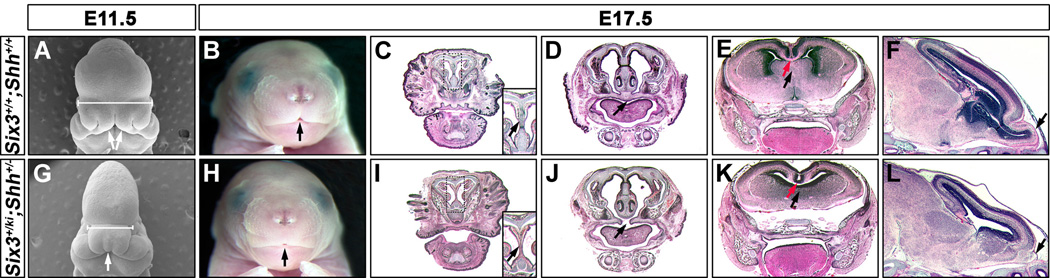
Holoprosencephaly (HPE), the most common forebrain malformation, is characterized by an incomplete separation of the cerebral hemispheres. Mutations in the homeobox gene SIX3 account for 1.3% of all cases of human HPE. Using zebrafish-based assays, we have now determined that HPE-associated Six3 mutant proteins function as hypomorphs. Haploinsufficiency of Six3 caused by deletion of one allele of Six3 or by replacement of wild-type Six3 with HPE-associated Six3 mutant alleles was sufficient to recapitulate in mouse models most of the phenotypic features of human HPE. We demonstrate that Shh is a direct target of Six3 in the rostral diencephalon ventral midline (RDVM). Reduced amounts of functional Six3 protein fail to activate Shh expression in the mutant RDVM and ultimately lead to HPE. These results identify Six3 as a direct regulator of Shh expression and reveal a crossregulatory loop between Shh and Six3 in the ventral forebrain.
前脑无裂畸形(HPE)是最常见的前脑畸形,其特征是大脑半球未完全分离。同源异型盒基因SIX3的突变占人类所有HPE病例的1.3%。利用基于斑马鱼的检测方法,我们现已确定与HPE相关的Six3突变蛋白发挥亚效等位基因的作用。Six3一个等位基因的缺失或野生型Six3被与HPE相关的Six3突变等位基因取代所导致的Six3单倍剂量不足,足以在小鼠模型中重现人类HPE的大多数表型特征。我们证明,音猬因子(Shh)是前脑间脑腹侧中线(RDVM)中Six3的直接靶点。在突变的RDVM中,功能性Six3蛋白数量减少无法激活Shh表达,最终导致HPE。这些结果确定Six3是Shh表达的直接调节因子,并揭示了腹侧前脑Shh与Six3之间的交叉调节环。