Cummings Steven R, Ettinger Bruce, Delmas Pierre D, Kenemans Peter, Stathopoulos Victoria, Verweij Pierre, Mol-Arts Mirjam, Kloosterboer Lenus, Mosca Lori, Christiansen Claus, Bilezikian John, Kerzberg Eduardo Mario, Johnson Susan, Zanchetta Jose, Grobbee Diederich E, Seifert Wilfried, Eastell Richard
San Francisco Coordinating Center and the California Pacific Medical Center Research Institute, San Francisco, USA.
N Engl J Med. 2008 Aug 14;359(7):697-708. doi: 10.1056/NEJMoa0800743.
Tibolone has estrogenic, progestogenic, and androgenic effects. Although tibolone prevents bone loss, its effects on fractures, breast cancer, and cardiovascular disease are uncertain.
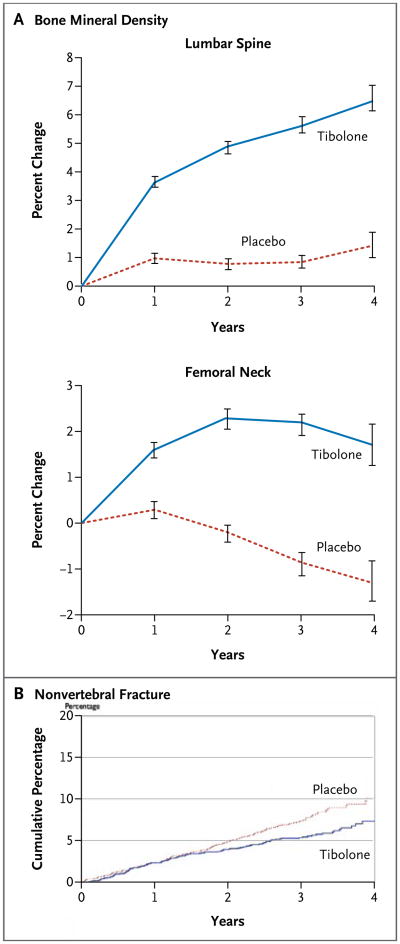
In this randomized study, we assigned 4538 women, who were between the ages of 60 and 85 years and had a bone mineral density T score of -2.5 or less at the hip or spine or a T score of -2.0 or less and radiologic evidence of a vertebral fracture, to receive once-daily tibolone (at a dose of 1.25 mg) or placebo. Annual spine radiographs were used to assess for vertebral fracture. Rates of cardiovascular events and breast cancer were adjudicated by expert panels.
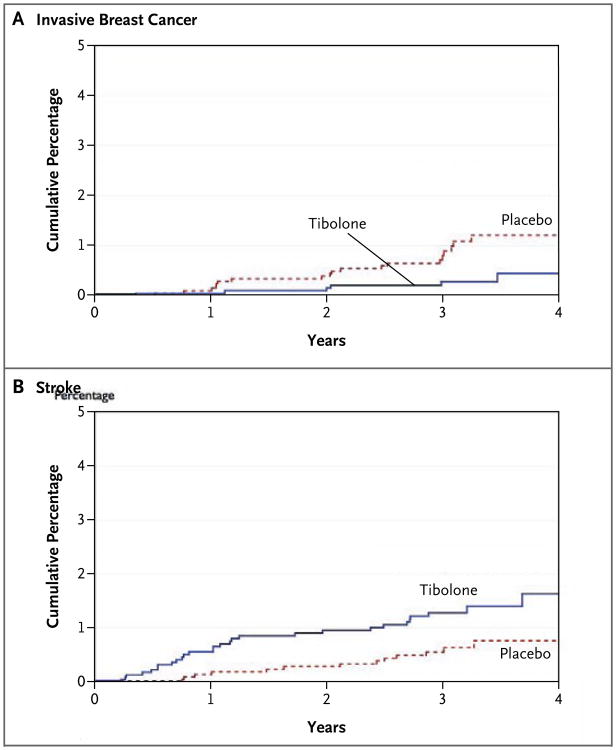
During a median of 34 months of treatment, the tibolone group, as compared with the placebo group, had a decreased risk of vertebral fracture, with 70 cases versus 126 cases per 1000 person-years (relative hazard, 0.55; 95% confidence interval [CI], 0.41 to 0.74; P<0.001), and a decreased risk of nonvertebral fracture, with 122 cases versus 166 cases per 1000 person-years (relative hazard, 0.74; 95% CI, 0.58 to 0.93; P=0.01). The tibolone group also had a decreased risk of invasive breast cancer (relative hazard, 0.32; 95% CI, 0.13 to 0.80; P=0.02) and colon cancer (relative hazard, 0.31; 95% CI, 0.10 to 0.96; P=0.04). However, the tibolone group had an increased risk of stroke (relative hazard, 2.19; 95% CI, 1.14 to 4.23; P=0.02), for which the study was stopped in February 2006 at the recommendation of the data and safety monitoring board. There were no significant differences in the risk of either coronary heart disease or venous thromboembolism between the two groups.
Tibolone reduced the risk of fracture and breast cancer and possibly colon cancer but increased the risk of stroke in older women with osteoporosis. (ClinicalTrials.gov number, NCT00519857.)
替勃龙具有雌激素、孕激素和雄激素样作用。尽管替勃龙可预防骨质流失,但其对骨折、乳腺癌和心血管疾病的影响尚不确定。
在这项随机研究中,我们将4538名年龄在60至85岁之间、髋部或脊柱骨密度T值为-2.5或更低或T值为-2.0或更低且有椎体骨折影像学证据的女性随机分为两组,分别每日服用一次替勃龙(剂量为1.25毫克)或安慰剂。每年进行脊柱X线摄影以评估椎体骨折情况。心血管事件和乳腺癌发生率由专家小组判定。
在中位34个月的治疗期间,与安慰剂组相比,替勃龙组椎体骨折风险降低,每1000人年发生70例,而安慰剂组为126例(相对风险,0.55;95%置信区间[CI],0.41至0.74;P<0.001),非椎体骨折风险也降低,每1000人年发生122例,而安慰剂组为166例(相对风险,0.74;95%CI,0.58至0.93;P=0.01)。替勃龙组浸润性乳腺癌风险也降低(相对风险,0.32;95%CI,0.从0.13至0.80;P=0至0.02),结肠癌风险降低(相对风险,0.31;95%CI,0.10至0.96;P=0.04)。然而,替勃龙组中风风险增加(相对风险,2.19;95%CI,1.14至4.23;P=0.02),基于此,该研究于2006年2月根据数据和安全监测委员会的建议停止。两组在冠心病或静脉血栓栓塞风险方面无显著差异。
替勃龙可降低骨质疏松老年女性的骨折和乳腺癌风险,可能还降低结肠癌风险,但会增加中风风险。(临床试验注册号,NCT00519857。)