Kim Ivana K, Ji Fei, Morrison Margaux A, Adams Scott, Zhang Qingrun, Lane Anne Marie, Capone Antonio, Dryja Thaddeus P, Ott Jurg, Miller Joan W, DeAngelis Margaret M
Department of Ophthalmology, Harvard Medical School, Massachusetts Eye and Ear Infirmary, Boston, MA 02114, USA.
Mol Vis. 2008 Aug 11;14:1487-95.
To examine if the gene encoding C-reactive protein (CRP), a biomarker of inflammation, confers risk for neovascular age-related macular degeneration (AMD) in the presence of other modifiers of inflammation, including body mass index (BMI), diabetes, smoking, and complement factor H (CFH) Y402 genotype. Additionally we examined the degree to which CRP common variation was in linkage disequilibrium (LD) within our cohort.
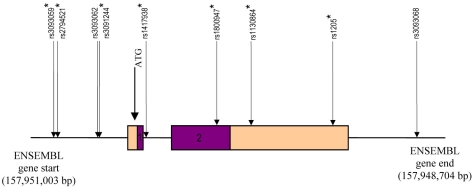
We ascertained 244 individuals from 104 families where at least one member had neovascular AMD, and a sibling had normal maculae and was past the age of the index patient's diagnosis of neovascular AMD. We employed a direct sequencing approach to analyze the 5'-promoter region as well as the entire coding region and the 3'-untranslated region of the CRP gene. CFH Y402 genotype data was available for all participants. Lifestyle and medical factors were obtained via administration of a standardized questionnaire. The family-based association test, haplotype analysis, McNemar's test, and conditional logistic regression were used to determine significant associations and interactions. Haploview was used to calculate the degree of LD (r2) between all CRP variants identified.
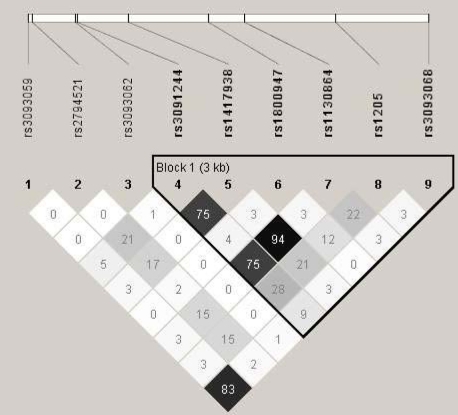
Six single nucleotide polymorphisms (SNPs; rs3091244, rs1417938, rs1800947, rs1130864, rs1205, and rs3093068) comprised one haplotype block of which only rs1130864 and rs1417938 were in high LD (r2=0.94). SNP rs3093068 was in LD but less so with rs3093059 (r2=0.83), which is not part of the haplotype block. Six SNPs made up six different haplotypes with > or = 5% frequency, none of which were significantly associated with AMD risk. No statistically significant association was detected between any of the nine common variants in CRP and neovascular AMD when considering disease status alone or when controlling for smoking exposure, BMI, diabetes, or CFH genotype. Significant interactions were not found between CRP genotypes and any of the risk factors studied. No novel CRP variation was identified.
We provide evidence that if elevated serum/plasma levels of CRP are associated with neovascular AMD, it is likely not due to genetic variation within CRP, but likely due to variations in some other genetic as well as epidemiological factors.
研究编码炎症生物标志物C反应蛋白(CRP)的基因,在存在其他炎症调节因子(包括体重指数(BMI)、糖尿病、吸烟和补体因子H(CFH)Y402基因型)的情况下,是否会增加新生血管性年龄相关性黄斑变性(AMD)的风险。此外,我们还研究了CRP常见变异在我们队列中的连锁不平衡(LD)程度。
我们从104个家庭中确定了244名个体,其中至少有一名成员患有新生血管性AMD,且其兄弟姐妹黄斑正常,年龄超过了索引患者新生血管性AMD的诊断年龄。我们采用直接测序方法分析CRP基因的5'启动子区域以及整个编码区和3'非翻译区。所有参与者都有CFH Y402基因型数据。通过标准化问卷获取生活方式和医学因素。使用基于家系的关联检验、单倍型分析、McNemar检验和条件逻辑回归来确定显著的关联和相互作用。使用Haploview计算所有已鉴定的CRP变异之间的LD程度(r2)。
六个单核苷酸多态性(SNP;rs3091244、rs1417938、rs1800947、rs1130864、rs1205和rs3093068)构成一个单倍型块,其中只有rs1130864和rs1417938处于高度LD(r2 = 0.94)。SNP rs3093068处于LD,但与rs3093059的LD程度较低(r2 = 0.83),rs3093059不属于该单倍型块。六个SNP构成了六种频率≥5%的不同单倍型,其中没有一种与AMD风险显著相关。单独考虑疾病状态或在控制吸烟暴露、BMI、糖尿病或CFH基因型时,CRP中的九个常见变异与新生血管性AMD之间均未检测到统计学上的显著关联。在CRP基因型与任何研究的风险因素之间未发现显著的相互作用。未鉴定出新的CRP变异。
我们提供的证据表明,如果血清/血浆中CRP水平升高与新生血管性AMD相关,可能不是由于CRP基因内的遗传变异,而是可能由于其他一些遗传以及流行病学因素的变异。