• 文献检索
  • 文档翻译
  • 深度研究
  • 学术资讯
  • Suppr Zotero 插件Zotero 插件
  • 邀请有礼
  • 套餐&价格
  • 历史记录
应用&插件
Suppr Zotero 插件Zotero 插件浏览器插件Mac 客户端Windows 客户端微信小程序
定价
高级版会员购买积分包购买API积分包
服务
文献检索文档翻译深度研究API 文档MCP 服务
关于我们
关于 Suppr公司介绍联系我们用户协议隐私条款
关注我们

Suppr 超能文献

核心技术专利:CN118964589B侵权必究
粤ICP备2023148730 号-1Suppr @ 2026

文献检索

告别复杂PubMed语法,用中文像聊天一样搜索,搜遍4000万医学文献。AI智能推荐,让科研检索更轻松。

立即免费搜索

文件翻译

保留排版,准确专业,支持PDF/Word/PPT等文件格式,支持 12+语言互译。

免费翻译文档

深度研究

AI帮你快速写综述,25分钟生成高质量综述,智能提取关键信息,辅助科研写作。

立即免费体验

氯仿的计算毒理学:使用贝叶斯推理、马尔可夫链蒙特卡罗模拟和人体生物监测数据的反向剂量测定法

Computational toxicology of chloroform: reverse dosimetry using Bayesian inference, Markov chain Monte Carlo simulation, and human biomonitoring data.

作者信息

Lyons Michael A, Yang Raymond S H, Mayeno Arthur N, Reisfeld Brad

机构信息

Quantitative and Computational Toxicology Group, Colorado State University, Fort Collins, CO 80523, USA.

出版信息

Environ Health Perspect. 2008 Aug;116(8):1040-6. doi: 10.1289/ehp.11079.

DOI:10.1289/ehp.11079
PMID:18709138
原文链接:https://pmc.ncbi.nlm.nih.gov/articles/PMC2516557/
Abstract

BACKGROUND

One problem of interpreting population-based biomonitoring data is the reconstruction of corresponding external exposure in cases where no such data are available.

OBJECTIVES

We demonstrate the use of a computational framework that integrates physiologically based pharmacokinetic (PBPK) modeling, Bayesian inference, and Markov chain Monte Carlo simulation to obtain a population estimate of environmental chloroform source concentrations consistent with human biomonitoring data. The biomonitoring data consist of chloroform blood concentrations measured as part of the Third National Health and Nutrition Examination Survey (NHANES III), and for which no corresponding exposure data were collected.

METHODS

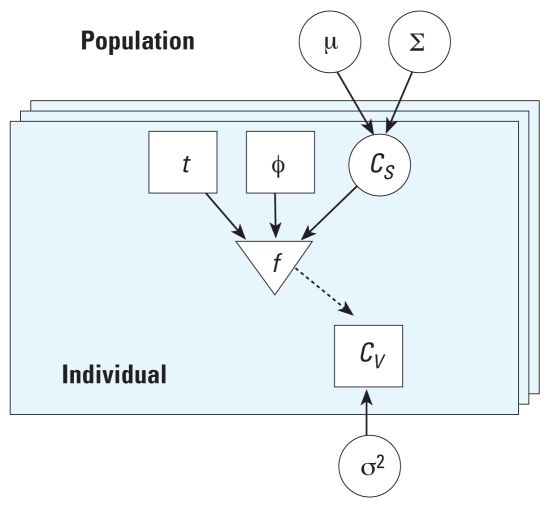
We used a combined PBPK and shower exposure model to consider several routes and sources of exposure: ingestion of tap water, inhalation of ambient household air, and inhalation and dermal absorption while showering. We determined posterior distributions for chloroform concentration in tap water and ambient household air using U.S. Environmental Protection Agency Total Exposure Assessment Methodology (TEAM) data as prior distributions for the Bayesian analysis.

RESULTS

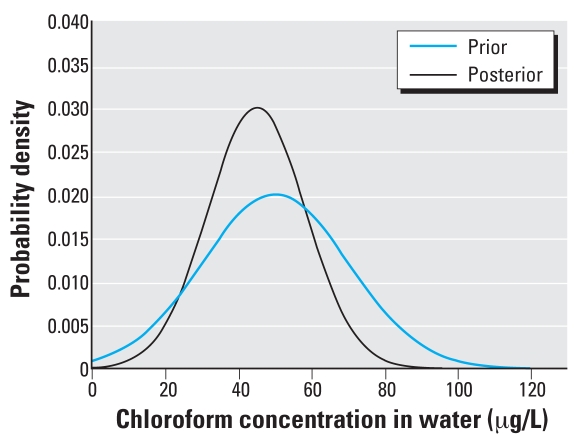
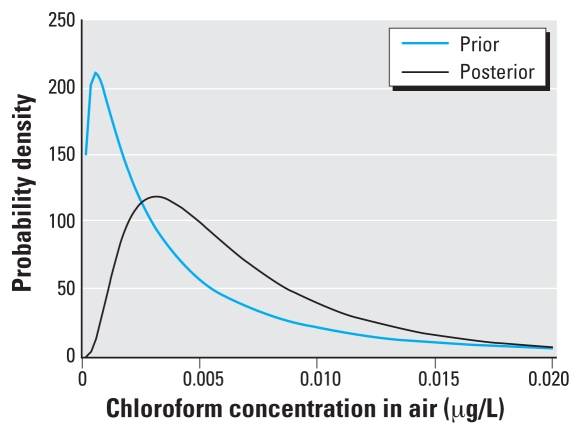
Posterior distributions for exposure indicate that 95% of the population represented by the NHANES III data had likely chloroform exposures < or = 67 microg/L [corrected] in tap water and < or = 0.02 microg/L in ambient household air.

CONCLUSIONS

Our results demonstrate the application of computer simulation to aid in the interpretation of human biomonitoring data in the context of the exposure-health evaluation-risk assessment continuum. These results should be considered as a demonstration of the method and can be improved with the addition of more detailed data.

摘要

背景

解读基于人群的生物监测数据的一个问题是,在没有此类数据的情况下重建相应的外部暴露情况。

目的

我们展示了一种计算框架的应用,该框架整合了基于生理学的药代动力学(PBPK)建模、贝叶斯推理和马尔可夫链蒙特卡罗模拟,以获得与人类生物监测数据一致的环境氯仿源浓度的人群估计值。生物监测数据包括作为第三次全国健康和营养检查调查(NHANES III)一部分测量的氯仿血液浓度,且未收集到相应的暴露数据。

方法

我们使用了一个结合的PBPK和淋浴暴露模型来考虑多种暴露途径和来源:饮用自来水、吸入家庭环境空气以及淋浴时的吸入和皮肤吸收。我们使用美国环境保护局总暴露评估方法(TEAM)数据作为贝叶斯分析的先验分布,确定了自来水中氯仿浓度和家庭环境空气中氯仿浓度的后验分布。

结果

暴露的后验分布表明,NHANES III数据所代表的95%的人群,自来水中氯仿的可能暴露量≤67微克/升[校正后],家庭环境空气中氯仿的可能暴露量≤0.02微克/升。

结论

我们的结果证明了计算机模拟在暴露-健康评估-风险评估连续统一体背景下辅助解释人类生物监测数据的应用。这些结果应被视为该方法的一个示范,并且可以通过添加更详细的数据来改进。
https://cdn.ncbi.nlm.nih.gov/pmc/blobs/171e/2516557/d7aba0f7459c/ehp0116-001040f7.jpg
https://cdn.ncbi.nlm.nih.gov/pmc/blobs/171e/2516557/afb0ca1dc152/ehp0116-001040f1.jpg
https://cdn.ncbi.nlm.nih.gov/pmc/blobs/171e/2516557/d75cc4d5dafe/ehp0116-001040f2.jpg
https://cdn.ncbi.nlm.nih.gov/pmc/blobs/171e/2516557/6062d82ddfbc/ehp0116-001040f3.jpg
https://cdn.ncbi.nlm.nih.gov/pmc/blobs/171e/2516557/81193fa527f4/ehp0116-001040f4.jpg
https://cdn.ncbi.nlm.nih.gov/pmc/blobs/171e/2516557/1b33134da654/ehp0116-001040f5.jpg
https://cdn.ncbi.nlm.nih.gov/pmc/blobs/171e/2516557/65c11e50db99/ehp0116-001040f6.jpg
https://cdn.ncbi.nlm.nih.gov/pmc/blobs/171e/2516557/d7aba0f7459c/ehp0116-001040f7.jpg
https://cdn.ncbi.nlm.nih.gov/pmc/blobs/171e/2516557/afb0ca1dc152/ehp0116-001040f1.jpg
https://cdn.ncbi.nlm.nih.gov/pmc/blobs/171e/2516557/d75cc4d5dafe/ehp0116-001040f2.jpg
https://cdn.ncbi.nlm.nih.gov/pmc/blobs/171e/2516557/6062d82ddfbc/ehp0116-001040f3.jpg
https://cdn.ncbi.nlm.nih.gov/pmc/blobs/171e/2516557/81193fa527f4/ehp0116-001040f4.jpg
https://cdn.ncbi.nlm.nih.gov/pmc/blobs/171e/2516557/1b33134da654/ehp0116-001040f5.jpg
https://cdn.ncbi.nlm.nih.gov/pmc/blobs/171e/2516557/65c11e50db99/ehp0116-001040f6.jpg
https://cdn.ncbi.nlm.nih.gov/pmc/blobs/171e/2516557/d7aba0f7459c/ehp0116-001040f7.jpg

相似文献

1
Computational toxicology of chloroform: reverse dosimetry using Bayesian inference, Markov chain Monte Carlo simulation, and human biomonitoring data.氯仿的计算毒理学:使用贝叶斯推理、马尔可夫链蒙特卡罗模拟和人体生物监测数据的反向剂量测定法
Environ Health Perspect. 2008 Aug;116(8):1040-6. doi: 10.1289/ehp.11079.
2
Use of a physiologically based pharmacokinetic model to identify exposures consistent with human biomonitoring data for chloroform.使用基于生理学的药代动力学模型来确定与氯仿人体生物监测数据一致的暴露情况。
J Toxicol Environ Health A. 2006 Sep;69(18):1727-56. doi: 10.1080/15287390600631367.
3
Development of a screening approach to interpret human biomonitoring data on volatile organic compounds: reverse dosimetry on biomonitoring data for trichloroethylene.一种用于解释挥发性有机化合物人体生物监测数据的筛查方法的开发:三氯乙烯生物监测数据的反向剂量测定法。
Risk Anal. 2007 Oct;27(5):1223-36. doi: 10.1111/j.1539-6924.2007.00964.x.
4
Reconstructing exposures from biomarkers using exposure-pharmacokinetic modeling--A case study with carbaryl.使用暴露-药代动力学模型从生物标志物重建暴露情况——以西维因为例的案例研究。
Regul Toxicol Pharmacol. 2015 Dec;73(3):689-98. doi: 10.1016/j.yrtph.2015.10.031. Epub 2015 Nov 7.
5
Reconstruction of Exposure to m-Xylene from Human Biomonitoring Data Using PBPK Modelling, Bayesian Inference, and Markov Chain Monte Carlo Simulation.使用生理药代动力学(PBPK)模型、贝叶斯推理和马尔可夫链蒙特卡罗模拟,从人体生物监测数据重建间二甲苯暴露情况。
J Toxicol. 2012;2012:760281. doi: 10.1155/2012/760281. Epub 2012 Apr 8.
6
Use of Markov Chain Monte Carlo analysis with a physiologically-based pharmacokinetic model of methylmercury to estimate exposures in US women of childbearing age.使用马尔可夫链蒙特卡罗分析方法与基于生理学的甲基汞药代动力学模型来估计美国育龄妇女的暴露情况。
Risk Anal. 2007 Aug;27(4):947-59. doi: 10.1111/j.1539-6924.2007.00934.x.
7
Reverse dosimetry: interpreting trihalomethanes biomonitoring data using physiologically based pharmacokinetic modeling.反向剂量测定法:使用基于生理的药代动力学模型解释三卤甲烷生物监测数据。
J Expo Sci Environ Epidemiol. 2007 Nov;17(7):591-603. doi: 10.1038/sj.jes.7500540. Epub 2006 Nov 15.
8
Relative source allocation of TDI to drinking water for derivation of a criterion for chloroform: a Monte-Carlo and multi-exposure assessment.相对 TDI 于饮用水之分配来源以推导氯仿之准则:一蒙地卡罗与多重曝露评估。
Regul Toxicol Pharmacol. 2013 Oct;67(1):98-107. doi: 10.1016/j.yrtph.2013.07.004. Epub 2013 Jul 16.
9
Part 2. Development of Enhanced Statistical Methods for Assessing Health Effects Associated with an Unknown Number of Major Sources of Multiple Air Pollutants.第2部分。开发增强的统计方法,以评估与多种空气污染物的未知数量主要来源相关的健康影响。
Res Rep Health Eff Inst. 2015 Jun(183 Pt 1-2):51-113.
10
Routes of chloroform exposure and body burden from showering with chlorinated tap water.
Risk Anal. 1990 Dec;10(4):575-80. doi: 10.1111/j.1539-6924.1990.tb00541.x.

引用本文的文献

1
Biomonitoring-Based Risk Assessment of Pyrethroid Exposure in the U.S. Population: Application of High-Throughput and Physiologically Based Kinetic Models.基于生物监测的美国人群拟除虫菊酯暴露风险评估:高通量和基于生理学的动力学模型的应用
Toxics. 2025 Mar 16;13(3):216. doi: 10.3390/toxics13030216.
2
Occupational Exposure and Health Impact Assessment of Diisocyanates in Finland.芬兰二异氰酸酯的职业暴露与健康影响评估
Toxics. 2023 Feb 27;11(3):229. doi: 10.3390/toxics11030229.
3
Bayesian inference of chemical exposures from NHANES urine biomonitoring data.

本文引用的文献

1
Use of Markov Chain Monte Carlo analysis with a physiologically-based pharmacokinetic model of methylmercury to estimate exposures in US women of childbearing age.使用马尔可夫链蒙特卡罗分析方法与基于生理学的甲基汞药代动力学模型来估计美国育龄妇女的暴露情况。
Risk Anal. 2007 Aug;27(4):947-59. doi: 10.1111/j.1539-6924.2007.00934.x.
2
Reverse dosimetry: interpreting trihalomethanes biomonitoring data using physiologically based pharmacokinetic modeling.反向剂量测定法:使用基于生理的药代动力学模型解释三卤甲烷生物监测数据。
J Expo Sci Environ Epidemiol. 2007 Nov;17(7):591-603. doi: 10.1038/sj.jes.7500540. Epub 2006 Nov 15.
3
贝叶斯推断 NHANES 尿液生物监测数据中的化学暴露。
J Expo Sci Environ Epidemiol. 2022 Nov;32(6):833-846. doi: 10.1038/s41370-022-00459-0. Epub 2022 Aug 17.
4
Health Risk Assessment of Ortho-Toluidine Utilising Human Biomonitoring Data of Workers and the General Population.利用工人和普通人群的人体生物监测数据对邻甲苯胺进行健康风险评估。
Toxics. 2022 Apr 25;10(5):217. doi: 10.3390/toxics10050217.
5
A Web-Based Database on Exposure to Persistent Organic Pollutants in China.中国基于网络的持久性有机污染物暴露数据库。
Environ Health Perspect. 2021 May;129(5):57701. doi: 10.1289/EHP8685. Epub 2021 May 4.
6
Statistical relationship between metabolic decomposition and chemical uptake predicts bioconcentration factor data for diverse chemical exposures.代谢分解与化学物质摄取之间的统计关系可预测不同化学暴露情况下的生物浓缩因子数据。
BMC Syst Biol. 2018 Aug 7;12(1):81. doi: 10.1186/s12918-018-0601-y.
7
A Physiologically-Based Pharmacokinetic Modeling Approach Using Biomonitoring Data in Order to Assess the Contribution of Drinking Water for the Achievement of an Optimal Fluoride Dose for Dental Health in Children.采用生物监测数据的基于生理学的药代动力学建模方法,以评估饮用水对儿童牙齿健康达到最佳氟化物剂量的贡献。
Int J Environ Res Public Health. 2018 Jun 28;15(7):1358. doi: 10.3390/ijerph15071358.
8
A Computational Workflow for Probabilistic Quantitative to Extrapolation.一种用于概率定量外推的计算工作流程。
Front Pharmacol. 2018 May 18;9:508. doi: 10.3389/fphar.2018.00508. eCollection 2018.
9
Physiological fidelity or model parsimony? The relative performance of reverse-toxicokinetic modeling approaches.
BMC Syst Biol. 2017 Mar 11;11(1):35. doi: 10.1186/s12918-017-0407-3.
10
Indicative and complementary effects of human biological indicators for heavy metal exposure assessment.人体生物指标在重金属暴露评估中的指示性和补充性作用。
Environ Geochem Health. 2017 Oct;39(5):1031-1043. doi: 10.1007/s10653-016-9870-9. Epub 2016 Sep 6.
The use of Markov chain Monte Carlo uncertainty analysis to support a Public Health Goal for perchloroethylene.
使用马尔可夫链蒙特卡罗不确定性分析来支持全氯乙烯的公共卫生目标。
Regul Toxicol Pharmacol. 2007 Feb;47(1):1-18. doi: 10.1016/j.yrtph.2006.06.008. Epub 2006 Aug 9.
4
Bayesian population analysis of a harmonized physiologically based pharmacokinetic model of trichloroethylene and its metabolites.三氯乙烯及其代谢物基于生理药代动力学模型的贝叶斯群体分析。
Regul Toxicol Pharmacol. 2006 Oct;46(1):63-83. doi: 10.1016/j.yrtph.2006.05.012. Epub 2006 Aug 4.
5
Use of a physiologically based pharmacokinetic model to identify exposures consistent with human biomonitoring data for chloroform.使用基于生理学的药代动力学模型来确定与氯仿人体生物监测数据一致的暴露情况。
J Toxicol Environ Health A. 2006 Sep;69(18):1727-56. doi: 10.1080/15287390600631367.
6
Revised assessment of cancer risk to dichloromethane: part I Bayesian PBPK and dose-response modeling in mice.二氯甲烷癌症风险的修订评估:第一部分 小鼠中的贝叶斯PBPK和剂量反应模型
Regul Toxicol Pharmacol. 2006 Jun;45(1):44-54. doi: 10.1016/j.yrtph.2005.12.007. Epub 2006 Jan 25.
7
Reconstructing population exposures from dose biomarkers: inhalation of trichloroethylene (TCE) as a case study.从剂量生物标志物重建人群暴露情况:以三氯乙烯(TCE)吸入为例的研究。
J Expo Anal Environ Epidemiol. 2004 May;14(3):204-13. doi: 10.1038/sj.jea.7500314.
8
Bayesian internal dosimetry calculations using Markov Chain Monte Carlo.使用马尔可夫链蒙特卡罗方法的贝叶斯体内剂量学计算。
Radiat Prot Dosimetry. 2002;98(2):191-8. doi: 10.1093/oxfordjournals.rpd.a006709.
9
Statistical issues in toxicokinetic modeling: a bayesian perspective.毒代动力学建模中的统计学问题:贝叶斯视角
Environ Health Perspect. 2000 Oct;108 Suppl 5:883-93. doi: 10.1289/ehp.00108s5883.
10
Physiologically based pharmacokinetic modeling of the temperature-dependent dermal absorption of chloroform by humans following bath water exposures.基于生理的药代动力学模型:人体在接触浴水后对温度依赖性氯仿经皮吸收的研究
Toxicol Sci. 2000 Jan;53(1):13-23. doi: 10.1093/toxsci/53.1.13.