Webster Thomas F, Hoffman Kate, Weinberg Janice, Vieira Verónica, Aschengrau Ann
Department of Environmental Health, Boston University Schoolof Public Health, Boston, Massachusetts 02118, USA.
Environ Health Perspect. 2008 Aug;116(8):1125-9. doi: 10.1289/ehp.10818.
Previous research demonstrated increased risk of breast cancer associated with higher socioeconomic status (SES) measured at both the individual and community levels. However, little attention has been paid to simultaneously examining both measures.
We evaluated the independent influences of individual and community SES on the risk of breast cancer using case-control data. Because our previous work suggests that associations may be stronger after including a latency period, we also assessed the effect of community-level SES assuming a 10-year latency period.
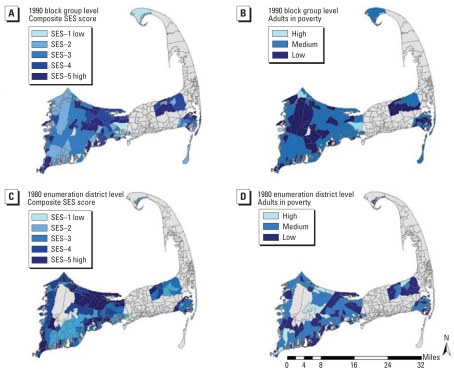
We obtained individual education for cases and matched controls diagnosed between 1987 and 1993 on Cape Cod, Massachusetts (USA). We acquired community-level SES from census data for 1980 and 1990. Using SES data at diagnosis and 10 years earlier, we constructed models for breast cancer risk using individual-level SES only, community-level SES only, and a multilevel analysis including both. We adjusted models for other individual-level risk factors.
Women with the highest education were at greater risk of developing breast cancer in both 1980 and 1990 [odds ratio (OR) = 1.17 and 1.19, respectively]. Similarly, women living in the highest-SES communities in 1990 had greater risk (OR = 1.30). Results were stronger in the analyses considering a latency period (OR = 1.69). Adjusting for intragroup correlation had little effect on the analyses.
Models including individual- or community-level measures of SES produced associations similar to those observed in previous research. Results for models including both measures are consistent with a contextual effect of SES on risk of breast cancer independent of individual SES.
既往研究表明,在个体和社区层面衡量的较高社会经济地位(SES)与乳腺癌风险增加相关。然而,很少有人关注同时考察这两种衡量方式。
我们使用病例对照数据评估个体和社区SES对乳腺癌风险的独立影响。由于我们之前的研究表明,纳入潜伏期后关联可能更强,因此我们还评估了假设潜伏期为10年时社区层面SES的影响。
我们获取了1987年至1993年在美国马萨诸塞州科德角诊断的病例及匹配对照的个体教育程度信息。我们从1980年和1990年的人口普查数据中获取社区层面的SES。利用诊断时及10年前的SES数据,我们构建了仅使用个体层面SES、仅使用社区层面SES以及包括两者的多水平分析的乳腺癌风险模型。我们对其他个体层面的风险因素进行了模型调整。
教育程度最高的女性在1980年和1990年患乳腺癌的风险均更高[优势比(OR)分别为1.17和1.19]。同样,1990年生活在SES最高社区的女性风险更高(OR = 1.30)。在考虑潜伏期的分析中结果更强(OR = 1.69)。调整组内相关性对分析影响不大。
包括个体或社区层面SES衡量方式的模型产生的关联与既往研究中观察到的相似。包括两种衡量方式的模型结果与SES对乳腺癌风险的情境效应一致,独立于个体SES。