Song Min Sup, Salmena Leonardo, Carracedo Arkaitz, Egia Ainara, Lo-Coco Francesco, Teruya-Feldstein Julie, Pandolfi Pier Paolo
Cancer Genetics Program, Beth Israel Deaconess Cancer Center and Department of Medicine, Beth Israel Deaconess Medical Center, Harvard Medical School, Boston, Massachusetts 02215, USA.
Nature. 2008 Oct 9;455(7214):813-7. doi: 10.1038/nature07290. Epub 2008 Aug 20.
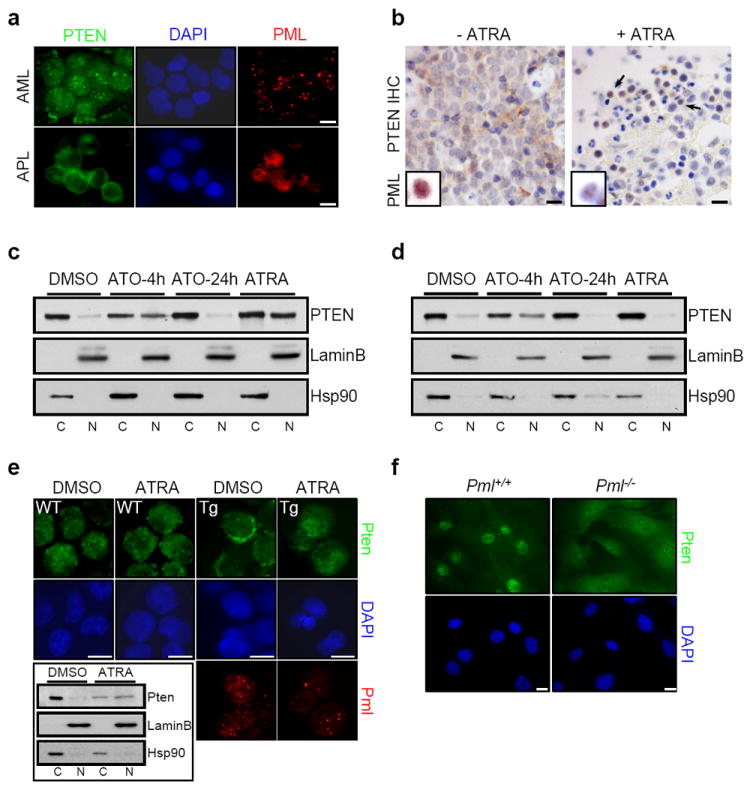
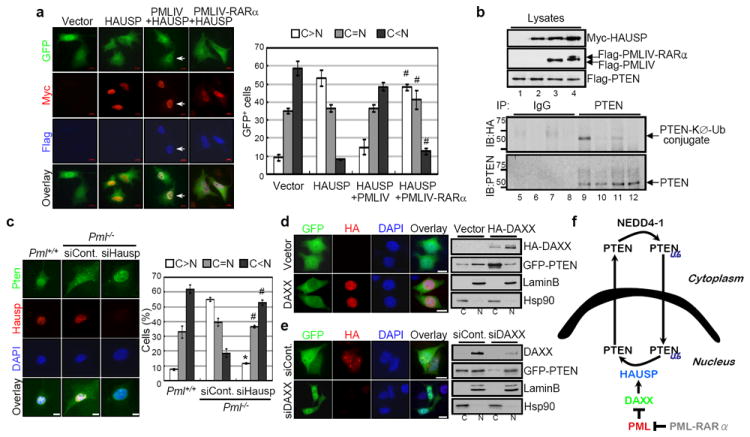
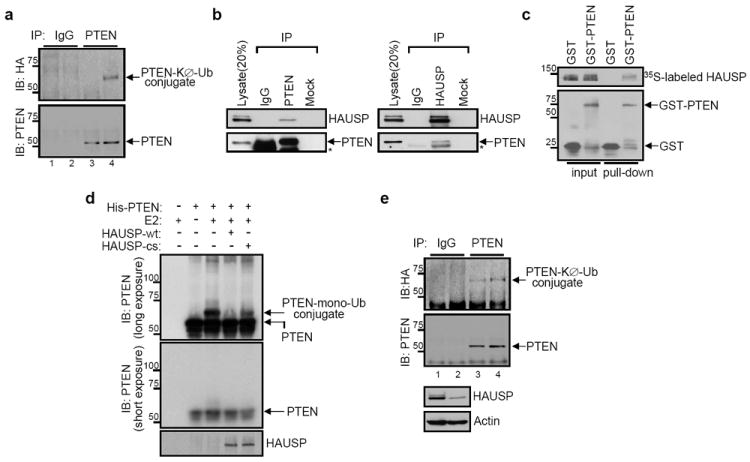
Nuclear exclusion of the PTEN (phosphatase and tensin homologue deleted in chromosome 10) tumour suppressor has been associated with cancer progression. However, the mechanisms leading to this aberrant PTEN localization in human cancers are currently unknown. We have previously reported that ubiquitinylation of PTEN at specific lysine residues regulates its nuclear-cytoplasmic partitioning. Here we show that functional promyelocytic leukaemia protein (PML) nuclear bodies co-ordinate PTEN localization by opposing the action of a previously unknown PTEN-deubiquitinylating enzyme, herpesvirus-associated ubiquitin-specific protease (HAUSP, also known as USP7), and that the integrity of this molecular framework is required for PTEN to be able to enter the nucleus. We find that PTEN is aberrantly localized in acute promyelocytic leukaemia, in which PML function is disrupted by the PML-RARalpha fusion oncoprotein. Remarkably, treatment with drugs that trigger PML-RARalpha degradation, such as all-trans retinoic acid or arsenic trioxide, restore nuclear PTEN. We demonstrate that PML opposes the activity of HAUSP towards PTEN through a mechanism involving the adaptor protein DAXX (death domain-associated protein). In support of this paradigm, we show that HAUSP is overexpressed in human prostate cancer and is associated with PTEN nuclear exclusion. Thus, our results delineate a previously unknown PML-DAXX-HAUSP molecular network controlling PTEN deubiquitinylation and trafficking, which is perturbed by oncogenic cues in human cancer, in turn defining a new deubiquitinylation-dependent model for PTEN subcellular compartmentalization.
第10号染色体缺失的磷酸酶及张力蛋白同源物(PTEN)肿瘤抑制因子的核排除与癌症进展相关。然而,目前尚不清楚导致PTEN在人类癌症中出现这种异常定位的机制。我们之前报道过,PTEN在特定赖氨酸残基处的泛素化调节其核质分配。在此我们表明,功能性早幼粒细胞白血病蛋白(PML)核体通过对抗一种此前未知的PTEN去泛素化酶——疱疹病毒相关泛素特异性蛋白酶(HAUSP,也称为USP7)的作用来协调PTEN的定位,并且PTEN能够进入细胞核需要这个分子框架的完整性。我们发现PTEN在急性早幼粒细胞白血病中定位异常,其中PML功能被PML-RARα融合癌蛋白破坏。值得注意的是,用触发PML-RARα降解的药物(如全反式维甲酸或三氧化二砷)治疗可恢复核内PTEN。我们证明PML通过一种涉及衔接蛋白DAXX(死亡结构域相关蛋白)的机制对抗HAUSP对PTEN的活性。支持这一模式的是,我们表明HAUSP在人类前列腺癌中过表达并与PTEN核排除相关。因此,我们的结果描绘了一个此前未知的控制PTEN去泛素化和运输的PML-DAXX-HAUSP分子网络,该网络在人类癌症中受到致癌信号的干扰,进而定义了一种新的依赖去泛素化的PTEN亚细胞区室化模型。