Academic Department of Clinical Oncology, University of Sheffield Weston Park Hospital, Sheffield, UK.
Ther Clin Risk Manag. 2008 Feb;4(1):149-62. doi: 10.2147/tcrm.s1526.
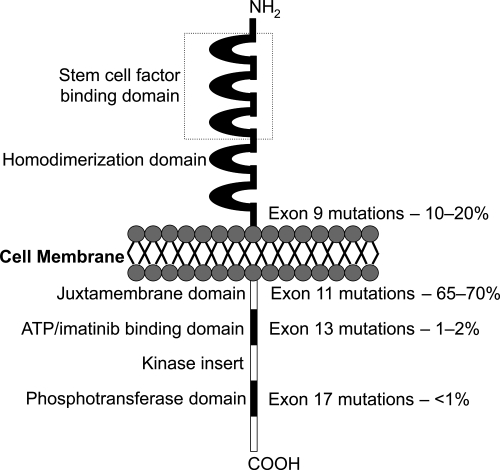
Gastrointestinal stromal tumor (GIST) is a rare primary neoplasm of the gastrointestinal tract, mesentery, or omentum. In the past, surgery has been the only effective treatment. The diagnosis and treatment of GIST has been revolutionized over the past decade, since expression of the receptor tyrosine kinase KIT was shown to occur on these tumors. Mutations in this proto-oncogene commonly cause constitutive activation of the KIT tyrosine kinase receptor, an important factor in the pathogenesis of the disease. The development of specific tyrosine kinase inhibitors, such as imatinib mesylate, has led to a breakthrough in the treatment of advanced GIST. Treatment with this drug has led to significant improvements in survival, with overall response rates in excess of 80%. Side effects are common, but usually manageable. The success of this drug has led to further trials investigating its use in the pre- and postoperative situation. This review summarizes the current knowledge of GIST and imatinib treatment and possible future developments.
胃肠道间质瘤(GIST)是一种罕见的胃肠道、肠系膜或网膜的原发性肿瘤。过去,手术一直是唯一有效的治疗方法。但在过去十年中,由于受体酪氨酸激酶 KIT 的表达被证明存在于这些肿瘤上,GIST 的诊断和治疗发生了革命性的变化。该原癌基因的突变通常导致 KIT 酪氨酸激酶受体的组成性激活,这是疾病发病机制中的一个重要因素。特异性酪氨酸激酶抑制剂(如甲磺酸伊马替尼)的开发为晚期 GIST 的治疗带来了突破。用这种药物治疗导致了生存的显著改善,总缓解率超过 80%。副作用很常见,但通常可以控制。这种药物的成功促使进一步的试验研究了其在术前和术后的应用。这篇综述总结了目前对 GIST 和伊马替尼治疗的认识以及可能的未来发展。