Department of Genome Science, University of Cincinnati, Cincinnati, OH, 4523, USA.
Nutr Metab (Lond). 2008 Aug 27;5:23. doi: 10.1186/1743-7075-5-23.
The alarming rise in the obesity epidemic and growing concern for the pathologic consequences of the metabolic syndrome warrant great need for development of obesity-related pharmacotherapeutics. The search for such therapeutics is severely limited by the slow throughput of animal models of obesity. Amenable to placement into a 96 well plate, zebrafish larvae have emerged as one of the highest throughput vertebrate model organisms for performing small molecule screens. A method for visually identifying non-toxic molecular effectors of fat metabolism using a live transparent vertebrate was developed. Given that increased levels of nicotinamide adenine dinucleotide (NAD) via deletion of CD38 have been shown to prevent high fat diet induced obesity in mice in a SIRT-1 dependent fashion we explored the possibility of directly applying NAD to zebrafish.
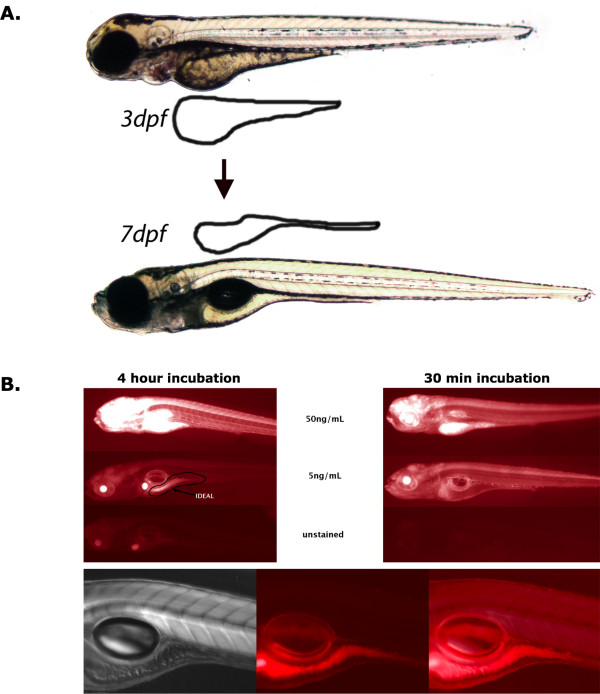
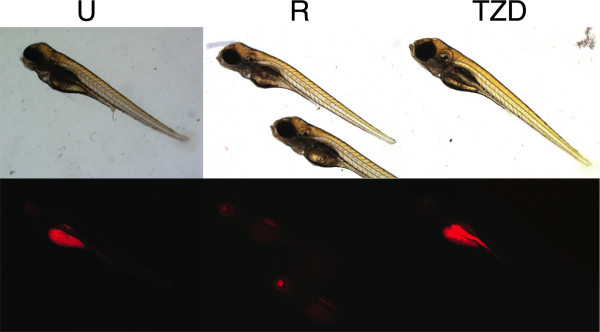
Zebrafish larvae were incubated with daily refreshing of nile red containing media starting from a developmental stage of equivalent fat content among siblings (3 days post-fertilization, dpf) and continuing with daily refreshing until 7 dpf.
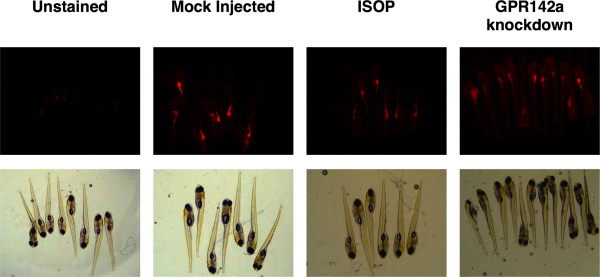
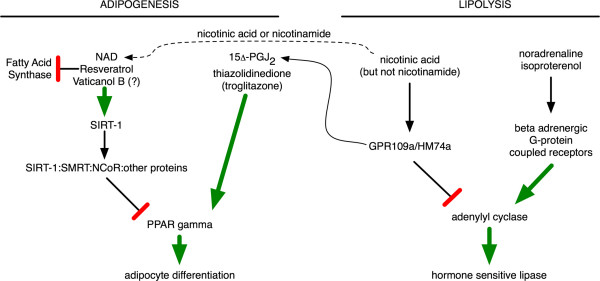
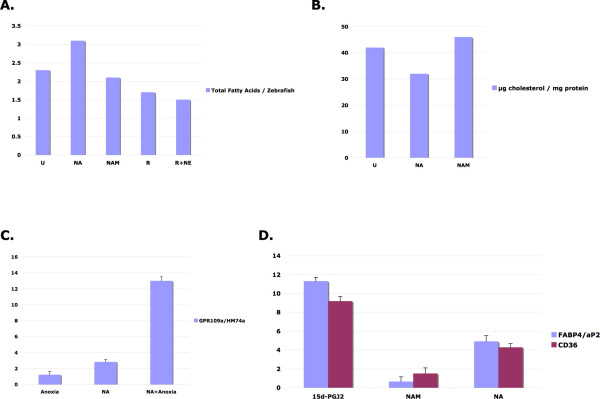
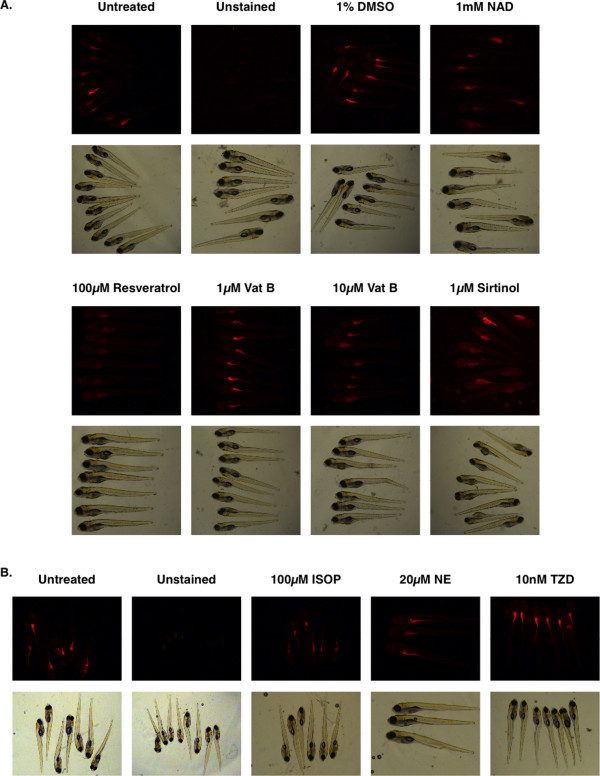
PPAR activators, beta-adrenergic agonists, SIRT-1 activators, and nicotinic acid treatment all caused predicted changes in fat, cholesterol, and gene expression consistent with a high degree of evolutionary conservation of fat metabolism signal transduction extending from man to zebrafish larvae. All changes in fat content were visually quantifiable in a relative fashion using live zebrafish larvae nile red fluorescence microscopy. Resveratrol treatment caused the greatest and most consistent loss of fat content. The resveratrol tetramer Vaticanol B caused loss of fat equivalent in potency to resveratrol alone. Significantly, the direct administration of NAD decreased fat content in zebrafish. Results from knockdown of a zebrafish G-PCR ortholog previously determined to decrease fat content in C. elegans support that future GPR142 antagonists may be effective non-toxic anti-obesity therapeutics.
Owing to the apparently high level of evolutionary conservation of signal transduction pathways regulating lipid metabolism, the zebrafish can be useful for identifying non-toxic small molecules or pharmacological target gene products for developing molecular therapeutics for treating clinical obesity. Our results support the promising potential in applying NAD or resveratrol where the underlying target protein likely involves Sirtuin family member proteins. Furthermore data supports future studies focused on determining whether there is a high concentration window for resveratrol that is effective and non-toxic in high fat obesity murine models.
肥胖症的惊人上升和对代谢综合征病理后果的日益关注,迫切需要开发与肥胖相关的药物治疗方法。由于肥胖动物模型的通量缓慢,这种治疗方法的研究受到严重限制。斑马鱼幼虫可以放入 96 孔板中,因此成为进行小分子筛选的高通量脊椎动物模型之一。开发了一种使用活体透明脊椎动物直观识别脂肪代谢无毒分子效应物的方法。鉴于通过删除 CD38 增加烟酰胺腺嘌呤二核苷酸 (NAD) 水平以 SIRT-1 依赖的方式可防止高脂肪饮食诱导的肥胖小鼠肥胖,我们探讨了直接向斑马鱼施用 NAD 的可能性。
从兄弟姐妹(受精后 3 天,3 dpf)的等效脂肪含量的发育阶段开始,用含有尼罗红的培养基每天更新斑马鱼幼虫,继续每天更新,直到 7 dpf。
PPAR 激活剂、β-肾上腺素能激动剂、SIRT-1 激活剂和烟酸处理均导致脂肪、胆固醇和基因表达的预期变化,表明从人类到斑马鱼幼虫的脂肪代谢信号转导的高度进化保守性。使用活斑马鱼幼虫尼罗红荧光显微镜可以以相对方式对脂肪含量的所有变化进行直观量化。白藜芦醇处理导致脂肪含量最大且最一致的减少。白藜芦醇四聚体 Vaticanol B 引起的脂肪损失等效于单独使用白藜芦醇。值得注意的是,直接给予 NAD 可减少斑马鱼的脂肪含量。先前确定可减少秀丽隐杆线虫脂肪含量的斑马鱼 GPCR 同源物的敲低结果支持未来的 GPR142 拮抗剂可能是有效的无毒抗肥胖治疗药物。
由于调节脂质代谢的信号转导途径的进化保守性明显较高,因此斑马鱼可用于鉴定无毒小分子或药理学靶基因产物,以开发治疗肥胖症的分子治疗药物。我们的结果支持在应用 NAD 或白藜芦醇方面具有广阔的应用前景,其潜在的靶蛋白可能涉及 Sirtuin 家族成员蛋白。此外,数据支持未来的研究集中于确定白藜芦醇是否存在有效的无毒高浓度窗口,在高脂肪肥胖小鼠模型中有效且无毒。