Tarendeau Franck, Crepin Thibaut, Guilligay Delphine, Ruigrok Rob W H, Cusack Stephen, Hart Darren J
Grenoble Outstation, European Molecular Biology Laboratory, Grenoble, France.
PLoS Pathog. 2008 Aug 29;4(8):e1000136. doi: 10.1371/journal.ppat.1000136.
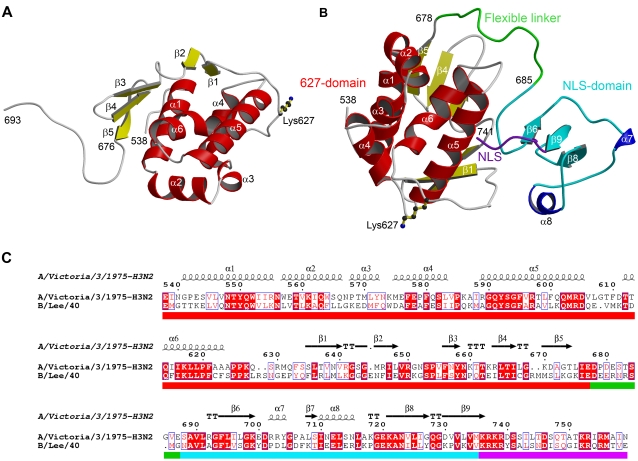
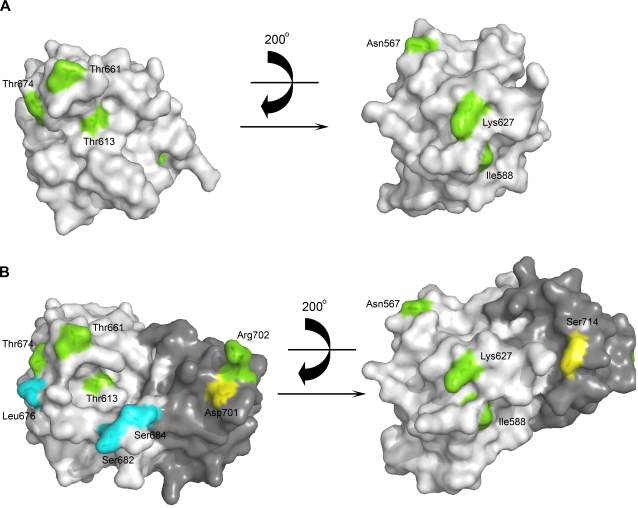
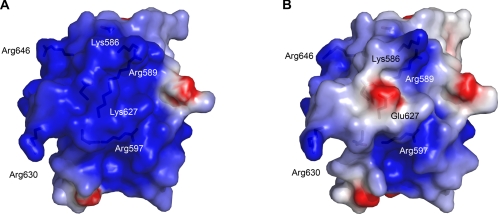
Understanding how avian influenza viruses adapt to human hosts is critical for the monitoring and prevention of future pandemics. Host specificity is determined by multiple sites in different viral proteins, and mutation of only a limited number of these sites can lead to inter-species transmission. Several of these sites have been identified in the viral polymerase, the best characterised being position 627 in the PB2 subunit. Efficient viral replication at the relatively low temperature of the human respiratory tract requires lysine 627 rather than the glutamic acid variant found systematically in avian viruses. However, the molecular mechanism by which any of these host specific sites determine host range are unknown, although adaptation to host factors is frequently evoked. We used ESPRIT, a library screening method, to identify a new PB2 domain that contains a high density of putative host specific sites, including residue 627. The X-ray structure of this domain (denoted the 627-domain) exhibits a novel fold with the side-chain of Lys627 solvent exposed. The structure of the K627E mutated domain shows no structural differences but the charge reversal disrupts a striking basic patch on the domain surface. Five other recently proposed host determining sites of PB2 are also located on the 627-domain surface. The structure of the complete C-terminal region of PB2 comprising the 627-domain and the previously identified NLS-domain, which binds the host nuclear import factor importin alpha, was also determined. The two domains are found to pack together with a largely hydrophilic interface. These data enable a three-dimensional mapping of approximately half of PB2 sites implicated in cross-species transfer onto a single structural unit. Their surface location is consistent with roles in interactions with other viral proteins or host factors. The identification and structural characterization of these well-defined PB2 domains will help design experiments to elucidate the effects of mutations on polymerase-host factor interactions.
了解禽流感病毒如何适应人类宿主对于监测和预防未来的大流行至关重要。宿主特异性由不同病毒蛋白中的多个位点决定,这些位点中只有少数发生突变就能导致跨物种传播。其中一些位点已在病毒聚合酶中被确定,最具特征的是PB2亚基中的627位。在人类呼吸道相对较低的温度下进行高效病毒复制需要赖氨酸627,而不是禽病毒中系统发现的谷氨酸变体。然而,尽管经常提到适应宿主因子,但这些宿主特异性位点中的任何一个决定宿主范围的分子机制尚不清楚。我们使用一种文库筛选方法ESPRIT来鉴定一个新的PB2结构域,该结构域包含高密度的假定宿主特异性位点,包括627位残基。该结构域(称为627结构域)的X射线结构呈现出一种新颖的折叠形式,赖氨酸627的侧链暴露于溶剂中。K627E突变结构域的结构没有显示出结构差异,但电荷反转破坏了该结构域表面一个显著的碱性区域。PB2其他五个最近提出的宿主决定位点也位于627结构域表面。还确定了包含627结构域和先前鉴定的NLS结构域(与宿主核输入因子importin alpha结合)的PB2完整C末端区域的结构。发现这两个结构域通过一个主要为亲水的界面聚集在一起。这些数据能够将参与跨物种转移的大约一半PB2位点三维映射到一个单一的结构单元上。它们的表面位置与在与其他病毒蛋白或宿主因子相互作用中的作用一致。这些明确的PB2结构域的鉴定和结构表征将有助于设计实验以阐明突变对聚合酶 - 宿主因子相互作用的影响。