Geng Xin, Shi Yong, Nakagawa Akihisa, Yoshina Sawako, Mitani Shohei, Shi Yigong, Xue Ding
Department of Molecular, Cellular, and Developmental Biology, Campus Box 347, University of Colorado, Boulder, Colorado 80309, USA.
Nat Struct Mol Biol. 2008 Oct;15(10):1094-101. doi: 10.1038/nsmb.1488. Epub 2008 Sep 7.
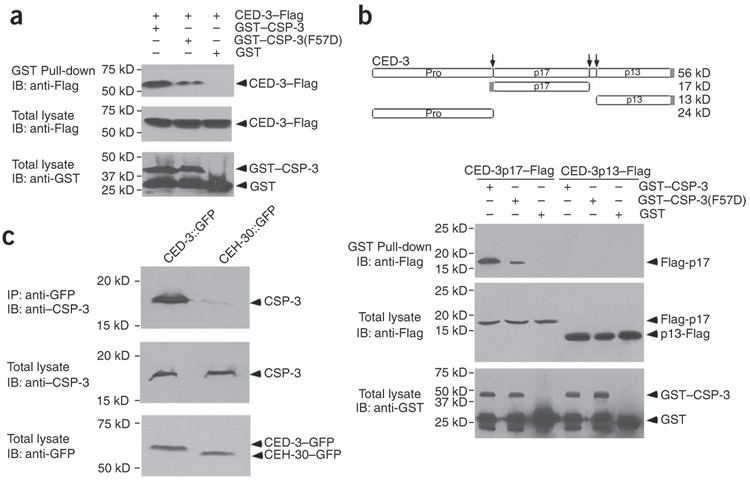
Inhibitor of apoptosis (IAP) proteins have a crucial role in apoptosis, through negative regulation of caspases in species from fruitflies to mammals. In Caenorhabditis elegans, however, no IAP homolog or caspase inhibitor has been identified, calling into question how the cell-killing caspase CED-3 can be negatively regulated. Here we show that inactivation of the C. elegans csp-3 gene, which encodes a protein similar to the small subunit of the CED-3 caspase, causes cells that normally live to undergo apoptosis in a CED-3-dependent manner. Biochemical analysis reveals that CSP-3 associates with the large subunit of the CED-3 zymogen and inhibits zymogen autoactivation. However, CSP-3 does not block CED-3 activation induced by CED-4, nor does it inhibit the activity of the activated CED-3 protease. Therefore CSP-3 uses a previously unreported mechanism to protect cells from apoptosis.
凋亡抑制蛋白(IAP)在从果蝇到哺乳动物的物种中,通过对胱天蛋白酶的负调控,在细胞凋亡过程中发挥着关键作用。然而,在秀丽隐杆线虫中,尚未鉴定出IAP同源物或胱天蛋白酶抑制剂,这引发了关于细胞杀伤性胱天蛋白酶CED-3如何受到负调控的疑问。在此,我们表明,秀丽隐杆线虫csp-3基因(其编码一种与CED-3胱天蛋白酶小亚基相似的蛋白质)的失活,会导致正常存活的细胞以CED-3依赖的方式发生凋亡。生化分析表明,CSP-3与CED-3酶原的大亚基结合,并抑制酶原的自激活。然而,CSP-3并不阻断CED-4诱导的CED-3激活,也不抑制活化的CED-3蛋白酶的活性。因此,CSP-3利用一种此前未报道的机制来保护细胞免于凋亡。