Funatogawa Ikuko, Funatogawa Takashi, Nakao Mutsuhiro, Karita Kanae, Yano Eiji
Department of Hygiene and Public Health, Teikyo University School of Medicine, Tokyo 173-8605, Japan.
Int J Epidemiol. 2009 Feb;38(1):83-92. doi: 10.1093/ije/dyn182. Epub 2008 Sep 9.
The National Nutrition Survey, Japan (NNS-J) provides annual anthropometric information for a whole nation over 50 years. Based on this survey, the mean body mass index (BMI) of Japanese men and elderly women has increased in recent decades, but that of young women has decreased. We examined the effect of birth cohort on this phenomenon.
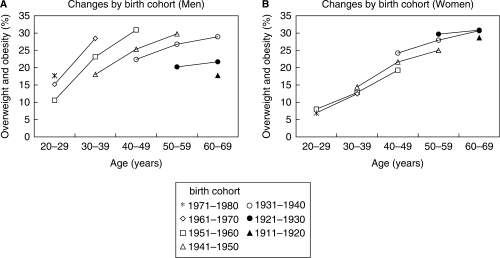
We analysed data from the NNS-J for subjects aged 20-69 years. BMI during 1956-2005 and the prevalence of overweight and obesity (BMI >/= 25 kg/m(2)) during 1976-2005 were estimated.
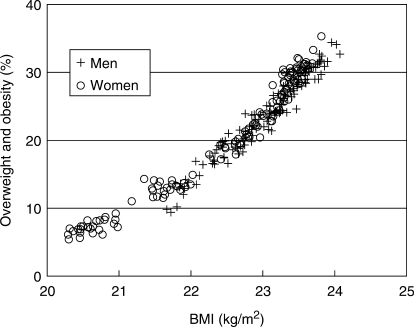
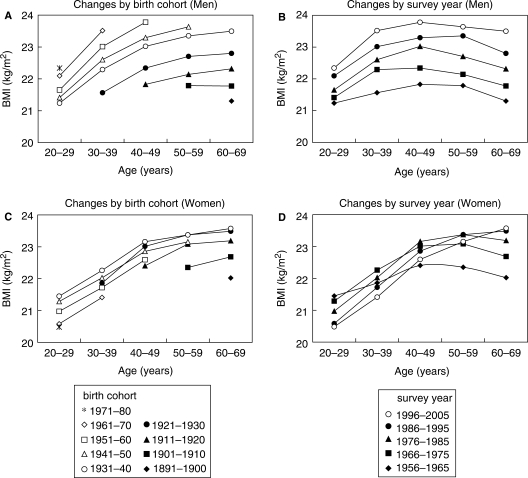
The BMI increased with age in every birth cohort, with similar increments, and did not peak until 60-69 years of age. However, with cross-sectional age, the BMI usually peaked before 60-69 years of age. The differences among cohorts already existed at 20-29 years of age, and slightly increased in men between 20-29 and 30-39 years of age. The BMI in all male age groups increased from the 1891-1900 through 1971-80 cohorts. However, in women, the figure increased until the 1931-40 cohorts, but later decreased. Changes in prevalence were generally consistent with changes in BMI. The recent increase (decrease in young women) in the mean BMI is attributable to birth cohort, indicating that thinner (fatter) and less recent birth cohorts have been replaced by fatter (thinner) ones.
A cohort effect was quantitatively demonstrated based on a repeated annual survey. In Japan, the differences in BMI among cohorts were already established by young adulthood.
日本全国营养调查(NNS-J)提供了50多年来全国范围的年度人体测量信息。基于这项调查,日本男性和老年女性的平均体重指数(BMI)在近几十年有所上升,但年轻女性的BMI却有所下降。我们研究了出生队列对这一现象的影响。
我们分析了NNS-J中20至69岁受试者的数据。估算了1956 - 2005年期间的BMI以及1976 - 2005年期间超重和肥胖(BMI≥25 kg/m²)的患病率。
每个出生队列的BMI均随年龄增长,增幅相似,直到60 - 69岁才达到峰值。然而,从横断面年龄来看,BMI通常在60 - 69岁之前达到峰值。各队列之间的差异在20 - 29岁时就已存在,男性在20 - 29岁至30 - 39岁之间略有增加。所有男性年龄组的BMI从1891 - 1900年队列到1971 - 1980年队列均有所上升。然而,在女性中,这一数字在1931 - 1940年队列之前有所上升,但之后下降。患病率的变化总体上与BMI的变化一致。近期平均BMI的上升(年轻女性下降)可归因于出生队列,这表明较瘦(较胖)且较晚出生的队列已被较胖(较瘦)的队列所取代。
基于年度重复调查定量证明了队列效应。在日本,各队列之间BMI的差异在成年早期就已确立。