Ejima Aki, Griffith Leslie C
Department of Biology, National Center for Behavioral Genomics and Volen Center for Complex Systems, Brandeis University, Waltham, Massachusetts, USa.
PLoS One. 2008 Sep 19;3(9):e3246. doi: 10.1371/journal.pone.0003246.
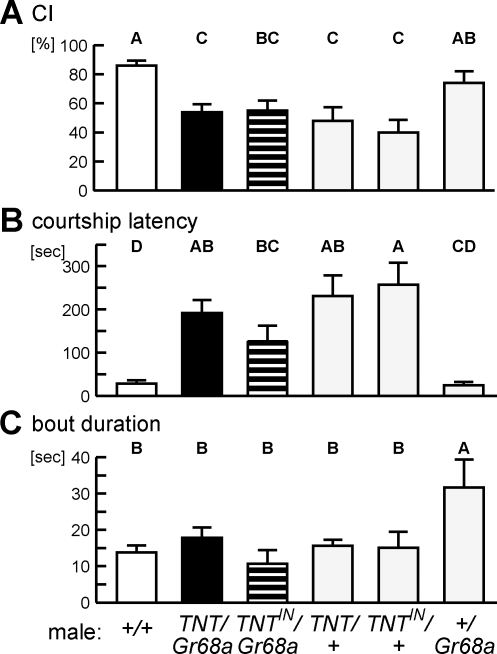
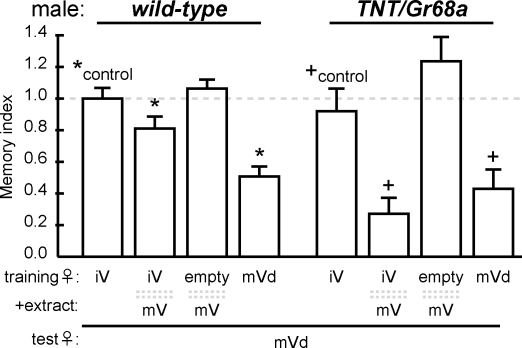
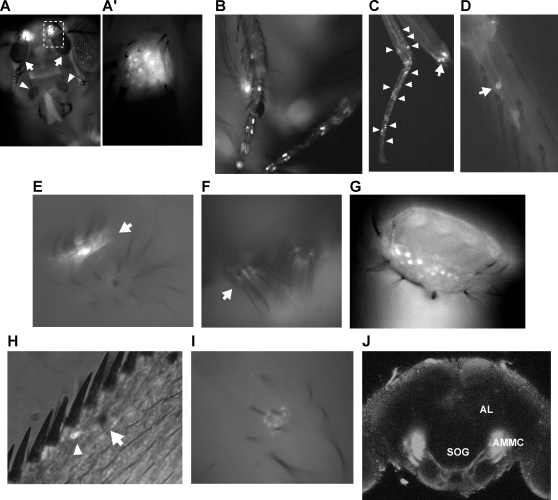
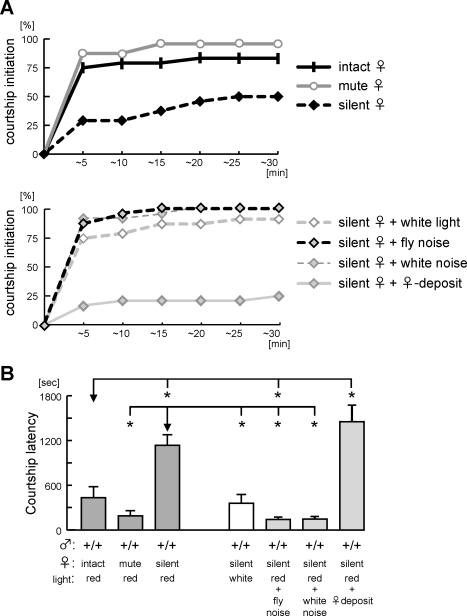
Finding a mating partner is a critical task for many organisms. It is in the interest of males to employ multiple sensory modalities to search for females. In Drosophila melanogaster, vision is thought to be the most important courtship stimulating cue at long distance, while chemosensory cues are used at relatively short distance. In this report, we show that when visual cues are not available, sounds produced by the female allow the male to detect her presence in a large arena. When the target female was artificially immobilized, the male spent a prolonged time searching before starting courtship. This delay in courtship initiation was completely rescued by playing either white noise or recorded fly movement sounds to the male, indicating that the acoustic and/or seismic stimulus produced by movement stimulates courtship initiation, most likely by increasing the general arousal state of the male. Mutant males expressing tetanus toxin (TNT) under the control of Gr68a-GAL4 had a defect in finding active females and a delay in courtship initiation in a large arena, but not in a small arena. Gr68a-GAL4 was found to be expressed pleiotropically not only in putative gustatory pheromone receptor neurons but also in mechanosensory neurons, suggesting that Gr68a-positive mechanosensory neurons, not gustatory neurons, provide motion detection necessary for courtship initiation. TNT/Gr68a males were capable of discriminating the copulation status and age of target females in courtship conditioning, indicating that female discrimination and formation of olfactory courtship memory are independent of the Gr68a-expressing neurons that subserve gustation and mechanosensation. This study suggests for the first time that mechanical signals generated by a female fly have a prominent effect on males' courtship in the dark and leads the way to studying how multimodal sensory information and arousal are integrated in behavioral decision making.
寻找交配对象对许多生物来说都是一项至关重要的任务。雄性生物利用多种感官方式寻找雌性符合其自身利益。在黑腹果蝇中,视觉被认为是远距离求偶时最重要的刺激线索,而化学感应线索则在相对近距离时发挥作用。在本报告中,我们表明,当视觉线索不存在时,雌性果蝇发出的声音能让雄性在大空间中察觉到其存在。当目标雌性果蝇被人工固定时,雄性果蝇在开始求偶前会花费更长时间进行搜索。通过向雄性果蝇播放白噪音或录制的果蝇移动声音,求偶启动的延迟完全得到了缓解,这表明移动产生的声学和/或地震刺激最有可能通过提高雄性果蝇的整体兴奋状态来刺激求偶行为的启动。在Gr68a - GAL4控制下表达破伤风毒素(TNT)的突变雄性果蝇在大空间中寻找活跃雌性果蝇时存在缺陷,求偶启动也会延迟,但在小空间中则不会。研究发现,Gr68a - GAL4不仅在假定的味觉信息素受体神经元中多效性表达,还在机械感觉神经元中表达,这表明Gr68a阳性机械感觉神经元而非味觉神经元提供了求偶启动所需的运动检测功能。TNT/Gr68a雄性果蝇在求偶条件反射中能够区分目标雌性果蝇的交配状态和年龄,这表明雌性果蝇的辨别以及嗅觉求偶记忆的形成独立于那些负责味觉和机械感觉的Gr68a表达神经元。这项研究首次表明,雌性果蝇产生的机械信号在黑暗中对雄性果蝇的求偶行为有显著影响,并为研究多模态感官信息和唤醒如何在行为决策中整合开辟了道路。