Fisher John D, Crown Anthony M, Sorkaç Altar, Martinez-Machado Sasha, Snell Nathaniel J, Vishwanath Neel, Monje Silas, Vo An, Wu Annie H, Moșneanu Rareș A, Okoro Angel M, Savaş Doruk, Nkera Bahati, Iturralde Pablo, Kumari Aastha, Chou-Freed Cambria, Hartmann Griffin G, Talay Mustafa, Barnea Gilad
These authors contributed equally.
Department of Neuroscience, Brown University, Providence, RI, USA.
bioRxiv. 2024 Oct 23:2024.10.23.619891. doi: 10.1101/2024.10.23.619891.
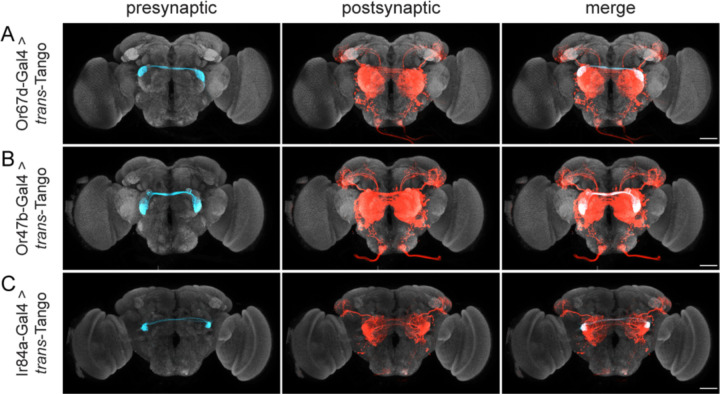
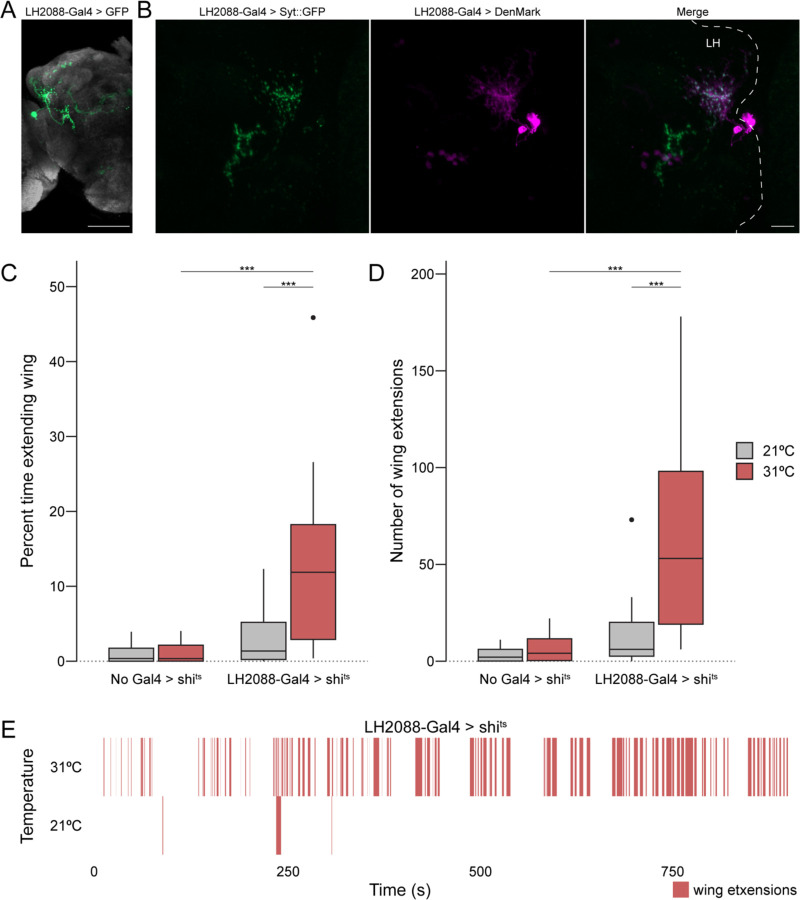
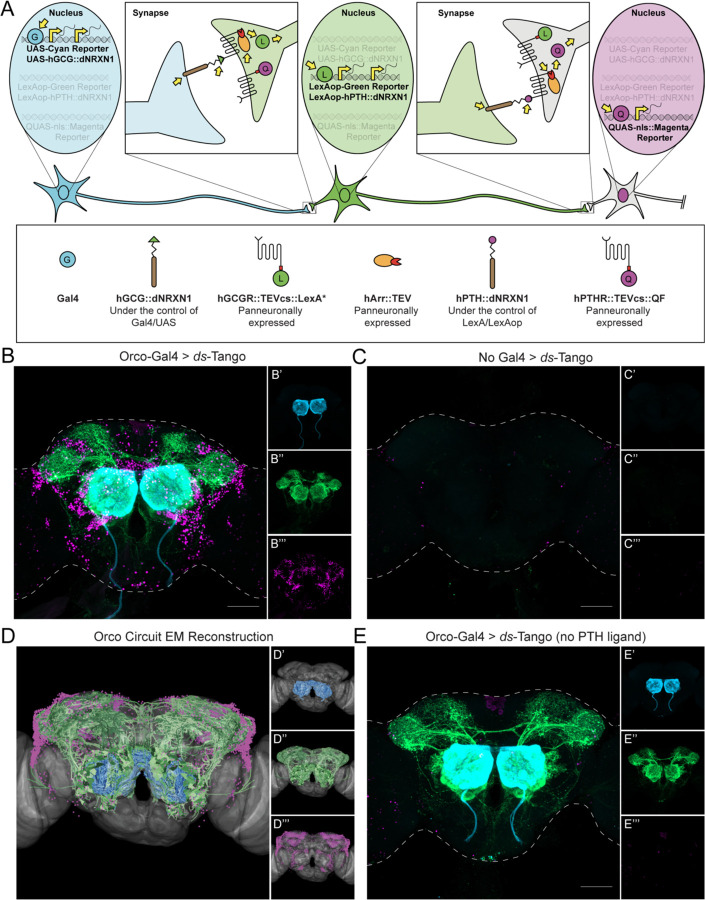
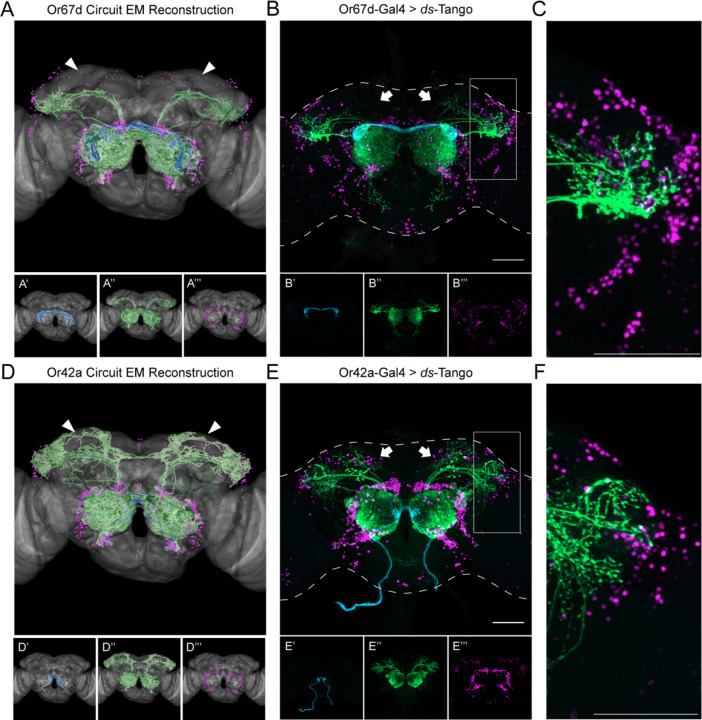
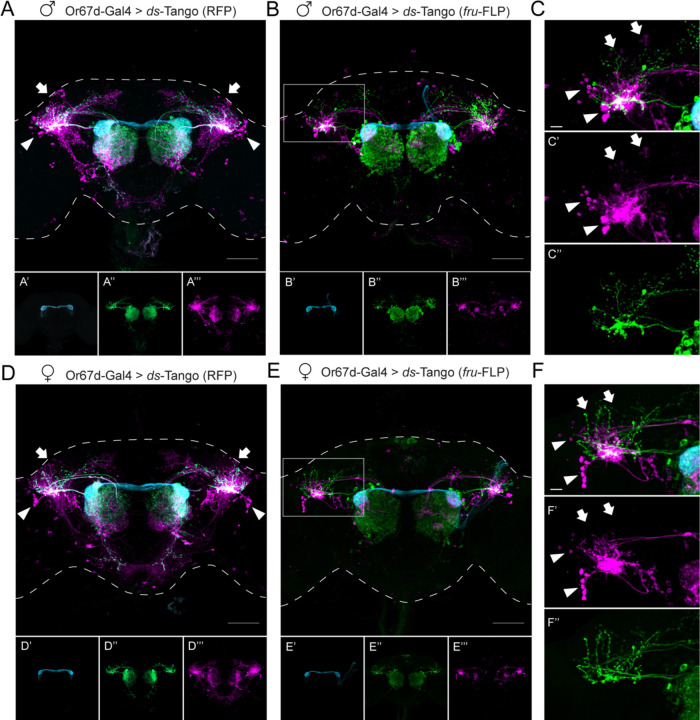
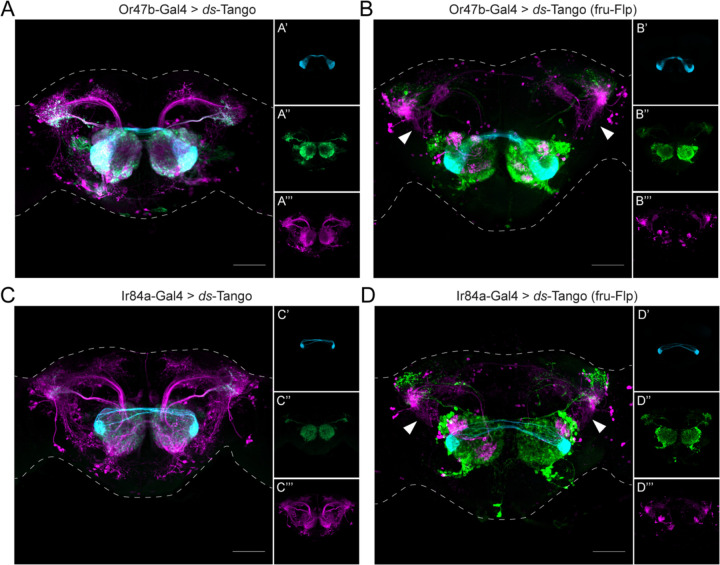
Animals exhibit sex-specific behaviors that are governed by sexually dimorphic circuits. One such behavior in male , courtship, is regulated by various sensory modalities, including olfaction. Here, we reveal how sexually dimorphic olfactory pathways in male flies converge at the third-order, onto lateral horn output neurons, to regulate courtship. To achieve this, we developed -Tango, a modified version of the monosynaptic tracing and manipulation tool Tango. In -Tango, two distinct configurations of Tango are positioned in series, thus providing selective genetic access not only to the monosynaptic partners of starter neurons but also to their disynaptic connections. Using -Tango, we identified a node of convergence for three sexually dimorphic olfactory pathways. Silencing this node results in deficits in sex recognition of potential partners. Our results identify lateral horn output neurons required for proper courtship behavior in male flies and establish -Tango as a tool for disynaptic circuit tracing.
动物表现出由性别二态性神经回路控制的性别特异性行为。雄性的一种此类行为,即求偶行为,受包括嗅觉在内的多种感觉模态调节。在此,我们揭示了雄性果蝇中性别二态性嗅觉通路如何在三阶水平汇聚到侧角输出神经元上,以调节求偶行为。为实现这一目标,我们开发了-Tango,它是单突触追踪和操纵工具Tango的改进版本。在-Tango中,Tango的两种不同配置串联排列,从而不仅能选择性地通过基因手段研究起始神经元的单突触伙伴,还能研究它们的双突触连接。使用-Tango,我们确定了三条性别二态性嗅觉通路的一个汇聚节点。使该节点沉默会导致对潜在配偶的性别识别出现缺陷。我们的研究结果确定了雄性果蝇适当求偶行为所需的侧角输出神经元,并将-Tango确立为一种双突触回路追踪工具。